
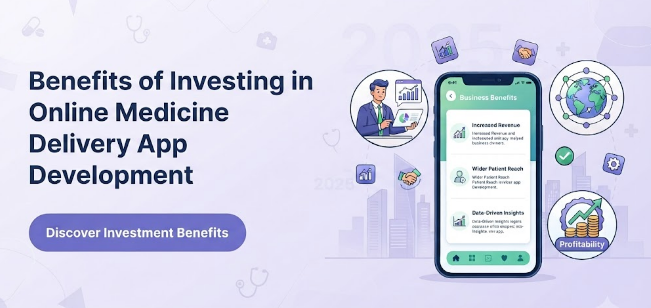
The healthcare industry is experiencing a major digital transformation as customers increasingly prefer convenient ways to access essential healthcare products. Traditional medicine purchasing often requires customers to visit a physical store, wait for assistance, and search for products manually. Digital platforms are changing this experience by allowing users to find medicines, upload prescriptions, place orders, make payments, and arrange doorstep delivery through their smartphones.
Businesses can respond to this growing demand through online medicine delivery app development. A well-designed application can connect customers, pharmacies, delivery partners, and administrators through one centralized ecosystem. Beyond convenience, it can help businesses streamline operations, expand their reach, improve customer engagement, and develop new revenue opportunities.
However, the value of an online medicine delivery platform depends on more than simply creating a mobile application. Businesses need to focus on usability, security, scalability, efficient delivery management, prescription handling, and reliable customer support. With the right strategy, an application can become an important digital channel for healthcare commerce.
What Is Online Medicine Delivery App Development?
Online medicine delivery app development is the process of building a digital platform that enables customers to browse medicines and healthcare products, submit prescriptions when applicable, place orders, make payments, and receive products through delivery services.
Depending on the business model, the application may connect multiple pharmacies or operate as a dedicated platform for one pharmacy or healthcare business. Typically, the ecosystem includes customer, pharmacy, delivery partner, and admin interfaces.
How Does an Online Medicine Delivery App Work?
The ordering journey generally follows a simple workflow:
- The customer registers on the application.
- The user searches for required medicines or healthcare products.
- A prescription is uploaded when required.
- Products are added to the cart.
- The customer selects an address and payment method.
- The pharmacy reviews and confirms the order.
- A delivery partner is assigned.
- The order is picked up and delivered.
- The customer receives order completion confirmation.
This connected process reduces manual communication and creates greater visibility across the complete order lifecycle.

Key Features of an Online Medicine Delivery App
A successful online medicine delivery app development strategy should include features that address customer expectations while supporting pharmacy and delivery operations.
1. User Registration and Profile Management
A straightforward registration process allows customers to create accounts quickly. Users can manage personal information, delivery addresses, prescriptions, payment preferences, and order history from their profiles.
Social login or phone-based authentication can also make account creation more convenient, depending on the platform's requirements.
2. Advanced Medicine Search
Customers should be able to search for medicines by name, category, brand, or other relevant attributes. Filters can help users narrow results based on availability, price, brand, and product type.
A well-optimized search experience reduces the time required to locate products.
3. Prescription Upload
Prescription management is particularly important for products that require professional authorization. Customers can upload prescription documents through the application, allowing authorized pharmacy staff to review them before processing relevant orders.
The platform should provide appropriate security and access controls for prescription information.
4. Digital Product Catalog
Pharmacies can use a product management system to add products, update pricing, manage descriptions, categorize items, and control availability.
Accurate catalog information can help customers make better purchasing decisions and reduce confusion during checkout.
5. Shopping Cart and Checkout
A simple cart allows users to review selected products, modify quantities, remove items, and confirm the final order.
The checkout process should clearly display product prices, applicable delivery charges, discounts, taxes where applicable, and the final payable amount.
6. Secure Payment Integration
Multiple payment options can make checkout more flexible. Businesses may support cards, digital wallets, online banking, and other appropriate payment methods based on their target market.
Secure payment processing is essential for protecting transaction information and maintaining customer confidence.
7. Real-Time Order Tracking
Customers can monitor their orders after dispatch through real-time tracking. GPS and map integration can provide delivery progress, route information, and estimated arrival times.
This feature improves transparency and can reduce customer uncertainty.
8. Pharmacy Dashboard
A dedicated pharmacy interface allows sellers or pharmacy teams to manage orders, prescriptions, inventory, products, pricing, and customer requests.
Centralized management can reduce dependence on manual workflows.
9. Delivery Partner Management
Delivery partners can receive assignments, view pickup and drop-off information, use navigation tools, update order statuses, and monitor completed deliveries.
Administrators can use delivery management tools to monitor active orders and improve operational coordination.
10. Notifications and Alerts
Push notifications can keep customers informed about important order events. Alerts may cover order confirmation, prescription approval, preparation, dispatch, delivery progress, and completion.
Relevant notifications create a more connected customer experience.
Read more :- Build a Doctor Appointment Booking App | Startup Guide
Why Choose Online Medicine Delivery App Development?
The demand for digital healthcare services continues to create opportunities for businesses that can deliver convenient and trustworthy experiences. Online medicine delivery app development enables businesses to combine commerce, logistics, customer service, and pharmacy management in a single ecosystem.
Build a Strong Digital Presence
A dedicated application gives healthcare businesses a direct digital touchpoint. Customers can interact with the brand without depending entirely on third-party platforms.
Improve Customer Retention
Convenience, reliable delivery, transparent pricing, and easy repeat ordering can contribute to stronger customer relationships. Features such as order history and saved addresses can make future purchases faster.
Support Business Expansion
A scalable platform can support additional pharmacies, delivery partners, products, and service areas as the business grows.
This makes scalability an important consideration from the beginning of the development process.
Create a More Transparent Experience
Order status updates, prescription workflows, delivery tracking, and notifications can provide customers with greater visibility into their purchases.
Transparency can contribute significantly to customer confidence.
Security Considerations for Medicine Delivery Apps
Healthcare-related applications can handle sensitive information, including customer details and prescription documents. Therefore, security should be considered throughout online medicine delivery app development.
Businesses should implement appropriate authentication mechanisms, secure data transmission, access controls, protected payment processing, and regular security assessments.
Prescription information should only be accessible to authorized personnel. Businesses should also evaluate applicable privacy, healthcare, payment, and data protection requirements based on the regions where they operate.

How to Make a Medicine Delivery App Successful
Technology alone does not guarantee business success. Companies should begin with market research and identify customer needs, competitor offerings, pharmacy partnerships, delivery requirements, and operational challenges.
The user interface should remain simple, with clear navigation from product discovery through checkout. Businesses should also test the application across different devices and network conditions.
Scalable infrastructure is equally important. As customer and order volumes increase, the platform should be capable of handling additional traffic without compromising performance.
Continuous improvement should also be part of the strategy. Analytics, customer feedback, and operational data can reveal areas where the application can be optimized.
Future Scope of Online Medicine Delivery Platforms
The future of online medicine delivery app development is likely to involve greater automation, personalization, analytics, and intelligent logistics.
Artificial intelligence can potentially support product discovery, customer assistance, demand forecasting, and delivery optimization. Predictive analytics can help businesses understand demand patterns and improve inventory planning.
Integration with broader digital healthcare ecosystems may also create opportunities to connect medicine ordering with additional healthcare services. However, businesses should ensure that any new functionality follows applicable legal, privacy, and healthcare requirements.
Conclusion
Digital transformation is creating new opportunities across the healthcare industry, and medicine delivery applications are becoming an important part of this evolution. Investing in online medicine delivery app development can help businesses provide greater customer convenience while improving order management, delivery coordination, engagement, and operational efficiency.
Features such as prescription uploads, advanced search, secure payments, real-time tracking, pharmacy dashboards, delivery management, notifications, and analytics can create a complete digital ordering ecosystem. At the same time, businesses should prioritize security, scalability, usability, and compliance when planning their platform.
Partnering with an experienced clone app development company can help businesses turn their healthcare delivery concept into a scalable and feature-rich digital solution. With the right technology and customer-focused strategy, an online medicine delivery platform can support sustainable growth in an increasingly digital healthcare market.
FAQs
1. What are the main benefits of online medicine delivery apps?
Online medicine delivery apps can provide customer convenience, wider market reach, streamlined order management, faster communication, delivery visibility, customer engagement, and new business opportunities.
2. What features should a medicine delivery application include?
Essential features can include user registration, medicine search, product catalogs, prescription upload, shopping cart, secure payments, order tracking, pharmacy management, delivery management, notifications, ratings, and an admin dashboard.
3. Can an online medicine delivery app support multiple pharmacies?
Yes. A marketplace-based application can connect multiple pharmacies and allow administrators to manage sellers, products, orders, commissions, and delivery operations through centralized systems.
4. How does real-time tracking improve medicine delivery?
Real-time tracking provides customers with information about delivery progress, location, and estimated arrival. It also helps businesses monitor active deliveries and identify potential operational delays.
5. Is security important when developing a medicine delivery app?
Yes. Medicine delivery platforms may process personal information, prescription documents, and payment details. Appropriate authentication, access controls, secure data handling, and payment protection should therefore be incorporated into the platform.