
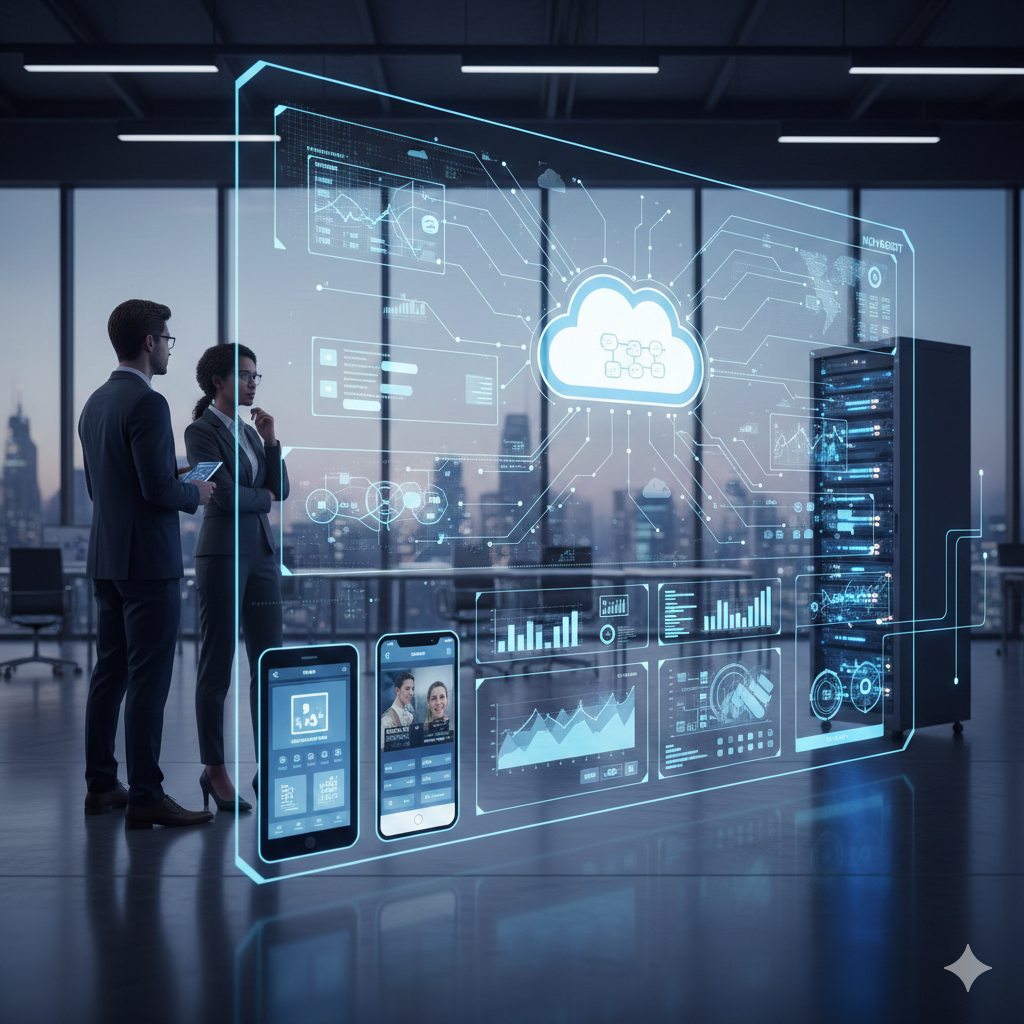
This article explores how AI and ML are revolutionizing enterprise app development, why large organizations are rapidly adopting AI-driven solutions, and how cloud-based enterprise application development is enabling scalable, intelligent enterprise ecosystems.
Why AI & Machine Learning Matter in Enterprise Software
Enterprise applications manage a wide spectrum of functions: internal operations, workforce management, supply chain, analytics, customer service, compliance, and more. Traditionally, these systems were rule-based and required heavy manual input. But modern enterprises generate vast volumes of real-time data that cannot be processed manually.
AI and ML step in to transform raw data into actionable intelligence.
Key Reasons AI & ML Are Becoming Essential in Enterprise Apps:
-
Automation of repetitive and complex processes
-
Real-time data interpretation and insights
-
Predictive capabilities for better decision-making
-
Personalized user experiences
-
Enhanced system efficiency and scalability
-
Adaptive learning to improve over time
AI-driven enterprise systems bring unmatched competitive advantages, allowing large businesses to move faster, reduce operational costs, and improve overall performance.
AI-Powered Transformation in Enterprise Application Development
1. Intelligent Process Automation (IPA)
Modern enterprises rely heavily on workflow automation. AI and ML elevate traditional automation into intelligent automation, where the system not only executes rules but also:
-
Understands patterns
-
Learns from repeated behavior
-
Predicts next steps
-
Optimizes processes without intervention
For example, enterprise apps can automate:
-
Invoice processing
-
Customer support
-
Inventory restocking
-
Compliance documentation
-
HR onboarding
When integrated into Custom enterprise application development services, intelligent automation enables companies to eliminate inefficiencies and accelerate operations.
2. Predictive Analytics for Strategic Decision-Making
Machine learning algorithms can analyze massive datasets to forecast:
-
Market trends
-
Sales performance
-
Equipment breakdown
-
Demand cycles
-
Customer behavior
Large enterprises, especially in manufacturing, finance, energy, and retail, rely on predictive analytics to minimize risk and maximize ROI.
ML-powered predictive analytics becomes even more powerful when deployed through cloud-based enterprise application development, providing real-time insights across distributed teams and global operations.
3. Personalization for Enterprise Users
AI-driven personalization is no longer limited to consumer apps. Enterprise users benefit from:
-
Customized dashboards
-
Intelligent search
-
Adaptive workflows
-
Personalized recommendations
-
Dynamic UI based on user behavior
For large businesses with thousands of employees, personalized interfaces significantly improve productivity and user satisfaction.
The Role of Machine Learning in Enterprise Mobile App Development
While enterprise software traditionally focused on desktop environments, the rapid rise of mobile workforces has made Enterprise mobile app development for large businesses a priority.
Machine learning enhances enterprise mobile apps with:
1. Smart Recommendations
Apps can suggest actions, products, or responses based on behavior and historical data.
2. Advanced Security
ML models detect anomalies, unauthorized access patterns, and possible fraud in real time.
3. Voice and Text-Based Assistance
Mobile apps now include AI assistants that support:
-
Hands-free navigation
-
Natural language queries
-
Smart task automation
4. Context-Aware Features
Mobile enterprise apps can adapt based on:
-
Location
-
Time
-
User role
-
Current task
ML ensures the mobile experience is not static, but adaptive and intelligent.
AI & ML in Cloud-Based Enterprise Application Development
The cloud plays a crucial role in enabling enterprise-grade AI.
Why the Cloud is Critical to AI Adoption:
-
Centralized data storage for large datasets
-
High computational power for training ML models
-
Global accessibility for distributed teams
-
Streamlined integration with enterprise systems
-
Elastic scalability to match business growth
AI-driven systems require constant training, updating, and monitoring—tasks made significantly easier with scalable cloud platforms such as AWS, Azure, and Google Cloud.
Cloud-Native AI Applications Deliver:
-
Faster deployment
-
Real-time analytics
-
Secure data handling
-
Seamless integration with IoT, ERP, CRM, and data lakes
-
Continuous model improvements
-
Reduced infrastructure costs
Cloud-based enterprise application development gives organizations a foundation to build AI-powered ecosystems capable of supporting long-term digital transformation.
Key Ways AI & ML Are Reshaping Enterprise App Development
1. Enhanced Data Security & Threat Detection
AI systems analyze access patterns and identify anomalies far faster than manual methods. They can detect:
-
Suspicious logins
-
Data breaches
-
Malware threats
-
Fraud attempts
-
Unusual employee behavior
This type of security is crucial for large enterprises handling sensitive financial, medical, or corporate data.
2. Smart Resource Management
AI improves resource allocation by analyzing:
-
System load
-
User activity
-
Hardware performance
-
Cloud consumption
This ensures apps always run efficiently, minimizing downtime and improving enterprise workflows.
3. Improved User Support Through AI Chatbots
AI-powered chatbots integrated into enterprise applications:
-
Reduce support workload
-
Resolve employee queries instantly
-
Automate ticketing
-
Provide system navigation assistance
This is especially valuable for large organizations with thousands of employees and massive IT infrastructure.
4. Accelerated Development Through AI-Assisted Coding
AI tools assist developers by:
-
Detecting bugs early
-
Suggesting optimized code
-
Automating testing
-
Speeding up deployment pipelines
This results in faster delivery of enterprise-grade apps with fewer vulnerabilities.
Industries Benefiting Most from AI-Powered Enterprise Apps
1. Healthcare
-
Predictive patient analytics
-
Smart scheduling
-
Automated claim processing
2. Manufacturing
-
Predictive maintenance
-
Quality control automation
-
Supply chain intelligence
3. Finance
-
Fraud detection
-
Risk forecasting
-
Customer insights
4. Retail
-
Inventory optimization
-
Customer behavior analysis
-
Personalized experiences
5. Logistics
-
Route optimization
-
Fleet management
-
Real-time tracking
AI and ML unlock unmatched efficiency across all enterprise sectors.
The Future of Enterprise Application Development with AI
The next wave of enterprise app development will be dominated by:
-
Autonomous business operations
-
Hyper-personalization
-
AI-driven decision engines
-
Intelligent automation across departments
-
Seamless integration with IoT, AR, and robotics
-
Full-scale cloud and edge AI adoption
As AI capabilities grow, enterprise applications will operate with minimal human input—creating systems that anticipate issues, optimize workflows, and support long-term growth.
Conclusion
AI and Machine Learning are transforming the way businesses build and use enterprise software. From automation to predictive analytics, enhanced security, and personalized user experiences, AI is reshaping the enterprise ecosystem for the better. With the rise of Custom enterprise application development services, large companies can now build intelligent solutions tailored to their unique operational needs.
Furthermore, the combination of Enterprise mobile app development for large businesses and cloud-based enterprise application development allows organizations to scale these intelligent capabilities across global teams and diverse environments.
Businesses that embrace AI-driven enterprise app development today will be the leaders of tomorrow—equipped with smarter systems, faster workflows, and technology that evolves alongside their goals.