
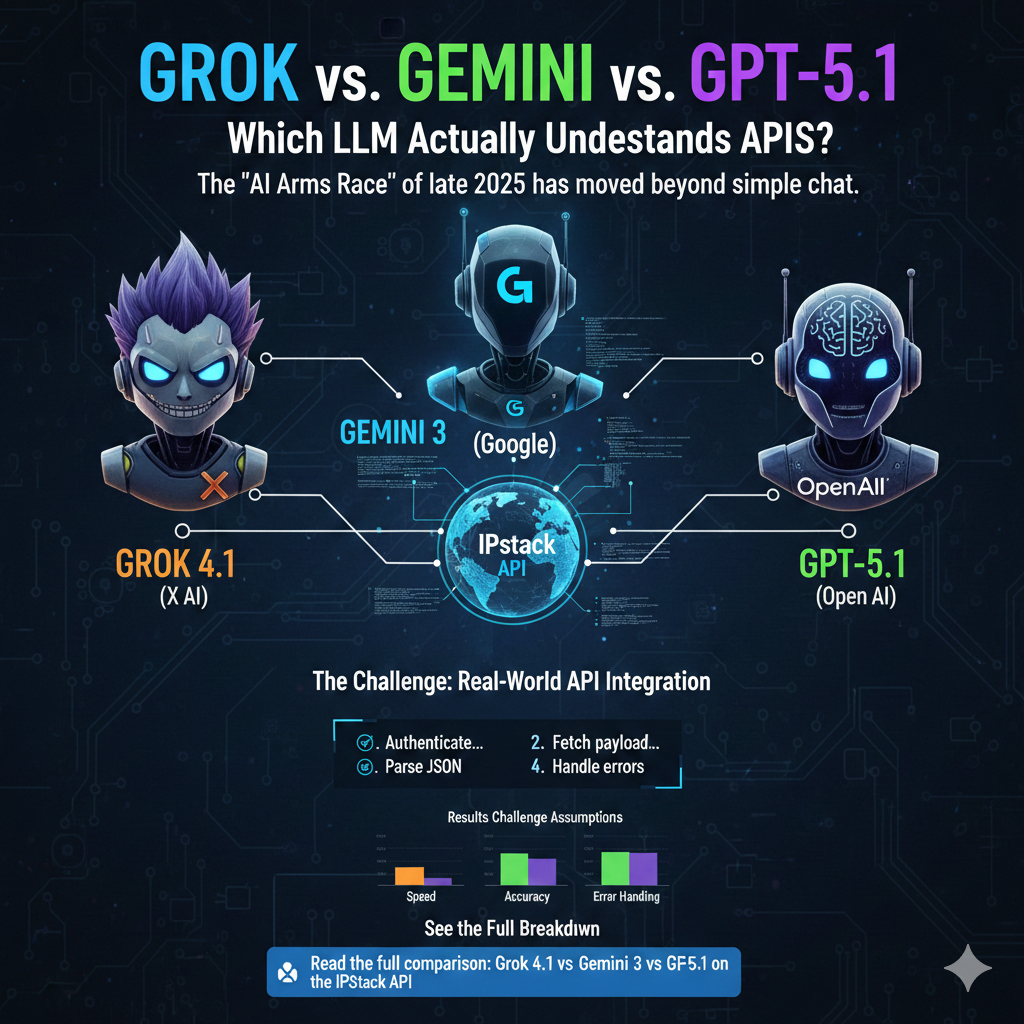
As digital platforms expand globally, developers deal with an increasing need for accurate, fast, and reliable geolocation data. IP intelligence now powers everything from fraud prevention to personalized content delivery, and APIs like IPstack sit at the core of these workflows. But with large language models becoming a key part of modern development, the question naturally emerges:
Which LLM handles API data best?
A recent deep-dive by APILayer compared Grok 4.1, Gemini 3, and GPT-5.1 using real IPstack API responses. The results offer practical guidance for teams building automated analytics, security frameworks, and data-driven systems.
Here’s a developer-focused breakdown of why this comparison matters, and what the findings mean for real-world applications.
Why LLM Performance on API Data Matters
Most LLM benchmarks test creative reasoning or abstract problem-solving. But developers using LLMs inside apps need something different:
- Accurate interpretation of structured JSON
- Ability to spot issues or anomalies
- Contextual understanding of geolocation data
- Clear and concise summarization
- Decision-making consistency
When an LLM makes sense of an IP address response, even a slight misinterpretation, like guessing the wrong country or ignoring a missing field, can affect security checks or user experience.
That’s why benchmarking LLMs using live, production-grade GEODATA from IPstack is so valuable.
What the Benchmark Revealed
The APILayer team ran multiple real-world prompts like:
- “Explain this IPstack API response in simple terms.”
- “Highlight security risks associated with this IP.”
- “Is this IP likely to be a VPN or proxy?”
- “Give a business-friendly summary for this geolocation data.”
Each model was tested for accuracy, interpretation quality, clarity, and depth of reasoning.
Here’s what stood out.
Grok 4.1: Lightning Fast and Efficient
Grok 4.1 performed extremely well in speed-related tasks. It delivered quick summaries, handled compact data, and kept explanations concise. If your workflow values fast decision outputs, for example, when responding to login attempts or real-time transactions, Grok 4.1 is a strong contender.
Its weaknesses?
It sometimes skipped less obvious details buried in the structure.
Gemini 3: Best for Deep Context Understanding
Gemini 3 excelled when prompts involved:
- Multi-layered IP insights
- Region-level context
- Detailed explanations
When analyzing more complicated or messy IPstack responses, Gemini 3 delivered thorough interpretations. This makes it ideal for data analytics dashboards, internal reporting tools, or multi-step AI pipelines.
However, it tended to give longer, sometimes overly detailed answers.
GPT-5.1: Most Balanced and Developer-Oriented
GPT-5.1 consistently produced the most accurate and balanced interpretation of IPstack API data. It recognized subtle fields like:
- ISP indicators
- Proxy/VPN likelihood
- Regional accuracy scores
- Location risk factors
It also excelled at code generation, API troubleshooting, and converting JSON into developer-ready formats. This combination makes GPT-5.1 the best all-around choice for developers building tools around IP intelligence.
What This Means for Modern Development
The comparison shows how important it is to match the right LLM with your use case. Whether you want:
- Fast automated decisions
- Deep geolocation insights
- Code-ready explanations
- Risk scoring clarity
…these models perform differently enough that your choice matters.
If your application relies on IP detection, location-based logic, or user verification, understanding how LLMs interpret geo APIs can help you build more accurate and scalable systems.
Read the Full, Detailed Benchmark
The complete results, with full prompt examples, model outputs, and scoring, are available in APILayer’s full blog analysis.
👉 Read the full comparison:
https://blog.apilayer.com/grok-4-1-vs-gemini-3-vs-gpt-5-1-we-tested-the-latest-llms-on-the-IPstack-api/
It’s an essential read for developers building secure, intelligent, and data-driven platforms.