
In an era defined by data abundance and rapid market shifts, organizations are under constant pressure to make faster, smarter, and more accurate decisions. Traditional decision-making models, often reliant on manual analysis and static reporting, are no longer sufficient to keep pace with today’s dynamic business environments. To address this challenge, enterprises are increasingly adopting Decision Intelligence Platforms (DIP) advanced solutions that transform raw data into actionable insights and enable real-time, data-driven decision-making.
QKS Group’s Decision Intelligence Platforms market research delivers a comprehensive global analysis of major vendors, technology trends, and competitive dynamics shaping this fast-growing market. The study examines vendors’ product features, core functionalities, and key differentiators, helping both technology providers and end users understand the current landscape and future growth opportunities.
The Rising Importance of Decision Intelligence Platforms
Organizations today generate massive volumes of structured and unstructured data from enterprise systems, customer interactions, digital channels, and external sources. Converting this data into timely and meaningful decisions has become increasingly complex. Decision Intelligence Platforms address this challenge by combining advanced analytics, artificial intelligence (AI), machine learning (ML), and business rules management into a unified decision-making framework.
By automating and augmenting decision processes, DIPs empower organizations to enhance agility, reduce risk, and maintain a competitive edge in highly dynamic markets.
Market Trends Driving DIP Adoption
QKS Group’s research highlights several trends accelerating the adoption of Decision Intelligence Platforms across industries:
- Growing demand for real-time and automated decision-making
- Increased use of AI and ML-driven predictive and prescriptive analytics
- Rising adoption of low-code and no-code decision modeling
- Integration of business rules, decision workflows, and analytics
- Expansion of DIP use cases across BFSI, insurance, telecom, retail, and healthcare
These trends reflect the shift toward intelligent, scalable platforms that support complex, high-volume decisions with greater transparency and control.
SPARK Matrix™: Competitive Landscape and Vendor Evaluation
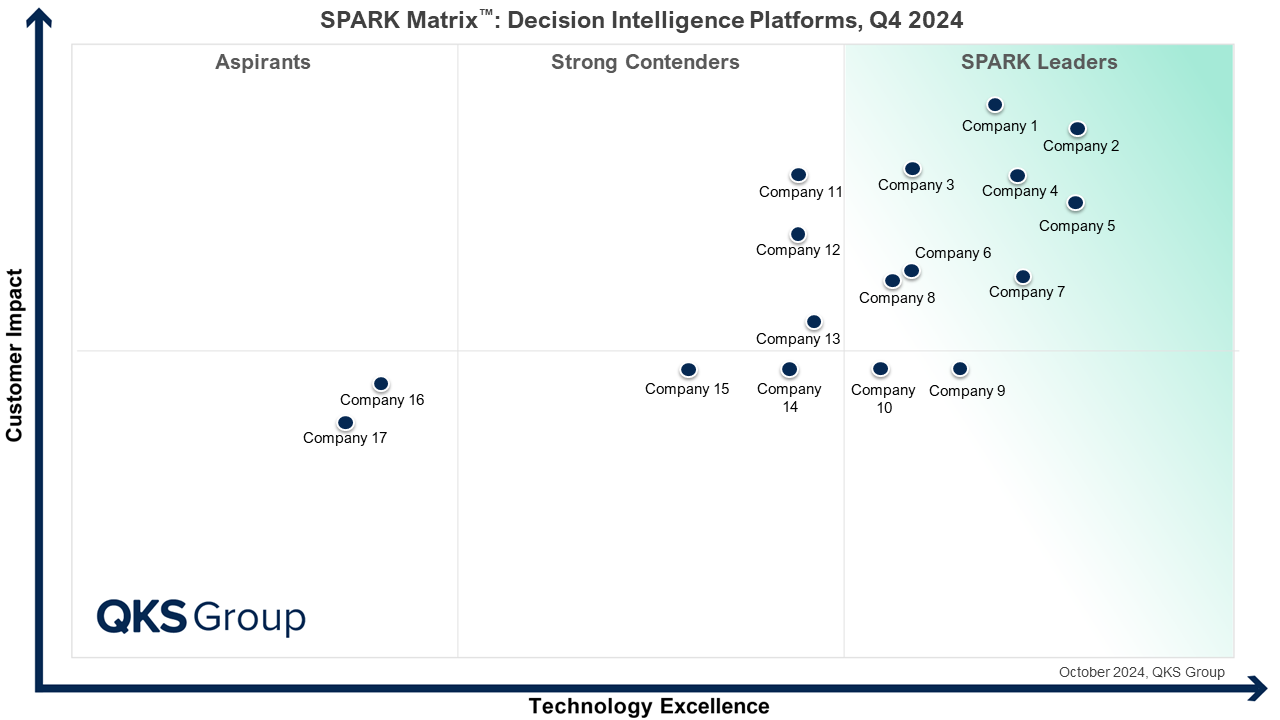
A key component of the research is QKS Group’s proprietary SPARK Matrix™ analysis, which provides a structured evaluation of leading Decision Intelligence Platform vendors based on technology excellence and customer impact. The SPARK Matrix offers clear insights into vendor positioning, competitive differentiation, and market leadership.
The study evaluates globally impactful vendors, including ACTICO, Aera Technologies, CRIF, DECISIONS, Experian, FICO, FlexRule, IBM, InRule, Pegasystems, Progress, Provenir, Quantexa, Sapiens, SAS, Sparkling Logic, and TIBCO Software. This comprehensive vendor assessment enables enterprises to benchmark solutions and select platforms aligned with their strategic, operational, and regulatory requirements.
For vendors, the SPARK Matrix serves as a strategic tool to identify strengths, address capability gaps, and build a growth-oriented technology roadmap.
AI-Driven Intelligence Transforming Business Decisions
According to an Analyst at QKS Group, “Decision Intelligence platforms are innovative tools that have become critical components of contemporary business operations. Organizations are inundated with large amounts of information in today's data-driven society, making decision-making a complex and demanding process. This difficulty is addressed by decision intelligence platforms, which use advanced algorithms, artificial intelligence, and machine learning to process and analyze data in real-time. These systems enable businesses to make data-driven decisions with speed, accuracy, and agility.”
Modern DIPs excel at extracting actionable insights from vast volumes of structured and unstructured data, enabling organizations to optimize decisions across customer engagement, risk management, fraud detection, pricing, and operational efficiency.
Business Benefits of Decision Intelligence Platforms
Implementing a robust Decision Intelligence Platform enables organizations to:
- Improve decision speed and accuracy
- Enhance customer experiences through personalized, real-time actions
- Optimize operational efficiency and resource utilization
- Reduce risk and improve compliance
- Foster innovation and continuous improvement
Download Sample Report : https://qksgroup.com/download-sample-form/%20?id=8053
By embedding intelligence directly into business workflows, DIPs transform decision-making from a reactive process into a strategic capability.
Conclusion
The Decision Intelligence Platforms market is rapidly evolving as enterprises seek intelligent solutions to navigate data complexity and business uncertainty. QKS Group’s market research and SPARK Matrix™ analysis provide valuable insights into vendor capabilities, competitive positioning, and future market direction.
For organizations looking to scale intelligent decision-making, drive digital transformation, and achieve sustainable growth, investing in the right Decision Intelligence Platform is a strategic imperative in today’s data-driven world.