
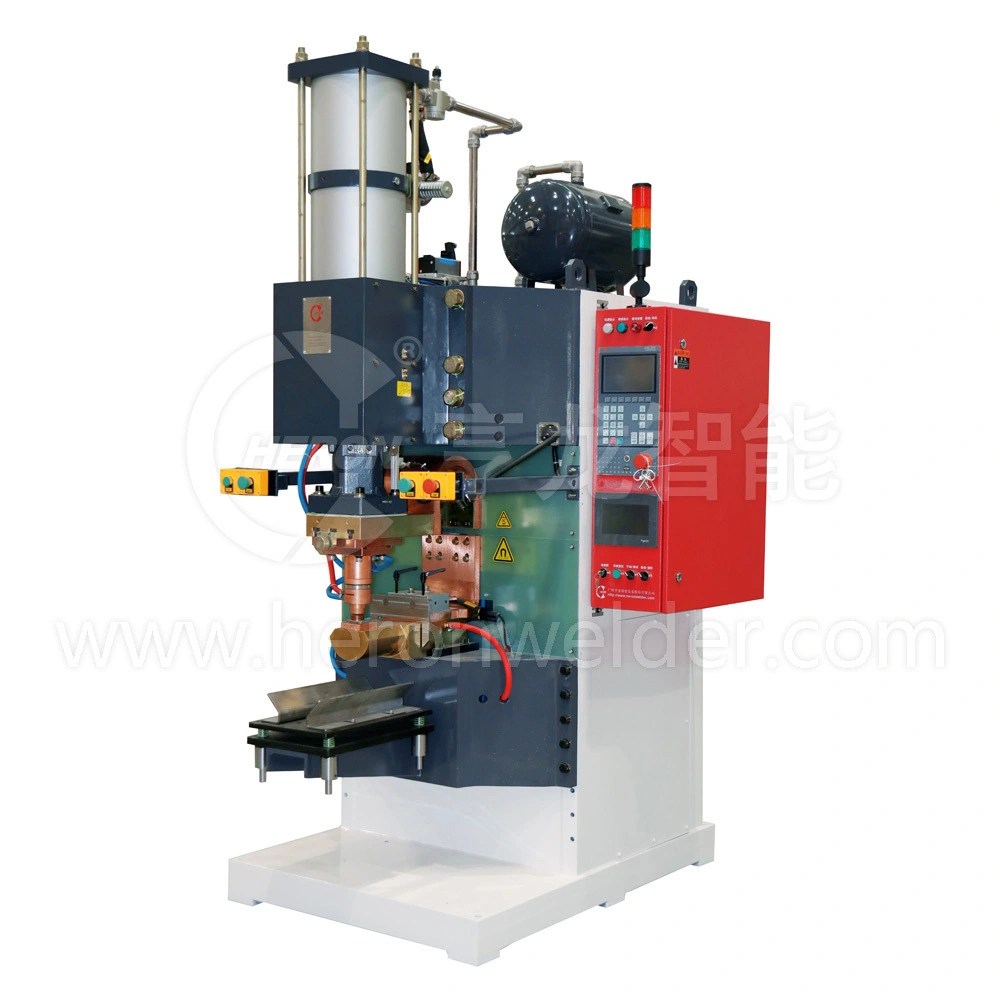
In the high-speed world of automotive manufacturing, spot welding remains one of the most critical metal-joining processes. Automotive spot welders enable manufacturers to join sheet metal efficiently and reliably from body-in-white assemblies to reinforcement structures and chassis components. For OEMs, automation integrators, and manufacturing engineers tasked with optimizing throughput, quality, and lifecycle cost, choosing the right spot welding solution is a strategic decision.
As a global manufacturer of industrial welding and metal-joining equipment, Heron Welder brings decades of expertise in resistance welding machines, controllers, welding guns, and automated production cells all engineered to drive performance in demanding automotive fabrication environments.
What Is an Automotive Spot Welder?
Automotive spot welding is a form of resistance welding where two overlapping metal sheets are joined by applying pressure and electric current through electrodes at discrete points. The current generates localized heat due to electrical resistance, melting the interface and forming a weld nugget as the materials solidify under force.
Core Principles of Automotive Spot Welding
-
Resistance Heating: Electrical current flows through the contact area between sheets. Heat ∝ current² × resistance.
-
Precise Electrode Force: Pneumatic or servo actuators apply consistent force to control nugget size and quality.
-
Time Control: Weld time (in milliseconds) and electrode tip geometry affect penetration and repeatability.
-
Process Control: Modern controllers monitor current, force, and time for reproducible results.
This combination of controlled heat and force makes automotive spot welding ideal for thin and medium gauge steels, aluminum alloys, and multi-material stacks increasingly used in modern vehicle design.
Why Automotive Spot Welders Are Critical in Vehicle Production
Automotive assemblies today demand:
-
High Throughput: Thousands of welds per vehicle body requiring rapid cycle times.
-
Repeatability: Consistent joint quality at scale across shifts and workstations.
-
Integration: Seamless interfacing with robotic systems and manufacturing execution systems (MES).
-
Adaptability: Capable of handling mixed materials, from high-strength steels to aluminum and coated substrates.
Heron’s resistance welding solutions, including MFDC (medium frequency direct current) and capacitor discharge systems, meet these requirements by delivering:
-
Precise energy control for consistent weld nuggets.
-
Reduced spatter and distortion for less rework.
-
Advanced controls that integrate with PLCs and automation frameworks.
Spot Welding vs. Other Automotive Welding Methods
While spot welding is indispensable in automotive fabrication, it is important to understand how it compares to other joining technologies.
Spot Welding vs. MIG/MAG Welding
| Attribute | Spot Welding | MIG/MAG Welding |
|---|---|---|
| Joint Type | Sheet overlap | Butt, fillet, lap |
| Speed | Very fast | Moderate |
| Automation | Excellent | Good |
| Heat Input | Localized | Higher |
| Distortion | Minimal | Higher |
Spot welding excels in lap joints typical of body structures, offering rapid cycles and lower thermal impact. MIG/MAG is more versatile for thicker components but slower and with greater distortion.
Spot Welding vs. Laser Welding
Laser welding offers high precision and minimal heat-affected zones, but it comes with higher capital costs and sensitivity to joint fit-up. Spot welding remains the workhorse for large volume automotive applications due to cost-effectiveness and robustness.
Spot Welding vs. Clinching & FSPR
Mechanical joining methods like clinching and self-pierce riveting (FSPR) are increasingly used for dissimilar materials (e.g., aluminum to steel). Heron’s portfolio includes these technologies, enabling manufacturers to choose the right solution based on material stack and structural requirements.
Key Components of an Automotive Spot Welding System
A complete automotive spot welding cell typically comprises:
Resistance Welding Power Supply
-
Provides controlled current output.
-
Heron offers transformer-based, MFDC, and capacitor discharge power supplies tailored to joint types and production speeds.
Welding Guns & Electrodes
-
Designed for ergonomic access, long tip life, and consistent contact.
-
Custom electrode geometries optimize current density for specific sheet stacks.
Weld Controllers
-
High-speed digital controllers track current, time, and force.
-
Industry 4.0-ready interfaces enable quality tracking, SPC integration, and traceability.
Actuation & Motion Systems
-
Pneumatic, hydraulic, or servo actuation to apply force with precision.
-
Integration with robotic arms or gantries for automated welding sequences.
Safety & Monitoring
-
Real-time process feedback ensures weld quality.
-
Safety interlocks protect operators and equipment.
Best Practices for Automotive Spot Welding
To maximize performance and uptime, adhere to these industry-recognized best practices:
1. Optimize Electrode Maintenance
Electrode wear changes contact area and resistance. Implement a scheduled inspection and dressing program to maintain repeatable weld quality.
2. Monitor Weld Parameters Continuously
Automated controllers that log current, time, and force enable predictive maintenance and early detection of drift or faults.
3. Integrate with Factory Automation
Spot welding systems should communicate with PLCs and higher-level systems to synchronize with material handling and quality checks.
4. Account for Material Variability
Different steel grades, coatings, and alloys require tailored parameters. Heron’s engineers can develop weld schedules that account for material mix and stack thickness.
5. Train Operators and Maintenance Teams
Empower your workforce with understanding of resistance welding fundamentals, safety protocols, and interpretation of weld reports.
Applications of Automotive Spot Welders
Automotive spot welders are indispensable across a vehicle’s lifecycle of parts and assemblies:
-
Body-in-White (BIW): Structural joints in pillars, rails, roof, and floor panels.
-
Door and Hood Assemblies: High volume lap welds with repeatable quality.
-
Seat Frames and Subframes: Consistent joints with minimal distortion.
-
Battery Enclosures (EVs): Spot and projection welds tailored for thicker gauge and multi-layer stacks.
-
Brackets and Reinforcements: High-strength joints in critical load areas.
Heron’s systems are specified in automotive OEM plants, tier-1 fabrication lines, and automated welding cells worldwide delivering reliability in high-demand environments.
FAQs About Automotive Spot Welders
Q1: What materials can automotive spot welders join?
Automotive spot welders can join a range of materials including mild steel, high-strength steel, galvanized steels, aluminum alloys, and tailored material stacks when paired with the right power supply and electrode configuration.
Q2: How does MFDC spot welding improve performance?
MFDC (medium frequency direct current) provides faster current rise times and better control over heat input compared to transformer-based systems, resulting in improved nugget consistency and reduced spatter.
Q3: Can spot welding be automated?
Yes. Spot welding systems are highly compatible with robotic arms, gantries, and PLC-based automation frameworks. Integrated controls and communication protocols ensure synchronization with material handling and quality systems.
Q4: What is the difference between spot welding and projection welding?
Spot welding joins overlapping sheets at discrete points. Projection welding uses intentional embossments or projections to localize current and pressure, making it suitable for attaching nuts, studs, and complex assemblies.
Q5: How does electrode geometry affect weld quality?
Electrode shape and size influence current density and contact area. Proper electrode design is critical for achieving target nugget size and minimizing wear especially in high-volume automotive applications.
Heron: Your Partner in Automotive Welding Solutions
At Heron Welder, we understand that welding and joining technologies are the backbone of efficient, high-quality automotive manufacturing. From automotive spot welders and MFDC resistance welding systems to clinching, self-pierce riveting (FSPR), welding guns, controllers, and fully automated production lines, we deliver solutions engineered for performance, reliability, and integration.
Whether you’re upgrading existing lines or designing new automated welding cells, our experts can help you select the right technology, optimize parameters, and support installation and training.
Ready to enhance your automotive fabrication capabilities?
Request a quote or consult with Heron’s welding and automation specialists today to design a tailored solution that drives productivity and quality in your operations.