
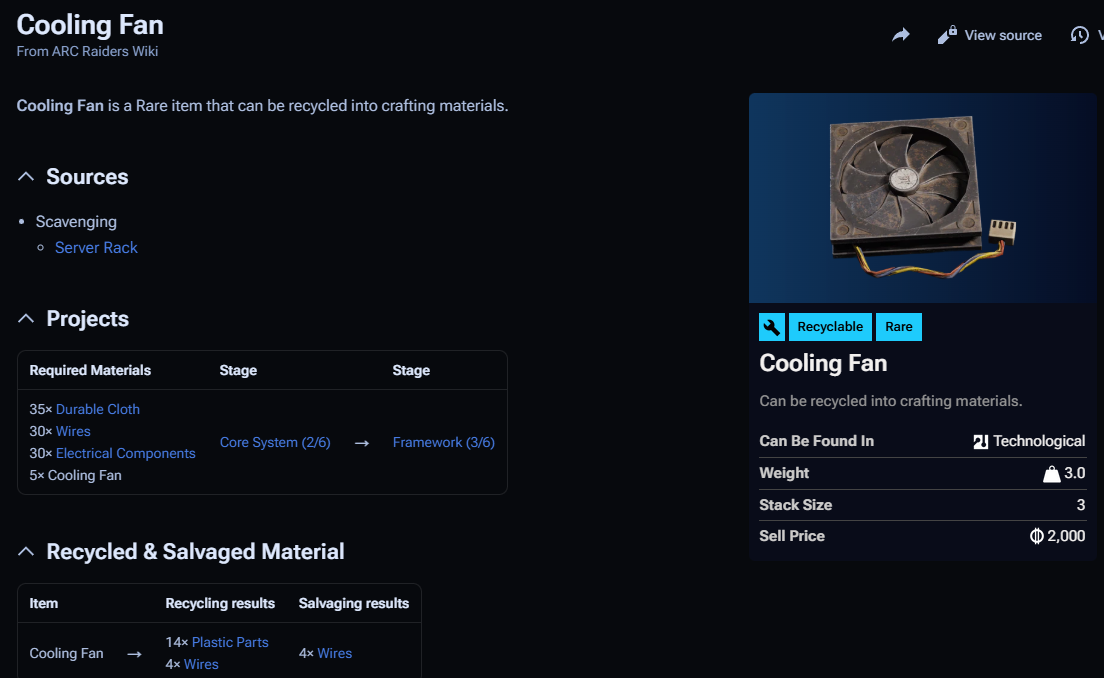
What is a Cooling Fan actually used for?
In practice, the Cooling Fan has two main purposes:
-
Progressing specific base projects
-
Being recycled into materials
The Cooling Fan is not a weapon part, armor upgrade, or direct crafting ingredient for gear. You never slot it into a weapon or use it in combat-related crafting. Its value comes from long-term progression rather than immediate power.
Most players encounter Cooling Fans while looting server racks or other technological containers. When you pick one up, you are basically deciding whether this run is about base progress or material farming.
Do I need Cooling Fans for base progression?
Yes, but only at certain points.
Cooling Fans are required for a mid-stage base project. You will need multiple units to move from one framework stage to the next. This requirement is not optional if you want to unlock later systems. If you recycle or sell all your Cooling Fans early, you will eventually need to go back out and farm them again.
This is why experienced players usually keep a small reserve in storage. Even if you are not actively working on that project yet, having them ready saves time later. Farming them on demand can slow progression, especially if you are unlucky with server rack spawns.
How many Cooling Fans should I keep?
From a practical standpoint, most players keep five to six Cooling Fans in storage.
This covers the known project requirement with a small buffer in case you miscount or want flexibility. Keeping more than that rarely helps, because Cooling Fans are not used repeatedly across many projects.
Once your required project is completed, extra Cooling Fans lose most of their strategic value.
Is it better to recycle Cooling Fans or salvage them?
Recycling is usually the better option.
When you recycle a Cooling Fan, you receive plastic parts and wires. Plastic parts are especially useful because they are consumed steadily across many recipes. Wires are also always in demand. Salvaging, on the other hand, only gives wires and fewer of them.
In real gameplay terms, recycling gives you more flexibility. Plastic parts bottleneck crafting far more often than wires for most players. Unless you are in a very specific situation where you only need wires immediately, recycling is the smarter long-term choice.
Should I sell Cooling Fans for coins?
Selling is rarely the best use, but it can make sense early on.
The coin value of a Cooling Fan is not high relative to its rarity. Early in the game, when you are short on coins for basic upgrades or vendor purchases, selling one or two can help stabilize your economy. Later on, coins become easier to earn through other means, and the opportunity cost of selling a Cooling Fan increases.
Most veteran players stop selling Cooling Fans entirely once their base projects are underway.
Where do Cooling Fans usually come from?
In actual runs, Cooling Fans most often come from server racks in technological zones.
They do not drop consistently from enemies, and you cannot reliably farm them through combat alone. If you are specifically looking for Cooling Fans, focus your routes on indoor tech-heavy areas rather than open scavenging zones.
This also affects risk management. Server racks tend to be in tighter spaces, which increases exposure to both machines and other players. Many squads plan short, targeted runs just to hit known rack locations and extract.
Are Cooling Fans worth carrying given their weight?
Cooling Fans are relatively heavy compared to basic materials. Carrying several can slow you down and limit how much else you can loot.
In practice, most players treat them as priority loot only when they need them. If your storage already has enough, it is often better to leave a Cooling Fan behind and pick up lighter, stackable materials instead.
This is especially true during longer runs where extraction distance matters more than single-item value.
How do Cooling Fans fit into long-term planning?
Cooling Fans are a classic example of an item that matters once, then mostly stops mattering.
Early on, players either hoard them or ignore them completely. Both approaches cause problems. Hoarding too many wastes storage and carry capacity. Ignoring them forces you into inefficient farming later.
A balanced approach works best: keep what you need for projects, recycle extras when plastic parts are low, and only sell if coins are urgently needed.
This same logic applies to many rare recyclable items, which is why experienced players often advise newer ones to think in terms of project timelines rather than item rarity alone.
Why do players sometimes overvalue Cooling Fans?
The “Rare” label creates confusion.
In Arc Raiders, rarity does not always equal importance. Cooling Fans are rare in terms of spawn rate, but their actual usage is narrow. New players often assume rare means powerful or essential across many systems. That is not the case here.
Understanding this distinction helps you make better inventory decisions and reduces frustration when you feel stuck farming something you already sold.
Are Cooling Fans connected to weapon blueprints?
Not directly.
Cooling Fans do not unlock weapons or upgrades by themselves. However, players sometimes mention them in the same conversations as blueprint progression, which leads to confusion. For example, discussions about base progression efficiency often come up alongside advice like when to buy Equalizer blueprint, even though the Cooling Fan itself is not part of that purchase.
The connection is indirect: efficient base progression supports better gear access overall.
Final practical advice
If you want a simple rule to follow:
-
Keep enough Cooling Fans to complete your required project
-
Recycle extras for plastic parts
-
Avoid selling unless you truly need coins early
-
Do not go out of your way to farm them once your project is done
Used this way, Cooling Fans become a minor but manageable part of your progression instead of a recurring annoyance.
Level 60-75 upgrade-Real Player-24 Support Speed and Security Guarantee | Global