
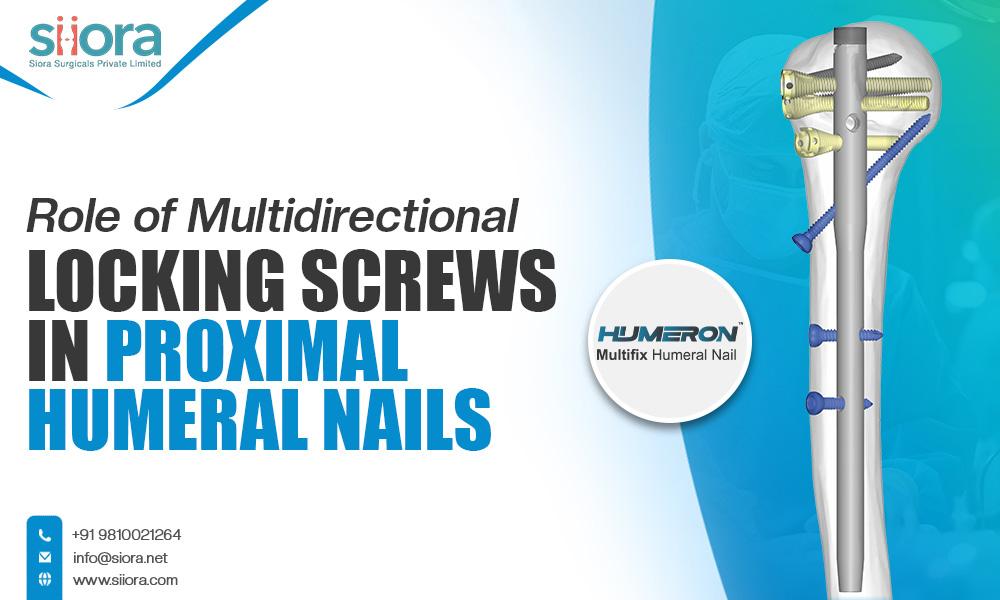
Fixing proximal humerus fractures is always a balancing act—too rigid a fixation can stress the bone, but too flexible a construct can collapse. That’s where multidirectional locking screws in proximal humeral nails come in. They give surgeons the ability to angle screws precisely into the best bone stock, improving stability while keeping soft tissue trauma minimal. Over the last decade, this concept has changed how orthopedic surgeons approach complex shoulder fractures, especially in osteoporotic bones.
Why the Shift to Multidirectional Locking?
Traditional humeral nails relied on fixed screw angles. That worked fine on paper, but fractures are rarely textbook-perfect. In real cases, fragments vary in size and alignment, and bone density can differ across regions of the head and shaft. A fixed-angle system often couldn’t reach strong bone or maintain reduction, particularly in multi-fragmentary fractures.
Multidirectional screw systems allow each screw to be inserted at variable angles—usually within a 15° to 30° cone around its axis. This flexibility makes a world of difference. Surgeons can target dense bone areas in the humeral head, avoid articular penetration, and angle screws away from fracture lines or voids. In short, they can adapt to what the bone gives them rather than forcing the bone to match the implant.
Better Fixation in Fragile Bone
Elderly patients with osteoporosis are the toughest group when it comes to shoulder fixation. Their bone quality simply doesn’t offer the grip that traditional locking screws need. Multidirectional locking screws help counter this by letting the surgeon anchor into zones of denser trabecular bone, providing stronger purchase. When combined with helically arranged screw patterns, the system distributes load evenly across the humeral head.
Studies have shown that nails equipped with multidirectional screw options reduce the risk of varus collapse and screw loosening, common failures in osteoporotic humeral fractures. With precise targeting, screws engage better cortical or subchondral bone, improving fixation stability even under early physiotherapy movements.
Enhanced Anatomical Reconstruction
Fracture patterns near the humeral head are often three- or four-part, involving displacement of the greater and lesser tuberosities. Multidirectional locking screws allow surgeons to capture these fragments securely by angling screws into each tuberosity. This anchoring preserves the rotator cuff attachments, directly impacting shoulder strength and postoperative mobility.
By offering separate trajectories for each screw, the system also makes it easier to reconstruct the humeral calcar—vital for preventing head collapse into varus. Some modern proximal humeral nails even include targeting jigs that let surgeons pre-plan individual screw angles for optimal subchondral support.
Early Mobilization, Faster Recovery
One of the most practical advantages of multidirectional locking screws is their contribution to immediate postoperative stability. Patients can start gentle shoulder motion earlier without risking fixation failure. That restores confidence and speeds recovery, particularly for those at risk of joint stiffness or adhesive capsulitis after prolonged immobilization.
Because the multidirectional locking construct resists torsion and shear, it also reduces micromotion across fracture lines. This controlled stability promotes better callus formation and faster union, often within 10–12 weeks in uncomplicated cases.
Reduced Complications
Older humeral nail systems faced issues like screw back-out, head impingement, and nonunion. In multidirectional systems, the screws lock firmly into the plate or nail head with a conical thread mechanism, creating a stable “fixed-angle” construct at whichever orientation the surgeon selects. This means less micro-movement at the bone-screw interface and lower failure rates.
Additionally, by avoiding articular surface breaches and reducing soft tissue irritation near the rotator cuff, patients experience fewer mechanical symptoms post-surgery. Many newer nail designs integrate multidirectional locking with smoother nail profiles, cutting down the risk of impingement during elevation or abduction.
The Future Outlook
Looking ahead, multidirectional locking systems are becoming a standard rather than a luxury in proximal humeral fixation. Engineers continue to refine targeting guides and develop hybrid options that integrate both fixed and variable locking for even finer control. Combined with minimal soft-tissue disruption techniques, they’re part of a wider movement toward biologically friendly fixation—strong, adaptable, and responsive to real anatomy.
For orthopedic surgeons, these innovations mean greater confidence in tackling complex fractures. For patients, it translates to a more stable shoulder, quicker rehab, and a smoother road back to function.
Want to see advanced humeral nail systems and other trauma implants? Visit booth N37.A71 at the upcoming WHX Dubai 2026 and explore advanced orthopedic systems by Siora Surgicals Pvt. Ltd.