
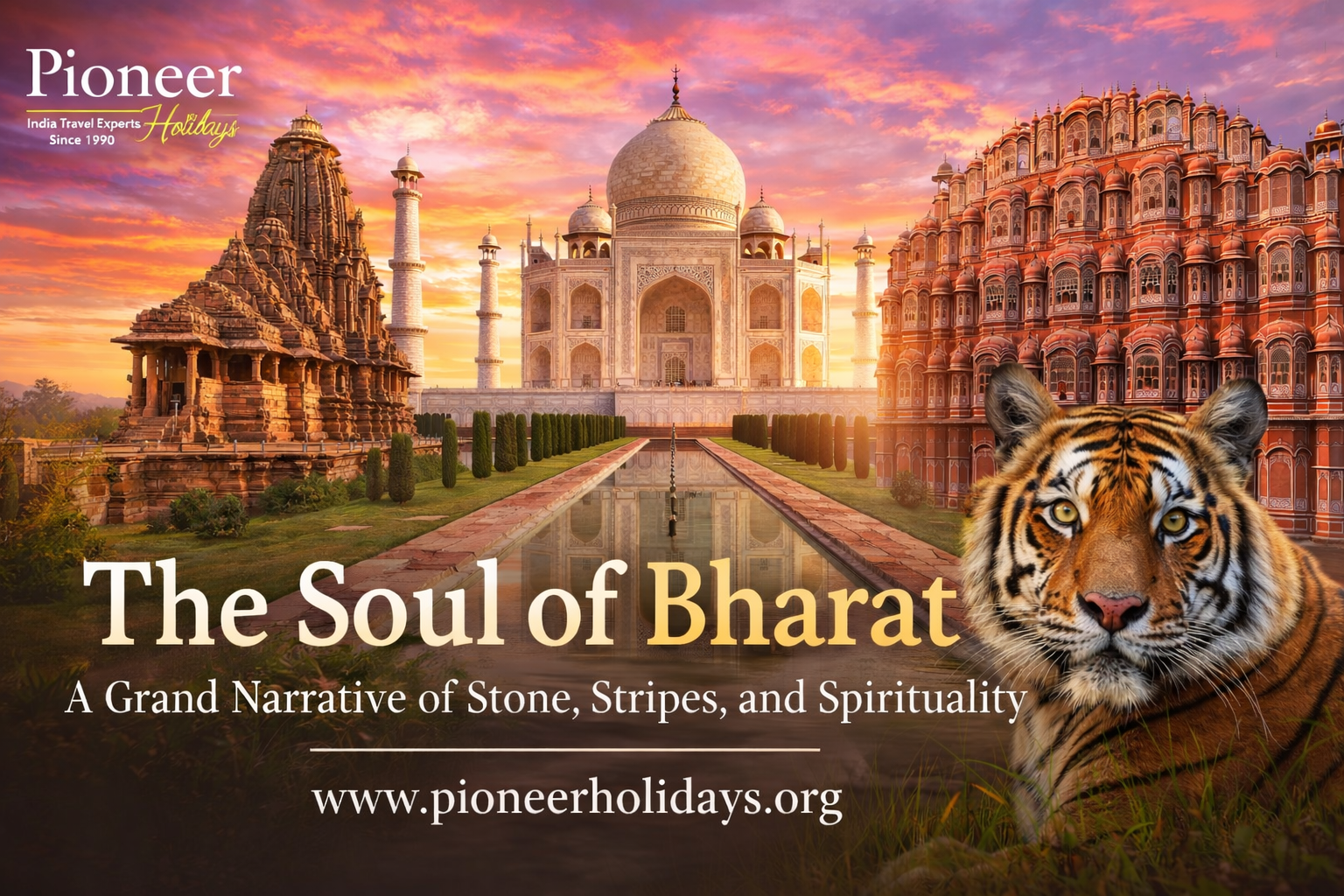
India is not a country that you merely 'see'—it is a country that you 'survive' and eventually 'surrender' to. It is a kaleidoscope of 1.4 billion dreams, thousands of years of history, and a geographical diversity that ranges from the frozen peaks of the Himalayas to the tropical shores of the south. However, for most travelers, the quintessential Indian experience is concentrated in the North, where the layers of time are most visible.
The standard journey often starts with the three-city circuit of Delhi, Agra, and Jaipur. But India is too vast to be contained in a triangle. To truly understand the duality of this land—the fierce power of nature and the quiet depth of the spirit—one must venture into the wild and the sacred. This is where the journey evolves into something much larger than a vacation.
Chapter 1: The Imperial Foundation (Delhi, Agra, Jaipur)
Before we venture into the extensions, let us dissect the architectural and cultural heavyweights that form the backbone of your odyssey.
Delhi: The Living Palimpsest
Delhi is a city that has been destroyed and rebuilt seven times. Each conqueror left behind a piece of their soul.
-
The Mughal Grandeur: In Old Delhi, the Red Fort stands as a testament to the height of Mughal power. Across the street, the Jama Masjid's domes dominate the skyline.
-
The British Blueprint: New Delhi, with its wide boulevards and circular squares like Connaught Place, reflects the order of the British Raj.
-
The Sufi Soul: At the Nizamuddin Dargah, the evening qawwalis (devotional music) offer a spiritual high that is independent of any religion. It is where Delhi’s heart truly beats.
Agra: The City of Eternal Love
Agra is more than just a gateway to the Taj. It is a city that was once the envy of the world.
-
The Taj Mahal: It is an architectural anomaly. Despite the millions of photos, seeing it in person—the symmetry, the delicate pietra dura (stone inlay), and the way the marble breathes—is a grounding experience.
-
The Agra Fort: This is where the story of the Taj becomes human. Walking through the halls where Shah Jahan was imprisoned by his own son, looking out at the Taj from a distant balcony, adds a layer of tragedy to the beauty.
Jaipur: The Pink Dream
Jaipur is a city of flair. It was the first planned city of its time, built on the principles of Vastu Shastra (ancient Indian science of architecture).
-
The Amer Fort: A sprawling complex of pale yellow and pink sandstone. The Sheesh Mahal (Palace of Mirrors) is its most delicate feature, designed so that a single candle could illuminate the entire room.
-
The Jantar Mantar: A UNESCO World Heritage site that houses 19 astronomical instruments. It is a reminder that the Rajput kings were scientists at heart.
Chapter 2: The Call of the Wild (Ranthambore)
For the traveler who finds beauty in the untamed, the journey takes a turn into the rugged Aravalli and Vindhya hills. This is where the golden triangle tour with ranthambore becomes a narrative of survival and majesty.
Ranthambore: Where Tigers Rule the Ruins
Ranthambore National Park is unlike any other wildlife sanctuary. It is a "historical jungle." Imagine a 10th-century fort, crumbling stone gateways, and ancient temples—all being reclaimed by the forest.
-
The Safari Experience: The thrill of a safari is not just in seeing the tiger, but in the 'tracking.' The guide stops the Jeep. The forest goes silent. Then, a Langur screams an alarm call from a tree. A Sambar deer barks. You know the "King" is near.
-
The Royal Bengal Tiger: Ranthambore’s tigers, like the legendary T-19 or T-120, are the most photographed in the world. They are often seen walking on the forest paths or drinking from the Padam Talao lake.
-
Birdwatcher's Paradise: With over 300 species of birds, including the Crested Serpent Eagle and the Painted Stork, the park is a vibrant ecosystem.
The golden triangle tour with ranthambore is the perfect balance for those who want to see the heights of human creation and the raw power of nature in a single trip.
Chapter 3: The Spiritual Gateway (Varanasi)
On the other end of the spectrum lies the oldest living city in the world. If Ranthambore is about the physical thrill, Varanasi is about the metaphysical journey. Integrating a golden triangle tour with varanasi into your plans is an invitation to explore the very meaning of existence.
Varanasi: The City of Light
Varanasi (also known as Kashi or Banaras) is where the physical world ends and the spiritual world begins. It is a city that defies logic but rewards faith.
-
The Ghats: There are 84 ghats along the Ganges. Dashashwamedh Ghat is the center of the universe every evening during the Ganga Aarti. The smell of incense, the sound of bells, and the sight of thousands of flickering lamps create a trance-like state.
-
The Boat Ride at Dawn: This is the most essential Varanasi experience. As you float on the river, you see the cycle of life—people bathing to wash away sins, priests meditating, and the smoke from the cremation pyres at Manikarnika Ghat. It is a humbling reminder of our mortality.
-
The Silk Heritage: Varanasi is famous for its Banarasi Silk. The weavers here use ancient handlooms to create sarees that are works of art, often taking months to complete a single piece.
-
Sarnath: Just a short drive away, Sarnath offers a peaceful retreat. This is where Buddha gave his first sermon after attaining enlightenment. The Dhamek Stupa stands as a tall symbol of peace in a world of chaos.
A golden triangle tour with varanasi is not just a sightseeing trip; it is a pilgrimage that stays with you long after you have left the city.
Chapter 4: Culinary Landscapes
One cannot talk about India without talking about the food. Each stop on this journey offers a different flavor profile.
-
Delhi: The 'Chaat' (savory snacks) of Old Delhi and the rich, buttery 'Dal Makhani' of New Delhi.
-
Agra: The 'Petha' (ash gourd sweet) and the Mughlai 'Boti Kebab'.
-
Jaipur: 'Ker Sangri' (desert beans) and the spicy 'Laal Maas'.
-
Ranthambore: Rustic 'Dal Baati Churma' enjoyed under the canopy of trees.
-
Varanasi: The morning 'Kachori Sabzi' followed by a frothy glass of 'Thandai'.
Chapter 5: Practical Advice for the Global Traveler
-
Connectivity: While India is well-connected by air and rail, the Golden Triangle is best explored by a private chauffeured car for flexibility.
-
Language: English is widely spoken in the tourism sector, but learning a few Hindi words like Namaste (Hello) and Dhanyawad (Thank you) goes a long way.
-
Respect: India is a traditional country. When visiting temples or mosques, ensure your shoulders and knees are covered. Always remove your shoes before entering a holy site.
Frequently Asked Questions (FAQs)
1. How many days are ideal for this complete journey? To do justice to both the Golden Triangle and the extensions (Ranthambore and Varanasi), a 12 to 14-day itinerary is ideal. This allows for a relaxed pace and enough time for multiple safaris and spiritual explorations.
2. What is the best time to see tigers in Ranthambore? While the park is open from October to June, the best sightings usually happen between March and May. As the water sources dry up, tigers frequently visit the remaining lakes, making them easier to spot.
3. Is Varanasi suitable for children? Varanasi is intense. For children, the boat rides and the evening Aarti can be magical, but the crowded alleys can be overwhelming. We suggest keeping the Varanasi leg shorter if traveling with very young children.
4. Can I visit the Taj Mahal on a Friday? No. The Taj Mahal remains closed every Friday for general viewing. It is only accessible to those attending prayers at the mosque inside the complex.
5. How do I get from Jaipur to Varanasi? The fastest way is a direct flight. There are also overnight trains for those who want to experience the legendary Indian Railways, but a flight is recommended to save time for sightseeing.
The Final Takeaway
India is a land of contradictions. It is noisy yet peaceful, chaotic yet organized, ancient yet modern. Whether you find yourself in the back of a Jeep in the dusty trails of Rajasthan or sitting on the stone steps of an ancient ghat in Varanasi, you will realize that India is not a place you visit to see things—it is a place you visit to see yourself differently.
To plan your bespoke adventure and explore these hidden layers of the subcontinent, visit us PioneerHolidays.