
Introduction
In today’s world of smart manufacturing and digital transformation, PLC and SCADA integration has become the foundation of modern automation. Programmable Logic Controllers (PLCs) handle on-site control tasks, while SCADA systems (Supervisory Control and Data Acquisition) provide centralized visibility, data logging, and decision-making capabilities.
Among the many PLCs on the market, the Allen-Bradley Micro850 2080-L50E-48QBB PLC stands out for its flexibility, connectivity, and reliability. In this article, we’ll explore how this compact yet powerful controller integrates seamlessly with SCADA systems, the protocols it supports, and how this integration enhances industrial performance across different applications.
Understanding SCADA and Its Role in Automation
SCADA, short for Supervisory Control and Data Acquisition, is an industrial system used to collect, analyze, and control real-time data from equipment and processes. It provides operators with a visual dashboard to monitor system performance, detect abnormalities, and make quick, informed decisions.
In this ecosystem, PLCs like the Micro850 act as the operational core, executing control logic and gathering field data from sensors, valves, and motors. SCADA then compiles that information to present a clear, centralized view of operations. Together, they form a powerful combination that drives efficiency, safety, and real-time control in industrial environments.
Overview of the Micro850 2080-L50E-48QBB PLC
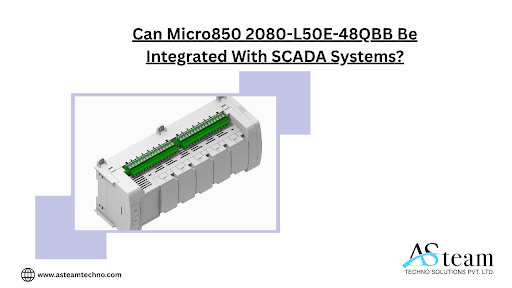
The Micro850 2080-L50E-48QBB, part of the Allen-Bradley Micro800 family, is designed for small to mid-sized automation projects that require flexible communication and dependable performance. It comes with 48 digital I/O points, allowing it to manage several processes simultaneously without the need for expansion modules in many cases.
Connectivity is one of its strongest suits. The controller includes built-in Ethernet/IP, Modbus TCP/RTU, and serial communication ports, making it easy to connect to both modern and legacy industrial systems. Configuration is handled through Connected Components Workbench (CCW)—a free and intuitive software platform from Rockwell Automation that simplifies programming, communication setup, and data mapping.
These combined features make the Micro850 a highly adaptable PLC that’s ready for SCADA integration right out of the box.
How Micro850 Integrates with SCADA Systems
a. Ethernet/IP Communication
The Micro850 2080-L50E-48QBB is equipped with a dedicated Ethernet port that supports EtherNet/IP, one of the most widely adopted industrial communication protocols worldwide. This allows seamless, high-speed communication between the PLC and SCADA systems, ensuring that operators have instant access to process data, device status, and alarms.
EtherNet/IP’s open architecture also guarantees compatibility with leading SCADA platforms like FactoryTalk View, AVEVA InTouch, and Ignition. Through this network, real-time updates and control commands can be transmitted efficiently, enabling smooth and reliable system performance.
b. Modbus TCP and Modbus RTU
In addition to Ethernet/IP, the Micro850 supports Modbus TCP and Modbus RTU, offering great flexibility for integration. Modbus TCP, which runs over Ethernet, is ideal for newer systems that require high-speed communication. Meanwhile, Modbus RTU, which operates over RS-232 or RS-485 serial connections, is perfect for legacy devices or applications that lack Ethernet infrastructure.
This dual protocol support makes the Micro850 compatible with a wide range of equipment and SCADA systems, including those from different manufacturers—an important advantage for facilities using mixed automation technologies.
c. Configuration via Connected Components Workbench (CCW)
The Connected Components Workbench (CCW) software is a key tool that simplifies SCADA integration. Through CCW, engineers can set up Ethernet communication parameters, assign IP addresses, and configure controller tags—all within a user-friendly interface.
These controller tags, which represent real-world variables like motor speed, temperature, or valve position, can then be shared with the SCADA system. Once connected, SCADA operators can view live data, monitor alarms, and make control adjustments in real time. This setup streamlines integration, reduces engineering time, and improves visibility across the plant floor.
Real-World Applications of Micro850–SCADA Integration
The Micro850 2080-L50E-48QBB is used across various industries where data-driven decision-making and centralized control are essential.
In manufacturing, it enables real-time monitoring of production lines, allowing operators to track performance, identify bottlenecks, and respond to alarms promptly. In water and wastewater treatment, it uses Modbus TCP to connect distributed sensors and pumps, enabling remote monitoring and efficient process management. In HVAC and building automation, SCADA integration allows centralized temperature, airflow, and energy control, improving comfort and energy efficiency.
These examples show how the Micro850’s SCADA compatibility helps achieve faster troubleshooting, reduced downtime, and greater operational insight across different industrial sectors.
Benefits of Integrating Micro850 with SCADA
Integrating the Micro850 PLC with a SCADA system brings numerous advantages to modern automation setups:
- Energy Efficiency: Real-time visibility helps monitor and reduce power usage.
- Reduced Downtime: Predictive maintenance tools minimize unexpected failures.
- Improved Decision-Making: Access to historical trends and analytics supports smarter planning.
- Enhanced Safety: Constant monitoring ensures quick detection of abnormal conditions.
Overall, this integration leads to better performance, lower costs, and a more sustainable automation environment.
Conclusion
The Allen-Bradley Micro850 2080-L50E-48QBB is built with SCADA integration in mind. Its support for EtherNet/IP, Modbus TCP/RTU, and CCW-based configuration makes it an adaptable and dependable choice for engineers seeking smooth connectivity and control.
Perfect for small and medium-sized automation projects, this PLC provides the communication flexibility and ease of setup needed for modern digital operations. By integrating the Micro850 with SCADA, businesses can unlock greater efficiency, visibility, and reliability—paving the way toward a smarter, more connected industrial future.
FAQs
1. What makes the Micro850 2080-L50E-48QBB compatible with SCADA systems?
The Micro850 features EtherNet/IP and Modbus TCP/RTU support, allowing direct communication with most major SCADA platforms. Its built-in Ethernet port and simple CCW configuration make integration fast and efficient.
2. Which protocols are used for connecting the Micro850 to SCADA?
It primarily uses EtherNet/IP for high-speed data exchange and Modbus TCP/RTU for broader compatibility with different industrial devices and systems.
3. Can I use the Micro850 with third-party SCADA software?
Yes. Thanks to its open communication standards, the Micro850 can connect to third-party SCADA systems like AVEVA, Ignition, and Wonderware without compatibility issues.
4. How does CCW software make SCADA integration easier?
Connected Components Workbench (CCW) simplifies configuration by allowing engineers to set up communication parameters, assign tags, and expose real-time data to SCADA dashboards—all through one interface.
5. Is the Micro850 suitable for both small and large-scale automation setups?
While it’s optimized for small to medium-scale projects, its scalability and flexible networking capabilities make it suitable for use in larger distributed automation systems as well.
Reach Us
Asteam Techno Solutions Pvt. Ltd. is AVEVA (Formerly Wonderware) Registered System Integrator providing sale/service/support and executing the HMI/SCADA, Historian/MES Solutions to End-user & OEM/System Integrator community for their diverse needs.
Leading single-source supplier & solution provider for industrial automation hardware and software solutions needed.