
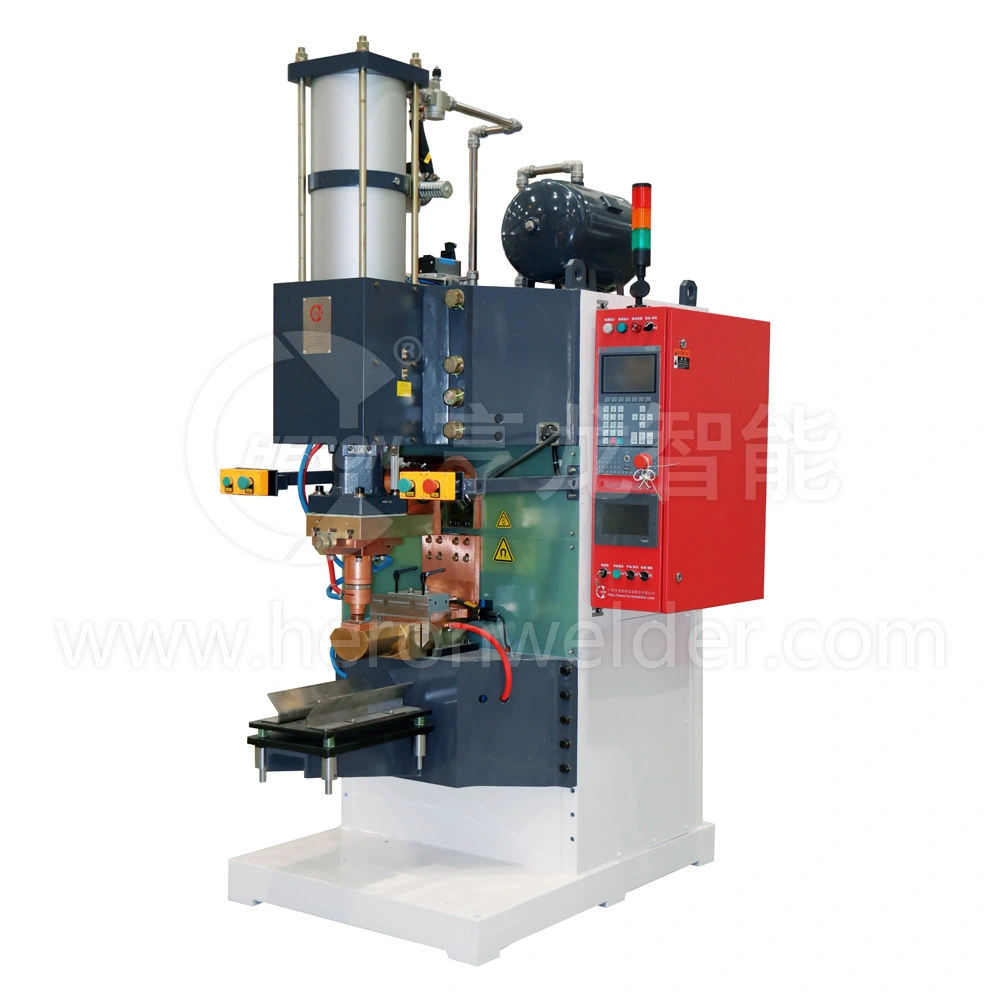
Electric resistance welding (ERW) is one of the most widely adopted joining technologies in modern manufacturing, especially where speed, repeatability, and automation are critical. For OEMs, automotive suppliers, appliance manufacturers, and industrial fabricators, ERW delivers a cost-effective and highly controllable method of joining metal components without filler materials or open flames.
At Heron Welder, this technology forms the backbone of advanced resistance welding systems including spot, projection, seam, MFDC, and automated welding production lines engineered for high-volume industrial environments.
What is Electric Resistance Welding?
Electric resistance welding is a solid-state joining process where heat is generated by the electrical resistance of metals when a high current passes through them under pressure. The heat is concentrated at the interface of the workpieces, causing localized melting or plastic deformation that forms a strong metallurgical bond.
The fundamental principle is simple:
- High current + resistance + pressure = heat generation at joint
- No filler material required
- No flux or shielding gas required
- Extremely fast cycle times
In resistance spot welding (a key subset of ERW), electrodes clamp overlapping sheets while current flows through a small contact area, forming a weld “nugget.”
The heat generated can be expressed as:
Q = I²Rt
Where:
- I = current
- R = electrical resistance
- t = time
Even a few milliseconds of controlled energy input can create a strong joint.
How Electric Resistance Welding Works (Process Breakdown)
Electric resistance welding typically follows a controlled sequence:
1. Workpiece Positioning
Metal sheets or components are precisely aligned in fixtures. Accuracy here is critical for weld consistency, especially in automated production.
2. Electrode Clamping
Copper alloy electrodes apply pressure to hold the materials together. This ensures stable electrical contact.
3. Current Application
A high-amperage, low-voltage current passes through the joint interface. Resistance at the contact point generates intense heat.
4. Weld Formation
The metal softens or melts locally, forming a weld nugget under pressure.
5. Cooling & Solidification
The current stops, pressure is maintained briefly, and the joint solidifies into a strong metallurgical bond.
This entire cycle can occur in milliseconds to a few seconds, making ERW ideal for mass production environments.
Types of Electric Resistance Welding
Modern industrial systems use different ERW variants depending on application needs:
1. Resistance Spot Welding
Used for overlapping sheet metal joints. It is widely applied in automotive body assembly and appliance manufacturing due to its speed and automation capability.
2. Resistance Seam Welding
Uses rotating wheel electrodes to create continuous weld seams, commonly used in tanks, tubes, and sealed containers.
3. Projection Welding
Uses embossed projections to localize current and pressure, ideal for nuts, bolts, and fastener welding.
4. Flash Butt Welding
Used for joining rod, rail, or bar sections through controlled flashing and forging.
Key Advantages of Electric Resistance Welding
For manufacturing engineers and production planners, ERW offers several strategic benefits:
✔ High Production Speed
Welds are completed in milliseconds, making it ideal for high-volume production lines.
✔ Automation-Friendly
Easily integrated with robotic systems, conveyors, and CNC-controlled fixtures.
✔ Clean Process
No filler wire, flux, or post-weld cleaning required.
✔ Consistent Quality
Precise control of current, force, and time ensures repeatable weld strength.
✔ Energy Efficiency (Especially MFDC Systems)
Modern MFDC (Medium Frequency Direct Current) systems improve energy control, reduce transformer size, and enhance weld stability.
Industrial Applications of Electric Resistance Welding
ERW is deeply embedded across multiple industries:
Automotive Manufacturing
- Body-in-white assembly
- Door panels, chassis components
- Battery pack welding in EV production
Appliance Manufacturing
- Washing machines
- Refrigerators
- Metal housings and frames
Electrical & Energy Sector
- Busbars and connectors
- Battery tabs
- Electrical enclosures
Heavy Industrial Fabrication
- Steel cabinets
- HVAC systems
- Structural sheet assemblies
At Heron Welder, ERW systems are engineered specifically for these high-demand environments, ensuring stable weld quality even in continuous 24/7 production.
Challenges in Electric Resistance Welding
While ERW is highly efficient, industrial users must control key parameters carefully:
- Electrode wear (affects weld consistency)
- Material variability (coated or high-strength steels require tuning)
- Heat balance control
- Joint alignment accuracy
Advanced systems like MFDC resistance welding machines help overcome these issues through real-time current control and adaptive feedback systems.
Best Practices for Stable ERW Production
To achieve high-quality resistance welds consistently:
- Maintain correct electrode force and alignment
- Optimize welding current based on material thickness
- Use proper cooling systems for electrodes
- Regularly dress or replace electrode tips
- Integrate monitoring systems for weld quality control
Automation-integrated systems significantly reduce operator dependency and improve repeatability in mass production.
Heron Welder: Engineering ERW Solutions for Industry 4.0
As a global manufacturer of industrial welding technology, Heron Welder specializes in:
- Resistance spot welding machines
- MFDC projection and seam welders
- Automated welding production lines
- Clinching and self-pierce riveting (FSPR) systems
- Custom welding guns and controllers
Our solutions are designed for OEMs and Tier-1 suppliers who demand precision, reliability, and scalable automation.
From single-station welding setups to fully automated production lines, Heron provides end-to-end resistance welding engineering support.
Frequently Asked Questions (FAQs)
1. What is electric resistance welding used for?
It is used to join metal sheets or components in automotive, appliance, electrical, and industrial manufacturing without filler materials.
2. Is electric resistance welding strong enough for structural applications?
Yes, when properly controlled, ERW joints can achieve high mechanical strength suitable for automotive and industrial use.
3. What metals can be welded using ERW?
Low-carbon steel, stainless steel, aluminum alloys, and coated steels are commonly welded with optimized parameters.
4. What is the difference between AC and MFDC resistance welding?
MFDC systems offer faster response, better energy efficiency, and more precise control compared to traditional AC systems.
5. Can electric resistance welding be automated?
Yes, it is one of the most automation-friendly welding processes and is widely used in robotic production lines.
Final Thoughts
Electric resistance welding remains a cornerstone of modern industrial manufacturing due to its speed, efficiency, and adaptability. As industries move toward smart factories and automated production systems, advanced ERW technologies especially MFDC-based solutions are becoming essential for achieving consistent weld quality at scale.
Heron Welder continues to develop high-performance resistance welding systems designed to meet the evolving needs of global manufacturers, OEMs, and automation integrators.
Ready to Upgrade Your Welding Process?
If you are looking to improve production efficiency, weld consistency, or automation capability, Heron Welder can support your project with customized electric resistance welding solutions.
Contact Heron Welder today to request a quote or consult with our engineering team for a tailored welding and automation solution.