
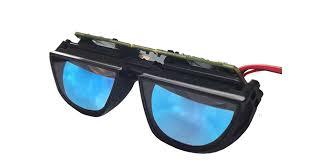
In the B2B AR/VR sector, the Birdbath optical module is favored for its ability to fold a long optical path into a compact form factor. By utilizing a 45-degree beamsplitter and a curved combiner, it allows for high-resolution Micro OLED imagery in a wearable footprint.
However, moving into 2026, the industry is hitting a "performance ceiling." Professional-grade AR requires high contrast and outdoor readability, yet many Birdbath implementations suffer from a hazy, "washed-out" image that fails to meet industrial safety standards. Here are the three primary bottlenecks and how to solve them.
1. Polarization-Induced Luminance Inefficiency
Birdbath modules rely on polarized light to manage the reflection and transmission through the beamsplitter.
The Problem: In many standard modules, there is a significant mismatch in polarization extinction ratios. Between the initial emission from the Micro OLED and the final reflection off the curved mirror, up to 50-60% of the light can be lost due to "misaligned" polarization states. This forces the display to run at maximum current, leading to thermal throttling and reduced battery life for the end-user.
The B2B Solution:
- Quarter-Wave Plate (QWP) Optimization: Ensure the QWP is laminated directly to the curved combiner with zero-gap optical bonding. This minimizes the "birefringence shift" that occurs when light passes through an air gap, drastically improving light throughput.
- S-Polarization Prioritization: Designing the optical engine to favor S-polarized light at the beamsplitter interface can improve reflection efficiency by 15-20% compared to generic P-polarized setups.
2. The "Ghosting" Ghost: Stray Light and Internal Reflections
In a Birdbath setup, light bounces between the beamsplitter and the combiner. If even a small percentage of light reflects off the "back side" of the beamsplitter, it creates a secondary, shifted image known as ghosting.
The Problem: For industrial HUDs or medical surgical overlays, ghosting isn't just an annoyance—it’s a safety hazard. Standard anti-reflective (AR) coatings often fail at the high incident angles required for wide field-of-view (FOV) Birdbath modules.
The Fix:
- Gradient-Index (GRIN) Coatings: Move away from standard multi-layer coatings to gradient-index coatings that provide consistent suppression across a wider range of incident angles (0° to 50°).
- Internal Light Baffles: Implementing sub-millimeter, laser-etched "light traps" on the non-active edges of the optical housing to absorb stray photons before they can bounce back into the exit pupil.
3. Thermal-Mechanical Alignment Stability
Because the Birdbath architecture is so sensitive to the distance between the display and the combiner, even microscopic shifts are visible.
The Problem: During extended use, the heat from the Micro OLED causes the plastic housing to expand. This thermal-mechanical drift shifts the focal plane, causing the virtual image to appear blurry or inducing "vergence-accommodation conflict," which leads to user nausea in professional training simulations.
Strategic Mitigation:
- Magnesium-Alloy Chassis: Replace plastic optical frames with die-cast magnesium or specialized "Zero-CTE" polymers. This ensures that the distance between the Micro OLED and the Birdbath optics remains constant from $0^\circ\text{C}$ to $50^\circ\text{C}$.
- Active Alignment (AA) Assembly: Utilize 6-axis robotic active alignment during the manufacturing process to lock the optical center to within $\pm5$ microns, ensuring maximum MTF (Modular Transfer Function) across the entire FOV.
Conclusion
Successful B2B integration of the Birdbath optical module requires moving past the "basic image" phase and into the "optical precision" phase. To survive the rigors of industrial and medical AR, manufacturers must prioritize polarization efficiency and thermal stability over raw lumen count. By eliminating internal ghosting and managing thermal expansion, Tier-1 suppliers can deliver AR modules that provide the razor-sharp clarity required for the next generation of professional wearables.