
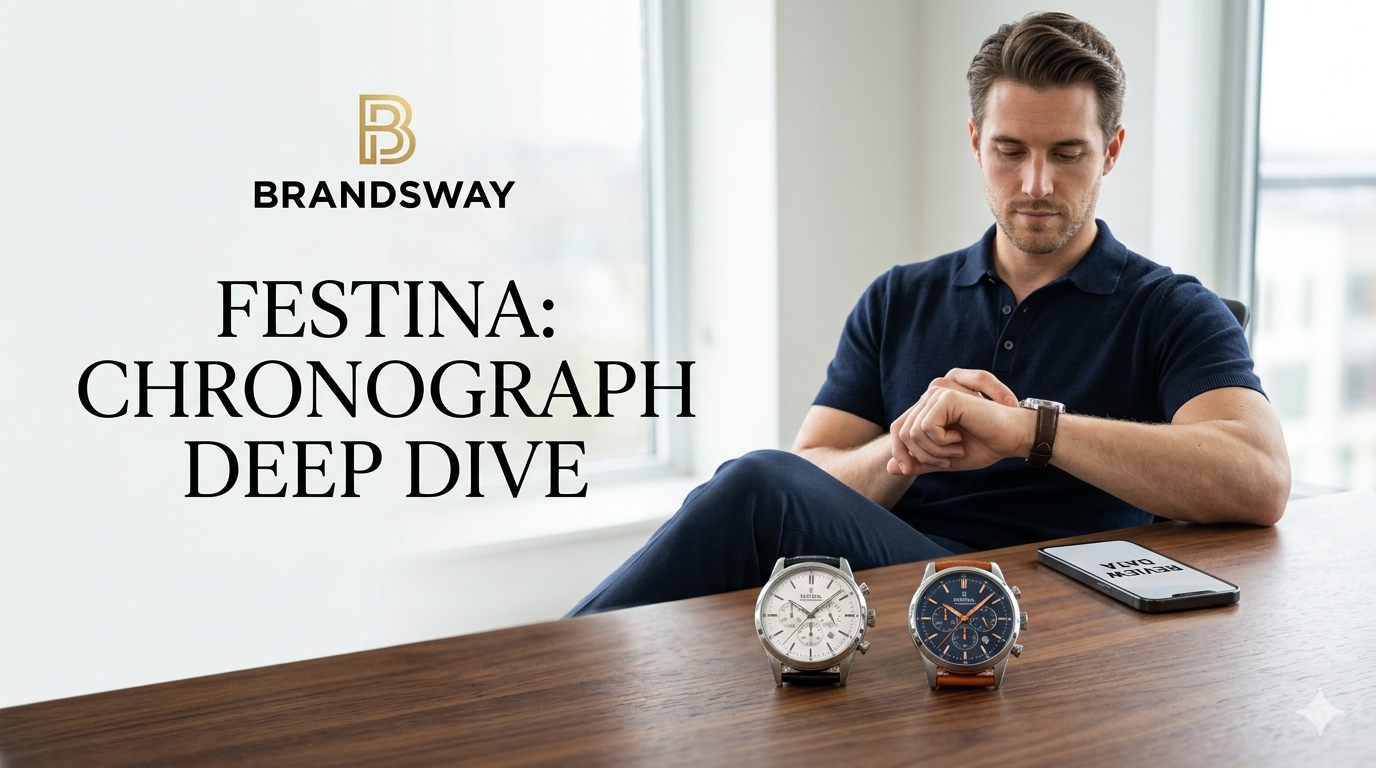
There is a misclassification that follows Festina chronographs through most of the English-language watch internet, and it is worth addressing before anything else. Festina is routinely filed under 'fashion watch' in roundups and comparison articles — placed alongside brands whose design language owes more to lifestyle marketing than to any genuine timekeeping heritage. This is incorrect, and the error costs informed buyers a real option.
Festina has been the official timekeeper of the Tour de France since 1983. The Chrono Bike series — still the brand's most recognised chronograph line — was built around the demands of professional cycling: legible sub-registers, robust pushers, and a case that doesn't snag on a jersey sleeve. The movement inside is not exotic, but the design brief was functional, not decorative. That distinction matters when you are evaluating what you are actually buying.
We carry the Festina chronograph from Brandsway, the brand's authorised Indian distributor, and have handled enough units through brandsway.in to give you an honest read on what works and what doesn't in the ₹12,000–₹22,000 range.
What the dial genuinely delivers at this price point
Festina chronograph dials in the Chrono Bike and F20 series are designed for legibility under stress — sub-registers at 3, 6, and 9 with sufficient diameter to read without squinting, applied indices rather than printed markers on most references, and a tachymeter scale around the bezel that is laser-engraved rather than printed. At under ₹20,000, applied indices are not universal across all mid-range European brands. Festina tends to include them on the chronograph line, and it shows in how the dial reads in lower light.
Case sizing runs predominantly between 43mm and 45mm for the sport chronograph references. This is a large watch by dress standards and a mainstream size by sport standards. On an average Indian male wrist — which tends to run between 16cm and 18cm in circumference — a 44mm Festina sits correctly without the lug overhang that affects some large-case watches. The bracelet integration is solid on steel-bracelet models; the rubber strap variants feel less premium but are more practical for active use.
Crown position and pusher action are things I always check first when handling a new chronograph reference. Festina's crown screws down on water-resistant models, which is good for India's monsoon conditions. The pushers engage with a satisfying click rather than a mushy compression — an indicator that the chronograph module has reasonable tolerances, even if the movement is not in-house.
Movement: what you are actually getting, and why it is fine
Festina chronographs in the India price range use Japanese quartz chronograph modules — primarily Miyota or equivalent — rather than Swiss lever-escapement movements. If you were expecting something in-house or Swiss-manufactured at ₹15,000, the answer is: not at this price point, and not from any European brand selling honestly at this level.
Quartz chronograph movements are accurate to approximately +/- 15 seconds per month, require battery replacement every 18–24 months under normal use, and are highly reliable in Indian climate conditions because they have no mechanical lubricants to degrade in humidity. The common objection — 'it's just a quartz' — misunderstands the purpose. A Festina chronograph is a European-designed, sports-heritage instrument with a reliable Japanese movement. That is exactly what it should be at ₹14,000–₹20,000.
The honest caveat: if you have already owned a Swiss-made ETA or Valjoux movement watch — a Tissot, a Hamilton, a lower-range Tag Heuer — and you are expecting that experience in a Festina, you will notice the difference in the weight and feel of the seconds hand sweep. A quartz movement produces a tick-step motion; a mechanical sweep is different. Know what you are buying before you commit.
Case finishing: above average in places, average in others
The stainless steel case finishing on Festina chronographs in the ₹15,000–₹22,000 range is a mix of brushed and polished surfaces that is well-executed on the lugs and case sides, slightly less refined on the caseback. The caseback on most Festina sport chronographs is a solid screw-back — practical for water resistance, less interesting than a display back. There is nothing to see inside, and the caseback reflects that functional choice.
Where Festina punches above its weight: the mineral crystal. Most brands in this price range use mineral glass rather than sapphire, and Festina is no exception. Mineral crystal scratches under normal daily use — keys, rough surfaces, a careless moment with a metal watchband on the opposite wrist. This is not a design flaw; it is a price-point reality. A sapphire crystal would add ₹3,000–₹5,000 to the unit cost. If scratch resistance is a priority, either choose carefully or accept periodic crystal replacement at a qualified watchmaker.
The sports heritage argument: why it matters for buyers who research
The fashion watch misclassification I mentioned at the outset has a practical consequence: it leads buyers to compare Festina chronographs against fashion-brand quartz pieces with similar dial layouts but none of the functional design history. A Festina chronograph designed around Tour de France requirements is not the same category of object as a chronograph-look fashion piece with a display back full of decorative movement parts. The functional heritage — real event timing, real cyclist wear testing, a real partnership with one of sport's most demanding competitions — gives the design discipline a coherent reason to exist.
This is the opinion I would defend: Festina chronographs are undervalued in the Indian market because of their misclassification, and buyers who do the research and buy through an authorised channel like Brandsway Lifestyle Pvt Limited tend to come away more satisfied than buyers who approached the purchase as a fashion decision. The watch rewards knowing what it is.
What to expect from Brandsway's authorised Indian channel
Every Festina chronograph available through brandsway.in comes with manufacturer warranty, sourced through official brand channels. The Brandsway team can field service and warranty queries directly — you are not navigating a third-party importer who sourced stock from a European liquidator.
The festina chronograph from brandsway arrives with documentation intact, a warranty card registered for the Indian sale, and the assurance that if a pusher spring fails within the warranty window, the claim process is local. That is not a minor administrative detail. A pusher spring repair on a mid-range chronograph costs ₹800–₹1,500 at an independent watchmaker. Through an authorised channel in the warranty period, it is covered.
In this price band, the watch is worth buying if you understand what you are purchasing: a European-designed sports chronograph with a reliable quartz movement, good dial legibility, solid water resistance, and a design rooted in professional sports timekeeping rather than lifestyle marketing. That is a real watch at an honest price. It is not a luxury piece and it does not need to pretend to be one.