
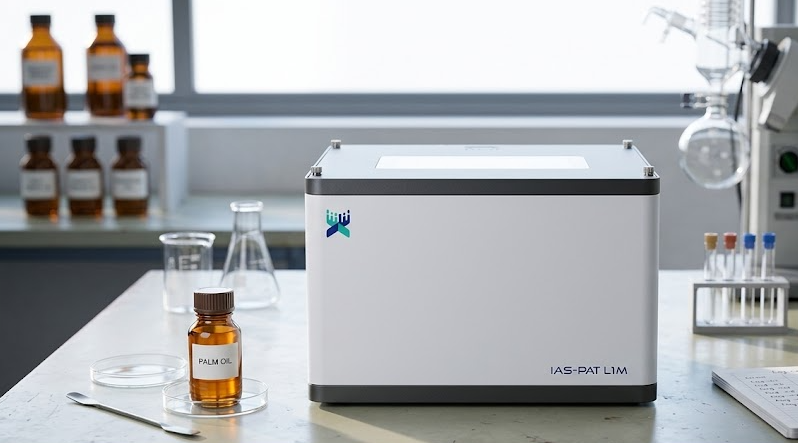
The global palm oil industry is becoming increasingly competitive, with manufacturers under constant pressure to improve production efficiency, reduce waste, and maintain consistent product quality. As processing volumes increase, relying solely on traditional laboratory testing is no longer enough to support modern manufacturing.
Conventional methods for measuring key indicators such as Free Fatty Acids (FFA) and the Deterioration of Bleachability Index (DOBI) typically involve manual sampling and laboratory analysis. While these methods can provide accurate results, they also introduce delays, increase labor requirements, and make it difficult to respond quickly when process conditions change.
To address these challenges, more palm oil producers are adopting online Near-Infrared (NIR) analyzers that provide continuous, real-time monitoring directly within the production line. One example is the IAS-PAT L1M Online NIR Analyzer, which combines laboratory-level analytical accuracy with industrial-grade durability for demanding processing environments.
Why Real-Time Monitoring Matters in Palm Oil Mills
Palm oil production involves multiple processing stages, each of which can influence the final product quality. Variations in raw materials, moisture levels, and processing conditions can quickly affect extraction efficiency and refining performance.
Without continuous monitoring, manufacturers may face problems such as:
- Rising Free Fatty Acid (FFA) levels
- Inconsistent moisture content
- Reduced oil extraction efficiency
- Increased chemical consumption during refining
- Lower product quality
- Higher operating costs
- More production downtime
An online NIR analyzer allows operators to monitor these changes as they happen, making it possible to adjust production parameters before quality problems develop.
Built for Harsh Industrial Environments
Palm oil mills are challenging places for analytical equipment. High temperatures, humidity, dust, vibration, and potentially hazardous environments require instruments designed specifically for industrial operation.
The IAS-PAT L1M Online NIR Analyzer features an explosion-proof design suitable for demanding manufacturing conditions. Its rugged construction allows installation close to critical processing equipment, including:
- Clarification systems
- Separation tanks
- Crude oil transfer pipelines
- Sludge treatment systems
Installing the analyzer directly on the production line eliminates the need for long sampling loops, reducing maintenance while improving measurement reliability.
The result is a safer working environment and more stable production control.
Flexible Optical Probes for Different Process Streams
One of the biggest challenges in palm oil processing is the wide variety of materials that require analysis.
Production facilities handle:
- Crude palm oil
- Palm kernel oil
- Pressed palm kernel cake
- Fiber-rich materials
- Wastewater streams
- Sludge and process residues
The IAS-PAT L1M addresses this challenge through modular optical probe technology.
Depending on the application, users can select probes designed for:
- Liquid process monitoring
- Solid material analysis
- High-pressure pipelines
- Abrasive production environments
Custom probe configurations are also available to match different pipe sizes, installation locations, and production layouts.
This flexibility makes the analyzer suitable for both new production lines and retrofit projects.
Real-Time Analysis of Critical Quality Parameters
Instead of waiting for laboratory reports, manufacturers can obtain continuous measurements of important production indicators.
Typical monitoring parameters include:
Free Fatty Acids (FFA)
FFA is one of the most important quality indicators in crude palm oil.
Continuous monitoring allows operators to quickly identify process changes caused by delayed fruit processing or extraction inefficiencies.
Moisture Content
Maintaining proper moisture levels is essential for product stability and storage performance.
Real-time data helps optimize clarification, drying, and storage operations.
DOBI (Deterioration of Bleachability Index)
DOBI directly affects refining performance.
Continuous monitoring allows refiners to adjust bleaching processes more accurately, reducing unnecessary chemical consumption.
Residual Oil Content
The analyzer can also measure oil remaining in palm kernel cake and other by-products.
This helps engineers identify opportunities to improve extraction efficiency and reduce production losses.
Supporting Smarter Process Control
Modern manufacturing increasingly depends on automated process control rather than manual intervention.
The IAS-PAT L1M integrates advanced chemometric models that convert NIR spectral data into practical production information in real time.
After calibration with laboratory reference data, the system continuously predicts key quality parameters throughout production.
Operators can monitor results through an intuitive interface or connect the analyzer directly to existing PLC or DCS control systems.
This enables automatic process adjustments such as:
- Steam flow optimization
- Press pressure adjustment
- Valve control
- Dryer operation
- Chemical dosing
Instead of reacting after problems occur, manufacturers can maintain stable production automatically.
Improving Efficiency While Reducing Costs
Continuous process monitoring delivers benefits beyond product quality.
By providing accurate real-time information, manufacturers can:
- Reduce laboratory testing frequency
- Lower chemical consumption
- Minimize product waste
- Improve extraction efficiency
- Increase production yield
- Reduce operating costs
- Improve process consistency
These improvements contribute directly to higher profitability and better resource utilization.
Why More Palm Oil Producers Are Choosing Online NIR Technology
As digital manufacturing becomes more common, online analytical systems are becoming an important part of modern palm oil production.
Compared with traditional laboratory analysis, online NIR technology offers several advantages:
- Continuous real-time measurements
- Faster process response
- Improved production consistency
- Reduced manual sampling
- Better process visibility
- Easier automation integration
- Lower maintenance requirements
- More efficient use of raw materials
These capabilities help manufacturers remain competitive while meeting increasingly strict quality requirements.
Final Thoughts
The palm oil industry continues to move toward smarter, more automated production. Real-time quality monitoring is becoming essential for maintaining efficiency, improving product consistency, and reducing operational costs.
The IAS-PAT L1M Online NIR Analyzer provides a practical solution by combining industrial durability with high-precision near-infrared analysis. From monitoring FFA, moisture, and DOBI to optimizing extraction efficiency and supporting automated process control, it helps manufacturers make faster, data-driven decisions throughout the production process.
For palm oil producers looking to improve yield, reduce waste, and build more intelligent processing facilities, online NIR analysis represents an important step toward the future of industrial manufacturing.
https://www.ias-glb.com/industry-news/ias-pat-l1m-online-nir-analyzer-revolutionizes.shtml