
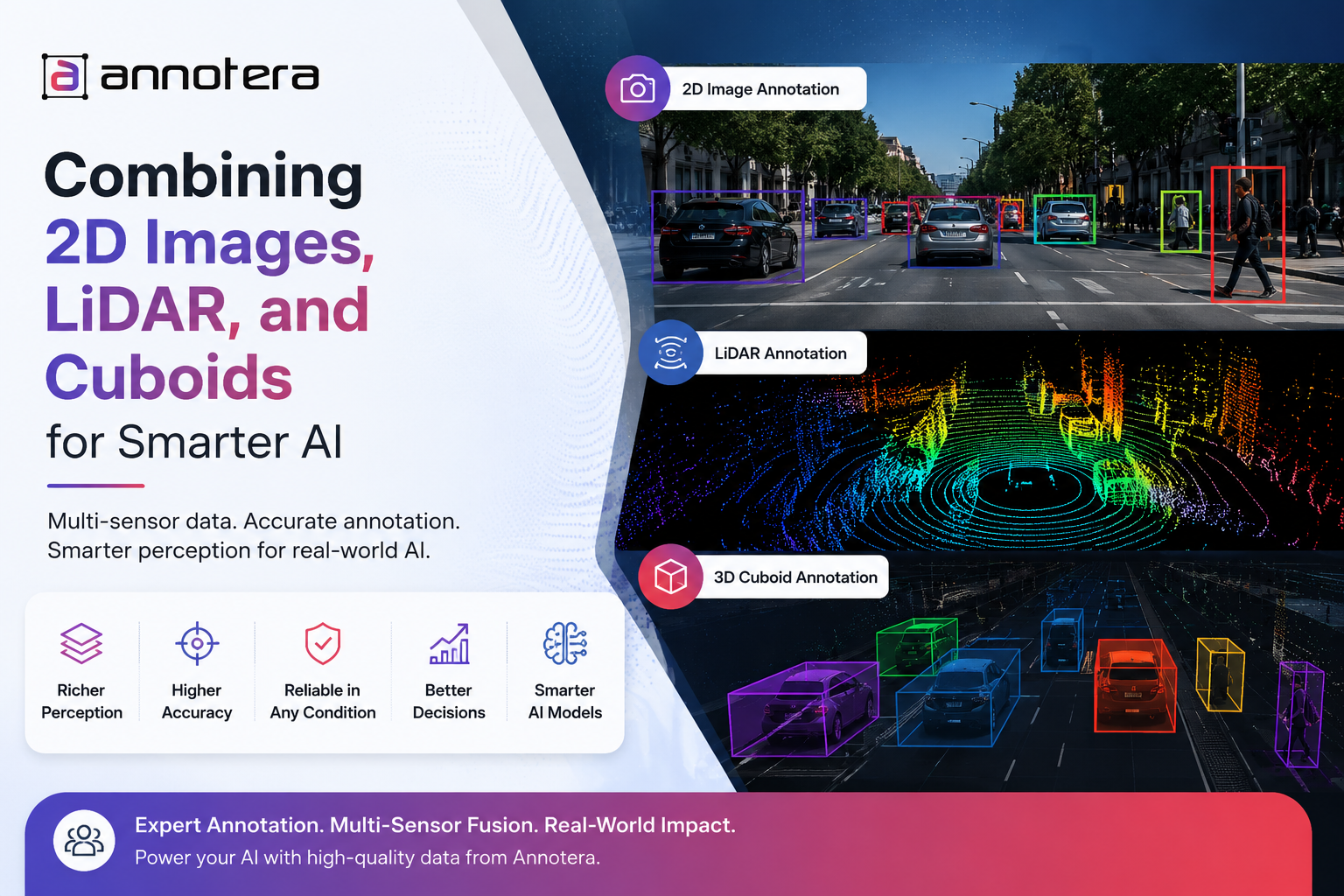
Artificial intelligence is becoming increasingly capable of understanding the physical world, but that intelligence depends heavily on the quality and diversity of its training data. Industries such as autonomous driving, robotics, smart cities, industrial automation, and warehouse logistics no longer rely on a single sensor to train computer vision models. Instead, they combine multiple data sources—including 2D camera images, LiDAR point clouds, and 3D cuboid annotation—to create highly accurate AI systems.
This multi-sensor approach allows AI models to perceive depth, distance, object boundaries, and spatial relationships with greater precision than traditional image-only datasets. However, combining these datasets also increases the complexity of annotation, making expert labeling and quality assurance more important than ever.
As a trusted data annotation company, Annotera helps AI teams create high-quality multimodal datasets by combining image annotation, LiDAR labeling, and 3D cuboid annotation into scalable annotation workflows.
Why Multi-Sensor Data Matters
Human vision naturally combines depth perception with visual context. AI models require a similar capability to perform reliably in dynamic environments.
A standard RGB camera captures textures, colors, and object appearance, while LiDAR sensors generate accurate three-dimensional measurements of the surrounding environment. When these datasets are synchronized, AI gains both semantic understanding and precise spatial awareness.
For example, an autonomous vehicle can identify a pedestrian through camera imagery while LiDAR determines the person's exact position and distance. Together, these sensors reduce uncertainty and improve decision-making.
This sensor fusion enables AI systems to:
-
Detect objects more accurately
-
Improve localization
-
Estimate depth precisely
-
Handle challenging weather conditions
-
Reduce false positives
-
Improve real-time navigation
The effectiveness of these capabilities depends entirely on well-annotated training datasets.
Understanding the Three Components
1. 2D Image Annotation
Image annotation teaches computer vision models to recognize objects within standard camera images. Depending on the project, annotations may include:
-
Bounding boxes
-
Semantic segmentation
-
Polygon annotation
-
Keypoint annotation
-
Instance segmentation
These annotations help AI recognize vehicles, pedestrians, traffic signs, machinery, retail products, medical instruments, or industrial assets.
Many organizations choose image annotation outsourcing because building internal annotation teams for large-scale datasets can significantly increase costs and slow project timelines.
Professional annotation partners ensure consistency across millions of images while maintaining strict quality standards.
2. LiDAR Annotation
LiDAR sensors generate dense point clouds representing the physical world in three dimensions.
Unlike images, LiDAR measures actual distance, making it essential for applications requiring accurate depth estimation.
LiDAR annotation involves labeling:
-
Vehicles
-
Cyclists
-
Roads
-
Buildings
-
Trees
-
Obstacles
-
Infrastructure
-
Dynamic objects
Proper point cloud annotation enables AI to understand object position, orientation, and movement.
LiDAR is particularly valuable during:
-
Night driving
-
Fog
-
Rain
-
Low-light environments
-
Construction sites
-
Industrial facilities
3. 3D Cuboid Annotation
Among all 3D labeling techniques, 3D cuboid annotation has become the industry standard for object detection in spatial environments.
Instead of drawing a simple 2D bounding box, annotators create a three-dimensional cuboid around an object.
Each cuboid captures:
-
Length
-
Width
-
Height
-
Rotation
-
Position
-
Orientation
This provides AI models with comprehensive geometric information required for real-world interaction.
Applications include:
-
Autonomous vehicles
-
Warehouse robotics
-
Drone navigation
-
Smart manufacturing
-
Agricultural automation
-
Mobile robotics
Cuboids become even more valuable when aligned with synchronized camera images and LiDAR point clouds.
How Sensor Fusion Improves AI Performance
When AI receives information from multiple synchronized sensors, it can resolve ambiguities that single-sensor systems often struggle with.
For instance, camera images may have difficulty detecting objects in poor lighting. LiDAR, however, can still identify object shapes through distance measurements.
Similarly, LiDAR alone cannot determine object texture, color, or traffic signal information—details that cameras capture effectively.
By combining both datasets with 3D cuboid annotation, AI gains:
Better Object Detection
Objects hidden from one sensor may remain visible in another.
Improved Depth Perception
LiDAR provides accurate spatial measurements that cameras alone cannot achieve.
More Reliable Tracking
Cuboids maintain object identity consistently across sequential frames.
Stronger Occlusion Handling
Multiple viewpoints allow AI to estimate partially hidden objects.
Enhanced Environmental Understanding
Combining semantic information with geometric measurements helps AI make more informed decisions.
Challenges in Multi-Modal Annotation
Although multimodal datasets improve model performance, they also introduce several annotation challenges.
Sensor Synchronization
Camera images and LiDAR point clouds must align perfectly in time.
Even slight synchronization errors can create inaccurate labels.
Calibration
Different sensors use different coordinate systems.
Annotation teams must correctly calibrate camera and LiDAR data before labeling begins.
Annotation Consistency
Every object must receive identical labels across:
-
Images
-
Point clouds
-
Sequential frames
Inconsistent annotations reduce model accuracy.
Massive Dataset Volumes
Autonomous driving projects often generate millions of synchronized images and billions of LiDAR points.
Managing these datasets requires scalable annotation operations and rigorous quality control.
This is why many AI companies invest in data annotation outsourcing to accelerate delivery without sacrificing accuracy.
Why Expert Annotation Matters
Multimodal annotation is significantly more complex than traditional image labeling.
Annotators must understand:
-
Camera geometry
-
Point cloud interpretation
-
Spatial positioning
-
Object tracking
-
Sensor calibration
-
Quality validation
Every annotation directly influences how AI models learn to interpret the physical world.
Small labeling errors can lead to:
-
Missed detections
-
Poor localization
-
Navigation failures
-
Increased model retraining
-
Lower production accuracy
An experienced data annotation company helps minimize these risks through standardized workflows, expert reviewers, and multi-level quality assurance.
How Annotera Supports Multi-Modal AI Projects
At Annotera, we provide end-to-end annotation services designed for next-generation computer vision and autonomous AI applications.
Our teams combine expertise in image labeling, LiDAR annotation, and 3D cuboid annotation to deliver training datasets that meet enterprise-quality standards.
Our capabilities include:
-
Large-scale image annotation
-
LiDAR point cloud labeling
-
Multi-sensor synchronization
-
Cuboid generation and validation
-
Object tracking across video sequences
-
Quality assurance workflows
-
Human-in-the-loop review processes
-
Scalable global delivery
Whether organizations require image annotation outsourcing for large computer vision datasets or complete data annotation outsourcing for autonomous systems, Annotera delivers accurate, consistent, and production-ready annotations that help accelerate AI development.
Conclusion
As AI systems become more intelligent, they increasingly depend on rich, multi-dimensional data rather than isolated images. Combining 2D camera imagery, LiDAR point clouds, and 3D cuboid annotation enables models to perceive the world with greater depth, context, and precision.
However, the success of these systems ultimately depends on the quality of the underlying annotations. High-quality multimodal datasets improve detection accuracy, enhance navigation, reduce model errors, and support safer real-world deployment.
Partnering with an experienced data annotation company ensures that every image, point cloud, and cuboid is labeled consistently and accurately. Through scalable data annotation outsourcing and specialized image annotation outsourcing services, Annotera empowers organizations to build smarter AI models capable of performing confidently in the most demanding real-world environments.