
Introduction
Businesses that manufacture or import products for the Indian market must understand the importance of BIS Registration. The Bureau of Indian Standards (BIS) plays a crucial role in ensuring that products sold in India meet prescribed quality, safety, and performance standards. For many product categories, obtaining BIS approval is not only beneficial but also a legal requirement. Whether you are a domestic manufacturer or a foreign exporter, knowing the BIS Full Form, the significance of the BIS Certification Mark, and the procedure to obtain a BIS Certificate Online can help you comply with regulations and build customer confidence.
What is the BIS Full Form?
The BIS Full Form is Bureau of Indian Standards. It is India's national standards body established under the Bureau of Indian Standards Act, 2016. BIS is responsible for developing Indian Standards (IS), certifying products, and promoting quality assurance across different industries. The primary objective of BIS is to protect consumers by ensuring that products available in the market meet the required quality, safety, and reliability standards.
What is BIS Registration?
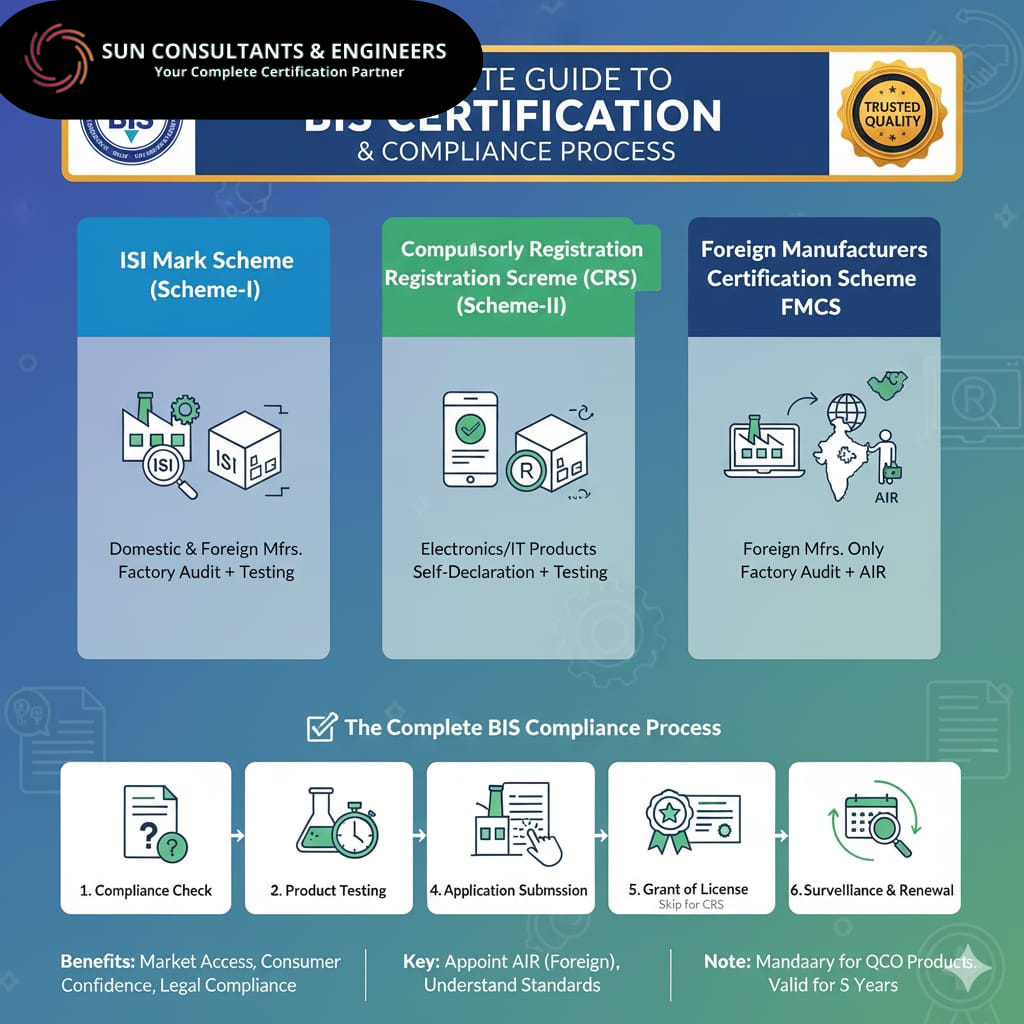
BIS Registration is the approval process through which manufacturers obtain authorization from the Bureau of Indian Standards to manufacture, import, or sell products covered under mandatory BIS regulations. Several product categories require BIS approval before they can be introduced into the Indian market. Depending on the product type, the registration may be granted under different certification schemes, including the Compulsory Registration Scheme (CRS), ISI Certification Scheme, or Foreign Manufacturers Certification Scheme (FMCS). Completing BIS Registration ensures that your products comply with Indian standards and legal requirements.
Understanding the BIS Certification Mark
The BIS Certification Mark is an official symbol issued by the Bureau of Indian Standards after successful certification of a product. This mark signifies that the product has undergone testing and meets the applicable Indian Standard.
The presence of the BIS Certification Mark provides assurance that the product offers:
- High quality
- Consumer safety
- Reliable performance
- Compliance with Indian regulations
Consumers often prefer products carrying the BIS Certification Mark because it reflects trust and quality assurance.
Why is BIS Registration Important?
Obtaining BIS Registration offers several advantages for manufacturers, importers, and consumers alike.
Some of the key benefits include:
- Legal Compliance: Many products cannot be sold in India without mandatory BIS approval.
- Improved Consumer Confidence: Certified products are viewed as safe and reliable.
- Better Market Acceptance: Businesses can expand their presence in regulated markets.
- Quality Assurance: Products comply with recognized Indian Standards.
- Business Growth: Certified products enjoy greater credibility among distributors and customers.
- Competitive Advantage: BIS-certified products often stand out from uncertified alternatives.
Who Needs BIS Registration?
Several businesses require BIS Registration, including:
- Indian manufacturers
- Foreign manufacturers exporting products to India
- Importers
- Electronics manufacturers
- Electrical appliance manufacturers
- IT equipment manufacturers
- LED lighting manufacturers
- Consumer goods manufacturers
Before launching a product in India, manufacturers should verify whether it falls under mandatory BIS certification requirements.
How to Apply for a BIS Certificate Online
The BIS Certificate Online process has made certification more efficient by allowing applicants to submit their applications digitally. Although specific procedures vary depending on the certification scheme, the general process remains similar.
Step 1: Identify the Applicable Standard
Determine the Indian Standard (IS) applicable to your product.
Step 2: Prepare Required Documents
Gather all necessary technical, legal, and manufacturing documents before applying.
Step 3: Product Testing
Submit product samples to a BIS-recognized laboratory for testing.
Step 4: Submit the Online Application
Complete the online application form and upload all required documents.
Step 5: BIS Evaluation
BIS reviews the application, test reports, and supporting documentation. Factory inspections may also be conducted depending on the certification scheme.
Step 6: Grant of Registration
Upon successful verification, BIS issues the registration certificate, allowing the manufacturer to use the BIS Certification Mark.
Documents Required for BIS Registration
The documents required may differ depending on the certification scheme, but generally include:
- Company registration certificate
- Manufacturing unit details
- Factory address
- Product specifications
- Product drawings
- Test reports
- Quality control documents
- Trademark authorization (if applicable)
- Authorized signatory details
- Product labels
Preparing complete documentation helps avoid unnecessary delays during certification.
Advantages of Applying for a BIS Certificate Online
The online certification system offers several practical benefits.
These include:
- Faster application processing
- Convenient document submission
- Online application tracking
- Improved transparency
- Reduced paperwork
- Easier communication with BIS authorities
- Efficient management of certification records
The digital process simplifies certification for both domestic and foreign manufacturers.
Common Challenges During BIS Registration
While applying for BIS Registration, businesses may encounter several challenges.
Some common issues include:
- Incorrect documentation
- Incomplete applications
- Product testing failures
- Delay in laboratory reports
- Non-compliance with applicable Indian Standards
- Factory inspection observations
Careful planning and accurate documentation significantly improve the chances of successful certification.
Tips for a Smooth BIS Registration Process
To ensure successful certification, manufacturers should follow these best practices:
- Identify the correct Indian Standard before applying.
- Ensure product testing is conducted in BIS-recognized laboratories.
- Maintain proper quality control systems.
- Submit accurate documentation.
- Keep manufacturing records updated.
- Respond promptly to BIS queries.
- Verify all application details before submission.
Following these practices helps reduce delays and improves the overall approval process.
Conclusion
Obtaining BIS Registration is an important step for manufacturers and importers looking to market regulated products in India. Understanding the BIS Full Form, the significance of the BIS Certification Mark, and the process of obtaining a BIS Certificate Online enables businesses to meet regulatory requirements while strengthening customer trust. A properly certified product not only complies with Indian standards but also enhances brand credibility, improves market acceptance, and supports long-term business growth.