
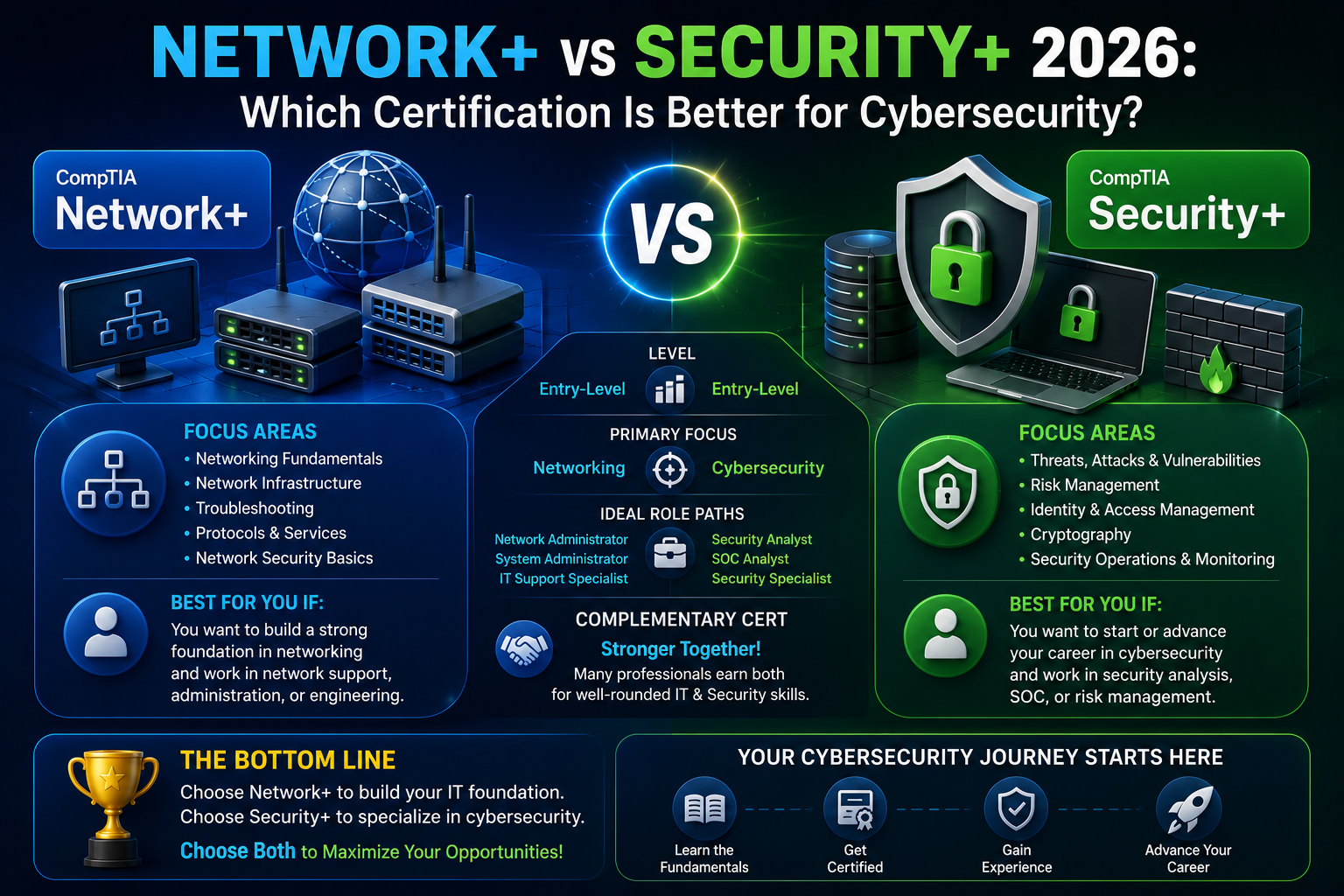
For professionals planning a career in cybersecurity, choosing the right certification can be challenging. Two of the most recognized vendor-neutral certifications from CompTIA are Network+ and Security+. While both certifications are widely respected by employers, they serve different purposes and develop different skill sets.
Many beginners wonder whether they should start with Network+ or move directly to Security+. Others already working in IT want to know which certification provides greater value for cybersecurity careers. The answer depends on your current experience, technical background, and long-term professional goals.
This guide compares Network+ and Security+ by examining their objectives, difficulty, skills, career opportunities, and how each certification supports a successful cybersecurity career in 2026.
Understanding the Purpose of Each Certification
Although both certifications belong to the CompTIA certification pathway, they focus on different areas of information technology.
CompTIA Network+ teaches networking fundamentals, infrastructure, routing, switching, wireless technologies, troubleshooting, and network operations. It provides the technical foundation needed to understand how enterprise networks function.
CompTIA Security+ builds upon those networking concepts by introducing cybersecurity principles such as identity management, risk management, threat detection, cryptography, security operations, incident response, and governance.
Rather than competing against each other, the certifications complement one another throughout a cybersecurity career.
Quick Comparison
The differences become clearer when viewed side by side.
| Feature | CompTIA Network+ | CompTIA Security+ |
| Primary Focus | Networking | Cybersecurity |
| Certification Level | Entry-Level | Entry-Level to Intermediate |
| Main Skills | Network administration | Information security |
| Best For | Networking careers | Cybersecurity careers |
| Practical Focus | Network infrastructure | Security implementation |
Both certifications are vendor-neutral and applicable across many technology environments.
Skills You Develop
Each certification emphasizes different technical competencies.
Network+ Skills
Candidates preparing for Network+ learn:
- Network architecture
- Routing and switching
- Wireless networking
- Network operations
- Troubleshooting
- IP addressing
- Network security basics
- Infrastructure management
These skills help professionals understand how devices communicate and how enterprise networks are designed.
Security+ Skills
Security+ expands beyond networking and focuses on protecting information systems.
Major learning areas include:
- Identity and access management
- Threat detection
- Cryptography
- Security architecture
- Risk management
- Incident response
- Governance
- Compliance
- Security operations
These objectives prepare professionals for defending enterprise environments against modern cyber threats.
Which Certification Is Better for Cybersecurity?
If your long-term goal is cybersecurity, Security+ generally provides more direct value because it focuses specifically on security principles and defensive technologies.
However, networking knowledge remains essential for cybersecurity professionals.
Understanding network traffic, routing, switching, protocols, and infrastructure helps security analysts investigate threats, identify vulnerabilities, and protect enterprise systems more effectively.
For this reason, many cybersecurity professionals view Network+ as a valuable foundation before pursuing Security+.
Which Exam Is More Difficult?
Most candidates consider Security+ slightly more challenging than Network+.
Network+ focuses primarily on networking technologies, while Security+ requires understanding both networking concepts and broader cybersecurity principles.
Security+ also includes more scenario-based questions involving risk management, identity management, threat response, and security decision-making.
Candidates with previous networking experience often find Security+ easier because they already understand many underlying infrastructure concepts.
Career Opportunities
Both certifications support strong IT careers, but the job roles differ.
Careers After Network+
Network+ supports positions such as:
- Network Technician
- Network Administrator
- Systems Administrator
- Technical Support Engineer
- Infrastructure Technician
Careers After Security+
Security+ prepares candidates for roles including:
- Security Administrator
- Cybersecurity Analyst
- SOC Analyst
- Security Consultant
- Incident Response Analyst
- Information Security Specialist
Professionals interested primarily in cybersecurity generally progress toward Security+ and later pursue more specialized security certifications.
Which Certification Should Beginners Choose?
The answer depends on your current experience.
Choose Network+ if you:
- Are new to IT.
- Want to understand networking first.
- Plan to build a strong technical foundation.
- Have limited networking experience.
Choose Security+ if you:
- Already understand networking fundamentals.
- Work in IT support or system administration.
- Plan to enter cybersecurity as quickly as possible.
- Want a certification focused directly on security.
Many professionals successfully earn both certifications because they develop complementary skills.
Preparation Strategy
Successful preparation combines theoretical learning with practical experience.
Candidates should:
- Review official exam objectives.
- Build small networking laboratories.
- Practice troubleshooting exercises.
- Study security concepts.
- Complete realistic practice exams.
- Review incorrect answers carefully.
Understanding why technologies work is more valuable than memorizing definitions.
Hands-on practice greatly improves confidence for both certifications.
Many candidates also strengthen their preparation using updated practice questions, realistic mock exams, and structured study resources available on this website https://certempire.com/, alongside official learning materials and practical laboratory exercises.
Long-Term Career Value
Cybersecurity continues expanding as organizations strengthen defenses against increasingly sophisticated threats.
Professionals with both networking knowledge and cybersecurity expertise remain highly valuable because they understand both the infrastructure being protected and the security technologies protecting it.
Whether you begin with Network+ or Security+, continuous learning and practical experience will remain essential throughout your career.
Conclusion
Network+ and Security+ are both excellent certifications, but they support different stages of a cybersecurity journey. Network+ builds the networking foundation needed to understand enterprise infrastructure, while Security+ develops the security knowledge required to protect that infrastructure from modern cyber threats.
If your primary goal is cybersecurity, Security+ generally provides greater direct value. However, combining both certifications creates a stronger technical foundation that supports long-term career growth across many cybersecurity roles.
FAQs
Which certification is better for cybersecurity?
Security+ is generally better for cybersecurity because it focuses on security principles, threat management, identity protection, incident response, and enterprise security operations.
Should I take Network+ before Security+?
Many beginners benefit from earning Network+ first because networking knowledge makes many Security+ concepts easier to understand during certification preparation.
Is Security+ harder than Network+?
Most candidates consider Security+ more challenging because it covers broader cybersecurity concepts in addition to networking fundamentals and includes more scenario-based questions.
Can I work in cybersecurity with only Security+?
Yes. Security+ supports entry-level cybersecurity roles, although practical experience and continued learning significantly improve long-term career opportunities.
Is networking knowledge important for cybersecurity?
Absolutely. Understanding networking helps cybersecurity professionals analyze threats, investigate incidents, identify vulnerabilities, and protect enterprise systems more effectively.
, Cybersecurity, Networking, IT Certifications, Security Careers, Cert Empire
Read More: Are Free IT Certification Exam Questions Enough to Pass Your Certification Exam?