
Digital technology powers everything from consumer electronics and telecommunications to aerospace, automotive, and industrial automation. As data speeds continue to increase, maintaining accurate signal transmission has become more challenging than ever. Even a small transmission error can affect the overall performance of a system, making quality testing an essential part of product development. This is where Bit error rate testing for digital systems plays a critical role by measuring how accurately data travels between devices.
Understanding Bit Error Rate Testing
Bit Error Rate (BER) is the ratio of incorrectly received bits to the total number of transmitted bits over a communication channel. BER testing evaluates the integrity of digital signals by identifying transmission errors that occur because of noise, interference, signal degradation, or hardware limitations.
The lower the bit error rate, the more reliable the communication system becomes. Engineers use BER testing throughout the design, validation, and production stages to ensure products meet performance expectations before reaching the market.
Why BER Testing Matters
Modern digital systems transfer enormous amounts of data at incredibly high speeds. As transmission rates increase, systems become more sensitive to signal integrity issues. BER testing helps engineers detect hidden problems before they cause failures in real-world applications.
Some key benefits include:
- Verifies communication accuracy
- Detects signal degradation
- Evaluates channel reliability
- Reduces product failures
- Improves customer satisfaction
- Supports compliance with industry standards
- Enhances long-term system performance
Without comprehensive BER testing, even advanced hardware may experience unexpected communication failures.
Industries That Depend on BER Testing
Bit error rate testing is widely used across numerous industries where dependable digital communication is essential.
These industries include:
- Telecommunications
- Data centers
- Consumer electronics
- Automotive electronics
- Aerospace and defense
- Medical devices
- Semiconductor manufacturing
- Industrial automation
- High-speed networking
- Research laboratories
Every sector relies on accurate data transmission to maintain operational efficiency and system safety.
Common Causes of Bit Errors
Bit errors can occur due to several factors affecting signal quality. Understanding these causes helps engineers improve system reliability.
Some common reasons include:
- Electrical noise
- Crosstalk between signal lines
- Impedance mismatch
- Clock timing issues
- Poor PCB design
- Signal attenuation
- Electromagnetic interference
- Connector defects
- Cable quality problems
- Temperature variations
Identifying these issues early reduces troubleshooting costs later in development.
The BER Testing Process
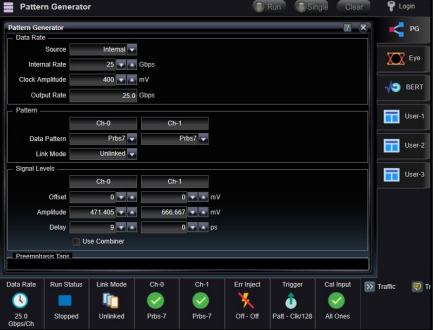
A standard BER test involves transmitting a known pattern of digital bits from a signal generator to the device under test. The receiver compares the incoming data against the original pattern and counts any mismatched bits.
The testing process generally includes:
- Generating test patterns
- Sending data through the communication channel
- Receiving transmitted data
- Comparing transmitted and received sequences
- Calculating the bit error rate
- Recording performance under different operating conditions
This structured process helps engineers evaluate communication quality with high precision.
Importance of High-Speed Signal Integrity
As communication standards evolve, maintaining signal integrity becomes increasingly difficult. Technologies such as PCIe, Ethernet, USB, DDR memory, and high-speed serial interfaces require exceptional signal quality to operate correctly.
Bit error rate testing for digital systems enables engineers to validate these interfaces under realistic operating conditions. Testing ensures that devices maintain consistent performance even at maximum data rates.
Reliable BER measurements help optimize designs before mass production begins.
How BitWise Laboratories Supports Advanced Testing
BitWise Laboratories provides advanced testing solutions designed to help engineers evaluate high-speed digital communication with confidence. Their expertise covers signal integrity analysis, BER measurements, protocol validation, and high-performance test methodologies.
Using modern instrumentation and proven engineering practices, BitWise Laboratories assists customers in identifying communication issues quickly and accurately. Their testing capabilities help organizations reduce development time while improving product quality.
Whether developing networking equipment, embedded systems, semiconductor devices, or communication hardware, comprehensive BER testing contributes to successful product deployment.
Best Practices for Effective BER Testing
To achieve reliable results, engineers should follow proven testing practices.
These include:
- Use calibrated test equipment.
- Test under multiple operating conditions.
- Evaluate different data patterns.
- Monitor environmental factors.
- Verify clock synchronization.
- Analyze signal integrity alongside BER measurements.
- Repeat tests for consistency.
- Document all testing parameters.
Following these practices produces dependable data for engineering decisions.
Future Trends in BER Testing
As artificial intelligence, cloud computing, 5G, and next-generation networking continue to grow, digital systems will operate at even faster speeds. Future communication technologies demand increasingly accurate testing methods capable of detecting extremely small error rates.
Advanced automation, machine learning-assisted analysis, and smarter testing platforms will further improve BER testing efficiency. Companies investing in reliable validation today will be better prepared for tomorrow's high-performance digital systems.
Conclusion
Reliable digital communication is the foundation of today's connected world. Even minor transmission errors can reduce performance, increase maintenance costs, and affect customer satisfaction. Bit error rate testing helps engineers verify signal integrity, improve product reliability, and identify communication issues before products reach the market.
With technical expertise and advanced testing capabilities, BitWise Laboratories supports organizations in developing dependable, high-speed digital systems that meet demanding industry requirements. Investing in comprehensive BER testing leads to stronger designs, improved product quality, and long-term operational success.
Frequently Asked Questions
What is Bit Error Rate testing used for?
Bit Error Rate testing measures the accuracy of digital data transmission by identifying errors that occur during communication. It helps engineers validate system reliability, improve signal integrity, and ensure high-performance operation across networking, semiconductor, automotive, aerospace, and industrial digital systems.