
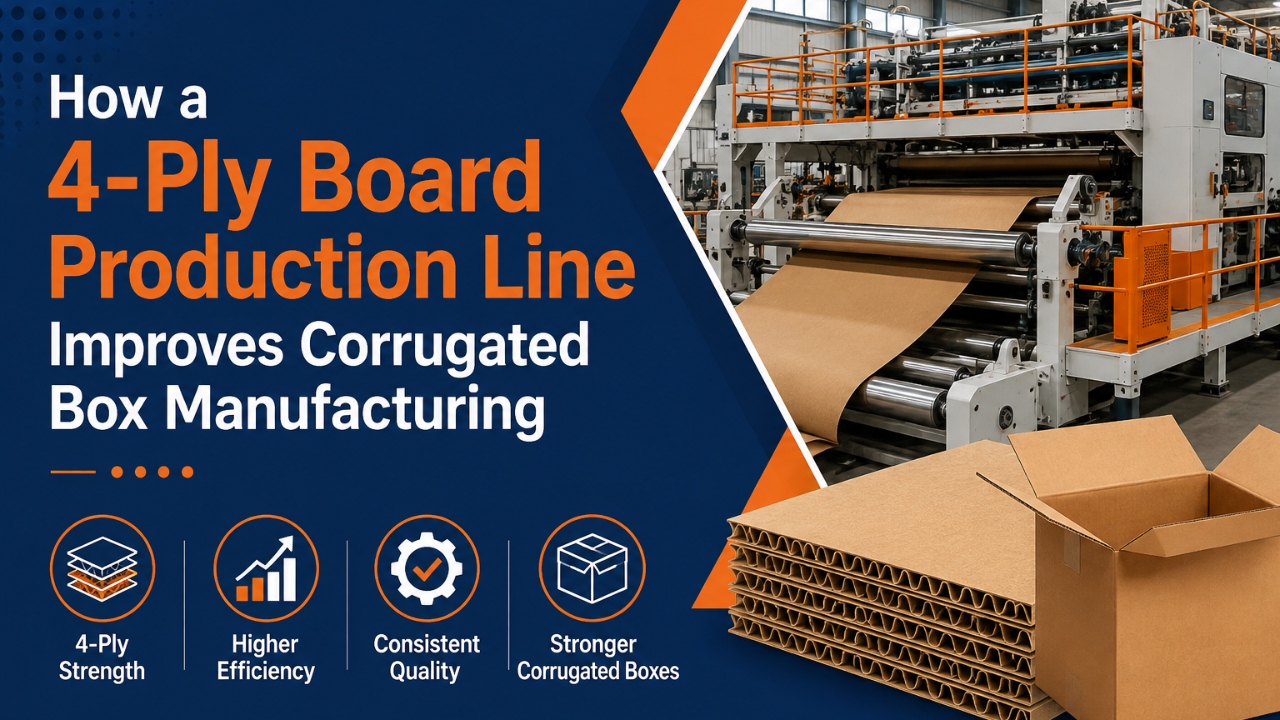
Most corrugated box manufacturers know 3 ply and 5 ply board production well.
But there is a third option that is changing how packaging plants operate. One that delivers better board strength, lower production cost, and smarter material use than conventional board making.
If you have not looked closely at 4 ply board production yet, this article is for you. Here is exactly what it is, how it works, why it improves corrugated box manufacturing, and why more packaging plants across India and globally are adding this capability to their production lines.
1. What Is a 4-Ply Board Production Line
Understanding the Structure
Before getting into the benefits, it helps to understand what 4 ply corrugated board actually is.
Standard corrugated board comes in two common configurations:
3 Ply (Single Wall): One fluted medium layer between two flat liner sheets. Three layers total. Lightweight. Used for standard consumer goods, e-commerce, and retail packaging.
5 Ply (Double Wall): Two fluted medium layers with three flat liner sheets. Five layers total. Heavy-duty. Used for industrial goods, appliances, and export packaging.
4 Ply Board sits between these two. It has two liner sheets and two medium layers but in a configuration that produces a stronger, more rigid board than 3 ply while using less material than a full 5 ply board.
How the Production Line Works
A 4-Ply Board Production Line produces this board through a precision-controlled process. Paper rolls feed into the line. Fluted layers are created and bonded with liner sheets using heat, pressure, and adhesive. The result is a 4 ply corrugated board that offers superior strength-to-weight ratio compared to conventional board configurations.
The production line integrates multiple stages including single facing, bonding, drying, and cutting into one continuous, efficient process.
2. The Problem with Conventional Board Production
Why 3 Ply and 5 Ply Do Not Always Fit
Both 3 ply and 5 ply production have limitations that packaging manufacturers deal with every day.
The 3 Ply Gap 3 ply board is strong enough for light to medium loads. But when clients need to package heavier or more fragile goods, 3 ply does not provide sufficient compression strength or stacking performance. Manufacturers then have to step up to 5 ply.
The 5 Ply Excess 5 ply board delivers strong performance but at a higher material cost. It uses significantly more paper than 3 ply. For goods that need something stronger than 3 ply but do not require the full strength of 5 ply, producing 5 ply boxes means using more material than necessary. That excess material cost adds up every month.
The Market Gap Many packaging applications fall in between. Medium-weight goods. Moderately fragile items. Export cartons that need better performance than 3 ply but do not justify the full 5 ply material cost.
4 ply board fills this gap precisely. It delivers the right strength for a wide range of applications while keeping material consumption lower than 5 ply production.
3. How a 4-Ply Board Production Line Improves Manufacturing
3.1 Better Board Strength for Medium-Heavy Applications
A 4-Ply Board Production Line produces boards with significantly better compression strength and stacking performance than 3 ply board.
This matters because stacking strength is one of the most critical performance parameters for corrugated boxes. Boxes used in warehouses, distribution centres, and during export shipments are stacked under load for extended periods. A box that cannot hold its shape under stacking pressure causes product damage and client complaints.
4 ply board delivers the stacking strength that many medium-heavy applications need without the full material cost of 5 ply production.
3.2 Reduced Material Cost Per Box
This is where the 4 ply board production advantage becomes very clear in financial terms.
A 4 ply board uses less paper than a 5 ply board. For packaging applications where 5 ply is currently being used but where the full strength of 5 ply is not actually needed, switching to 4 ply production reduces paper consumption per box without compromising the performance the application requires.
Less paper per box means lower raw material cost per box. At high production volumes, this reduction in paper consumption translates into significant monthly savings.
Natraj Machines' NTJ-4PNC 4-Ply Board Production Line features globally patented no-crush technology that enables manufacturers to save up to 15% per ton through reduced paper, glue, fuel, and floor space requirements. For a plant producing large volumes daily, this saving is substantial.
3.3 Lower Adhesive and Fuel Consumption
4 ply board production with advanced technology also reduces adhesive and fuel consumption compared to conventional 5 ply production.
Less adhesive per unit of board means lower adhesive cost per box. Lower fuel consumption in the drying and bonding process means lower energy cost per metre of board produced.
These reductions compound over time. A plant producing 10,000 square metres of board per day sees significant savings on adhesive and energy costs every month when running 4 ply production efficiently.
3.4 Improved Paper Utilisation
One of the less discussed advantages of a well-designed 4-Ply Board Production Line is better paper utilisation.
Paper waste in corrugated board production comes from several sources: startup and shutdown waste, trim waste, and defective board that cannot be converted into boxes.
Advanced 4 ply production lines with precision controls and no-crush technology produce more usable board per roll of paper. Less waste per roll means more boxes per ton of paper purchased. Better paper utilisation directly improves your production economics.
3.5 Stronger Boards Without Heavier Paper
Here is a technical advantage that matters for packaging performance.
Conventional board production sometimes requires heavier GSM paper to achieve the required board strength. Heavier paper costs more per roll. It also adds to the finished box weight, which can increase shipping costs for clients who pay freight by weight.
The no-crush technology in Natraj Machines' 4-Ply Board Production Line produces stronger boards without requiring heavier paper grades. The technology preserves the flute structure during the bonding process, maintaining the full compression strength that the fluted layer provides.
This means you can produce stronger boxes using standard paper grades rather than having to upgrade to heavier, more expensive paper.
3.6 Optimised Floor Space
A 4-Ply Board Production Line is designed for efficient floor space use. Producing board that would otherwise require a separate 5 ply line in a more compact footprint means more production per square metre of factory floor.
For plants operating in locations where factory space is limited or expensive, this space efficiency is a meaningful operational advantage.
4. What Applications Benefit Most from 4-Ply Board
4.1 Medium-Heavy Consumer Goods
Household appliances, kitchenware, tools, sporting goods, and similar medium-weight consumer products benefit from 4 ply packaging. Stronger than 3 ply. More cost-efficient than 5 ply.
4.2 E-Commerce Heavy Shipments
As e-commerce order values increase and consumers buy larger, heavier items online, the packaging must keep up. 4 ply boxes provide better protection for heavy e-commerce shipments than 3 ply while keeping packaging cost lower than 5 ply.
4.3 Industrial Components
Auto parts, electrical components, hardware, and similar industrial goods need packaging that can handle handling, stacking, and transport without deforming. 4 ply board delivers this performance for a wide range of industrial component applications.
4.4 Agricultural Export Packaging
Export grade agricultural packaging needs to perform under the stress of long transit times, varied climate conditions, and rough handling. 4 ply board provides the strength and rigidity that many agricultural export applications require.
4.5 Pharmaceutical Secondary Packaging
Pharmaceutical bulk shipments need secondary packaging that maintains its integrity throughout the supply chain. 4 ply board provides the compression strength and structural integrity that pharma secondary packaging requires.
5. How It Fits into Your Corrugated Box Making Machinery Line
5.1 Integration with Existing Converting Machines
One of the practical advantages of a 4-Ply Board Production Line is that the board it produces is compatible with standard downstream corrugated box making machinery.
Your existing flexo printer slotter, folder gluer, stitching machine, slitter scorer, and sheeting machine can all work with 4 ply board without major modification in most cases. This means adding a 4 ply board production line to an existing plant does not require replacing your full converting line.
5.2 Expanding Your Product Range
Adding a 4-Ply Board Production Line to your corrugated box plant expands the range of products you can offer clients.
You move from offering only 3 ply or 5 ply boxes to offering a third option that fills the performance and cost gap between them. This expanded product range makes you a more complete supplier for clients with varied packaging requirements. It reduces the chance of clients going to a competitor for boxes you cannot currently produce.
5.3 Competing for Higher Value Orders
4 ply boxes command better prices than 3 ply boxes. Adding 4 ply capability to your corrugated box plant means you can compete for orders from clients who currently buy from suppliers offering premium board configurations.
Industrial clients, export-focused businesses, and high-value consumer goods manufacturers are all potential new clients for a plant that adds 4 ply board production capability.
6. The Natraj Machines NTJ-4PNC 4-Ply Board Production Line
6.1 Globally Patented No-Crush Technology
Natraj Machines, one of India's leading corrugated box making machine manufacturers, has developed the NTJ-4PNC 4-Ply Board Production Line with globally patented no-crush technology.
This technology addresses one of the core challenges in corrugated board production: maintaining flute height during the bonding process. In conventional production, the pressure applied during bonding can crush the fluted layer, reducing its height and with it the compression strength of the finished board.
No-crush technology prevents this. The flute structure is preserved through the bonding process. The result is a stronger board that uses standard paper grades and delivers the full compression strength that the board structure is capable of providing.
6.2 Up to 15% Savings Per Ton
The NTJ-4PNC line saves manufacturers up to 15% per ton through reduced consumption of paper, glue, and fuel, as well as lower floor space requirements.
For a plant producing significant volumes of corrugated board daily, this saving represents a substantial reduction in monthly operating cost. The savings compound over the life of the machine, delivering strong long-term return on investment.
6.3 Built on Decades of Manufacturing Experience
Natraj Machines is headquartered in Palwal, Haryana, and has been manufacturing corrugated box making machinery for decades. ISO 9001:2008 certified, the company produces over 100 types of corrugating machines and serves packaging manufacturers across India and international markets.
Their 4-Ply Board Production Line is not an experimental product. It is built on the same engineering expertise and manufacturing standards that have made Natraj Machines one of India's most trusted corrugated packaging machinery manufacturers.
6.4 Complete Turnkey Support
Beyond the machine itself, Natraj Machines provides complete turnkey support for plant owners adding 4 ply capability. This includes machinery consultation, customised plant planning, installation, commissioning, operator training, preventive maintenance, spare parts supply, and comprehensive after-sales support.
This end-to-end approach means your corrugated box plant gets up and running on 4 ply production faster and more smoothly than if you were working with a supplier who only handles the machine sale.
7. Is a 4-Ply Board Production Line Right for Your Plant
7.1 Signs Your Plant Would Benefit
Your plant is a strong candidate for adding a 4-Ply Board Production Line if:
You currently produce 5 ply boxes for applications where the full 5 ply strength is not required. Your clients have started asking for packaging that performs better than your current 3 ply production. You are losing orders to competitors who offer a broader range of board configurations. Your paper and adhesive costs are higher than you would like and you are looking for ways to reduce them without compromising box quality. You want to expand your client base into industrial, export, or medium-heavy consumer goods markets.
7.2 Questions to Ask Before You Invest
Before investing in a 4 ply board production line, ask your corrugated box making machine manufacturers these questions:
Is the line compatible with my existing downstream converting machines? What paper grades does the line work with? What is the line's output speed and how does it match my current production volumes? What are the power, space, and infrastructure requirements? What training and after-sales support is included? What is the realistic payback period based on my current production volumes and raw material costs?
Final Thoughts
The 4-Ply Board Production Line is not a niche product for specialised applications. It is a practical, cost-efficient production capability that improves corrugated box manufacturing for a wide range of plants and client types.
It fills the gap between 3 ply and 5 ply production. It reduces raw material cost. It improves board strength without heavier paper. It saves on adhesive and energy. And it expands the range of clients and orders your plant can serve.
For corrugated box manufacturers looking to improve their production economics and expand their market reach, adding 4 ply board production capability is worth serious consideration.
Natraj Machines' NTJ-4PNC line, with its globally patented no-crush technology and proven savings of up to 15% per ton, represents one of the most technically advanced and economically compelling options available from Indian corrugated box making machine manufacturers today.