
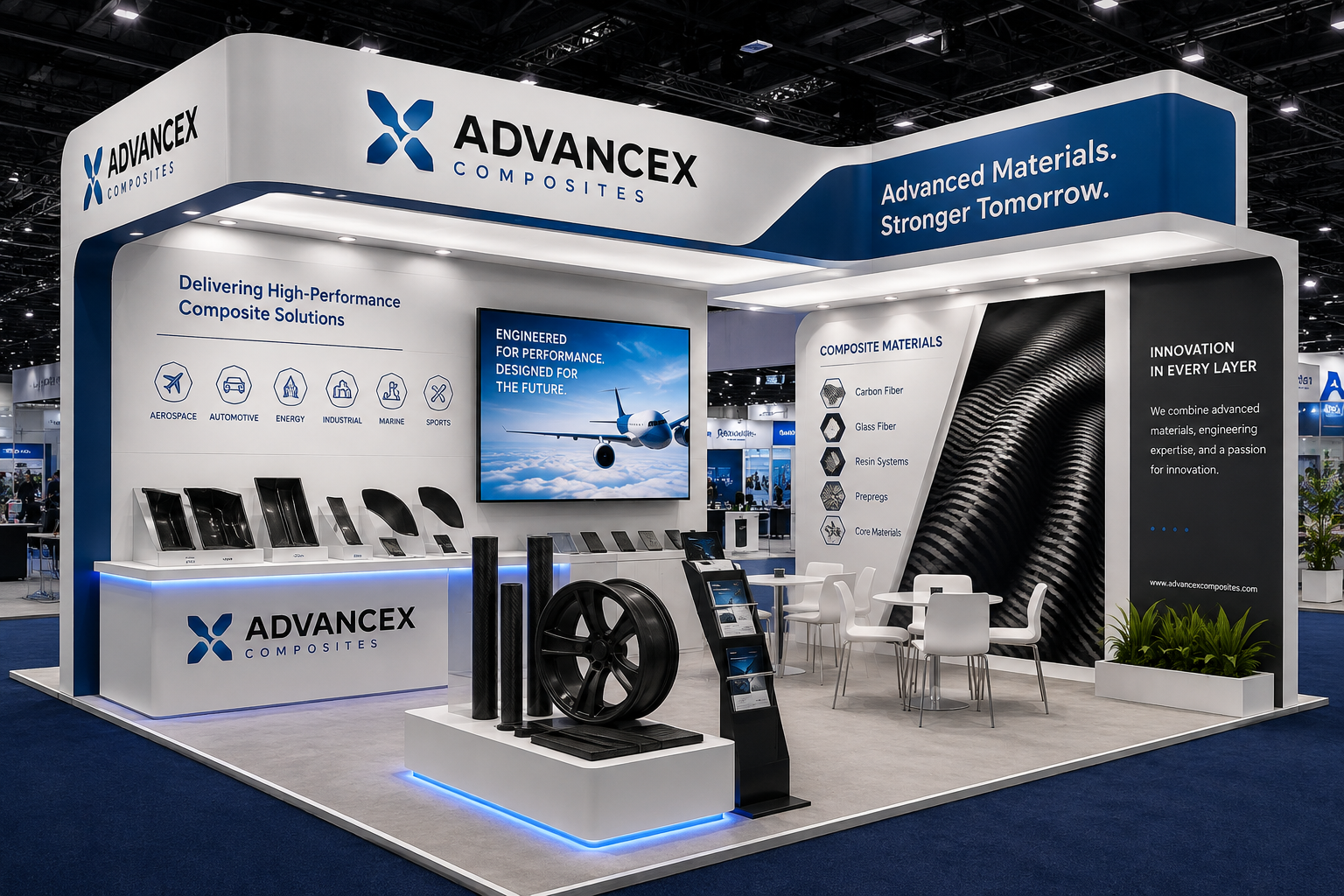
Exhibiting at a major industry event such as CAMX 2026 gives composites and advanced materials companies an opportunity to connect with engineers, manufacturers, researchers, procurement professionals, and other decision-makers. But with hundreds of exhibitors competing for attention, simply having a booth is not enough. A thoughtful Composites trade show booth design can help your company communicate complex products clearly, attract qualified visitors, and create meaningful conversations from the moment attendees enter the exhibit hall.
Why Booth Design Matters in the Composites Industry
Trade shows in technical industries are different from consumer-focused exhibitions. Visitors often arrive with specific technical questions, purchasing requirements, manufacturing challenges, and performance expectations.
A composites company may need to showcase carbon fiber, glass fiber, resin systems, prepregs, tooling, automated manufacturing equipment, testing technology, software, or finished components. Each product can involve complicated specifications that cannot always be explained through a simple banner.
Your booth therefore becomes an important communication tool.
A strong design should answer three questions quickly:
-
What does your company offer?
-
Why does your solution matter?
-
How can visitors learn more?
When these answers are visible and easy to understand, attendees have a reason to stop.
Understand Your CAMX Audience
Before selecting colors, graphics, furniture, or display technology, identify who you want to attract.
CAMX brings together professionals from areas such as aerospace, automotive, transportation, defense, construction, energy, manufacturing, and research. According to the CAMX booth-builder information published by Exhibitorly, the event attracts engineers, materials scientists, manufacturing professionals, procurement leaders, and other technical decision-makers.
This audience is usually interested in substance.
They want to understand performance, applications, manufacturing processes, durability, efficiency, cost benefits, and technical capabilities.
That means your booth should balance visual appeal with technical credibility.
Start With a Clear Booth Strategy
A successful booth begins before the first sketch is created.
Determine your primary exhibition goals. Are you launching a new material? Demonstrating manufacturing technology? Generating leads? Meeting existing customers? Building partnerships? Educating the market?
Your objective should influence every part of the booth.
For example, a company launching a new composite material may need a prominent product display and demonstration area. A software provider may need interactive screens and private meeting spaces. An equipment manufacturer may require substantial floor space for machinery demonstrations.
When your design reflects your objective, your booth becomes more purposeful.
Create a Strong First Impression
Visitors make quick decisions about whether to approach an exhibit.
Your booth should therefore communicate your brand from several feet away.
Large, clean graphics can help visitors identify your company without forcing them to read large blocks of text. Use a concise headline that explains your value proposition.
Instead of saying:
“Advanced Composite Material Solutions”
consider a more benefit-focused statement such as:
“Lightweight Materials Engineered for Next-Generation Mobility.”
The second statement gives visitors a better reason to investigate.
Use Graphics to Simplify Technical Information
Composites products can be highly technical. Unfortunately, technical information can easily become overwhelming when presented incorrectly.
Avoid covering every wall with paragraphs, specifications, and diagrams.
Instead, organize information into visual layers.
Layer One: Brand Message
This should be visible from the aisle.
It can include your company name, logo, primary message, and key differentiator.
Layer Two: Product Categories
Show visitors what you actually provide.
For example:
-
Carbon fiber materials
-
Glass fiber systems
-
Resin technologies
-
Prepreg solutions
-
Manufacturing equipment
-
Testing and inspection
-
Simulation software
-
Finished composite components
Layer Three: Technical Details
Once visitors enter the booth, provide deeper information through product sheets, interactive displays, samples, videos, and conversations with technical representatives.
This approach allows casual visitors and highly technical prospects to engage at different levels.
Showcase Real Composite Materials
One of the biggest opportunities for a composites exhibitor is physical product presentation.
Whenever possible, let attendees see and touch representative materials.
Material samples can make an abstract technology tangible. Instead of merely explaining the construction of a composite panel, show its layers. Instead of describing surface finishes, display actual samples.
You can also use:
-
Material cross-sections
-
Finished components
-
Cutaway models
-
Prototype parts
-
Process samples
-
Before-and-after comparisons
-
Application-specific components
These displays can become conversation starters.
Build Demonstrations Into the Booth
Demonstrations are particularly effective when your product involves a process.
Visitors may understand a manufacturing solution much faster when they can see it operating.
Depending on your product, consider demonstrations involving:
-
Automated composite manufacturing
-
Material testing
-
Lamination
-
Resin processing
-
Inspection
-
Simulation software
-
Robotics
-
Digital manufacturing
-
Quality-control systems
However, demonstrations should be planned carefully.
A machine or technical demonstration that creates excessive noise, congestion, or safety concerns can negatively affect the visitor experience. Your booth builder should understand how to integrate demonstrations into the overall layout.
Design for Technical Conversations
At CAMX, visitors may need more than a two-minute introduction.
Engineers and procurement professionals may want to discuss specifications, applications, production volumes, certifications, integration requirements, or pricing.
That makes meeting space essential.
Your booth could include:
Open Conversation Areas
These are useful for short discussions and initial introductions.
Semi-Private Meeting Areas
These provide additional privacy without completely closing the space.
Private Meeting Rooms
Larger exhibitors with complex sales cycles may benefit from enclosed rooms for confidential discussions and detailed presentations.
The key is balance.
Too many enclosed rooms can make your booth appear inaccessible. Too little meeting space can leave your team struggling to accommodate serious prospects.
Make Your Booth Easy to Navigate
A visually impressive booth can still fail if visitors don't know where to go.
Create logical zones.
For example:
Zone 1: Brand and welcome area
Zone 2: Featured product display
Zone 3: Interactive demonstration
Zone 4: Technical information
Zone 5: Meeting area
Zone 6: Lead-capture station
This structure helps visitors move naturally through the experience.
For larger island booths, maintaining clear sightlines is particularly important. Visitors should be able to see key products and messages from multiple directions.
Use Lighting Strategically
Lighting is more than decoration.
It can direct attention toward your most important products and create visual hierarchy.
Consider brighter focused lighting for:
-
Product samples
-
Featured machinery
-
Demonstration stations
-
New product displays
-
Brand messaging
Ambient lighting can establish the overall atmosphere, while accent lighting highlights specific features.
Avoid excessive lighting effects that distract from the technical nature of your presentation.
Incorporate Digital Technology
Technology can help explain complicated composite applications.
Large screens can display manufacturing processes, animations, simulations, product applications, and customer case studies.
Interactive touchscreens can allow visitors to explore:
-
Material specifications
-
Product configurations
-
Application examples
-
Performance data
-
Manufacturing processes
-
Technical documentation
But technology should have a purpose.
Adding screens simply because they look modern does not necessarily improve engagement. Every digital element should help visitors understand your product or take the next step.
Tell a Story With Your Booth
Think of your exhibit as a physical story.
A visitor should ideally move through a sequence:
Problem → Material → Technology → Application → Benefit → Conversation
For example, your booth might begin with an industry challenge such as weight reduction. Then introduce your composite solution, demonstrate its manufacturing process, show an application in an aerospace or automotive component, explain the performance advantage, and finally invite visitors to discuss their requirements.
This storytelling structure makes technical information easier to remember.
Keep the Design Visually Professional
Technical companies sometimes make the mistake of assuming that more information automatically means more credibility.
It doesn't.
Professionalism often comes from restraint.
Use consistent typography, strong spacing, high-quality graphics, and a limited visual hierarchy. Avoid cluttered displays and overly complicated messaging.
Your booth should look engineered rather than improvised.
This is particularly important for composites companies because the exhibit itself can reinforce the perception that your company is precise, innovative, reliable, and technically capable.
Highlight Applications, Not Just Products
Visitors are often more interested in what a product can accomplish than what it is called.
Instead of simply displaying:
“Carbon Fiber Sheet”
consider showing:
“Carbon Fiber Sheet for Lightweight Structural Applications.”
Then demonstrate where the material can be used.
Application-focused messaging can include industries such as:
-
Aerospace
-
Automotive
-
Marine
-
Wind energy
-
Infrastructure
-
Sporting goods
-
Industrial manufacturing
-
Defense
Showing the connection between your material and its real-world application makes the exhibit more relevant.
Design for Different Visitor Types
Not every CAMX visitor will want the same information.
A procurement manager may want pricing, supply capacity, lead times, and reliability.
An engineer may want technical specifications and performance information.
A researcher may want to understand material characteristics and innovation.
A manufacturing manager may focus on production efficiency and integration.
Your booth should provide multiple ways to engage.
Use large messaging for quick understanding, product displays for visual learners, technical documents for deeper research, and knowledgeable staff for detailed conversations.
Make Lead Capture Simple
A beautiful booth does not automatically produce valuable leads.
Lead capture should be integrated into the visitor experience.
Instead of immediately asking every attendee to fill out a long form, train staff to identify visitor needs first.
Questions can include:
-
What type of composite applications are you currently working on?
-
Are you evaluating a new material or manufacturing process?
-
What challenges are you trying to solve?
-
Are you looking for a supplier or technology partner?
-
What stage is your project currently in?
These questions can help your team determine whether a visitor is a general information seeker or a high-value prospect.
Choose the Right Booth Builder
Your booth builder plays a major role in turning the design concept into reality.
For a specialized event such as CAMX, general trade show experience may not be enough. Your contractor should understand technical exhibitions, product displays, demonstrations, meeting requirements, freight planning, installation, and venue regulations.
Exhibitorly notes that CAMX exhibitors should look for booth builders with experience in composites, advanced manufacturing, or engineering-focused trade shows.
When evaluating potential builders, review:
-
Relevant trade show experience
-
Previous technical exhibits
-
Portfolio quality
-
Custom fabrication capabilities
-
Project management
-
Installation experience
-
AV and technology integration
-
Material handling
-
Venue familiarity
-
Budget transparency
Comparing multiple builders can also give you a better understanding of available design approaches and pricing.
Consider the Georgia World Congress Center
CAMX 2026 is scheduled to take place at the Georgia World Congress Center in Atlanta. The venue requires careful planning around installation, freight, labor, electrical requirements, and move-in schedules.
These logistical details should be considered during booth design, not after the design is finalized.
For example, heavy equipment, large product samples, overhead structures, or complex demonstrations may require additional planning.
An experienced booth builder can help coordinate these requirements and reduce last-minute surprises.
Plan Your Booth Months in Advance
Waiting until the last minute can limit your options.
For a custom composites exhibit, you may need time for:
-
Concept development
-
Budget approval
-
Design revisions
-
Engineering
-
Graphic production
-
Product-display fabrication
-
AV planning
-
Venue approvals
-
Shipping
-
Installation
Exhibitorly recommends that exhibitors begin CAMX planning roughly six to nine months in advance, particularly when custom displays, technical demonstrations, or material samples are involved.
Early planning gives your team more time to refine the experience rather than simply trying to meet deadlines.
Avoid Common Booth Design Mistakes
Even experienced exhibitors can make avoidable mistakes.
Common problems include:
Too Much Text
Large blocks of technical copy discourage quick scanning.
Weak Branding
If visitors cannot identify your company from the aisle, your booth loses valuable visibility.
Poor Traffic Flow
Crowded entrances and blocked pathways make visitors uncomfortable.
Insufficient Meeting Space
Serious prospects may leave if your team cannot provide a suitable place for discussion.
Overuse of Technology
Technology should support the story rather than become the story.
Generic Design
A composites company should look like an advanced materials company, not a generic corporate exhibit.
Last-Minute Planning
Late decisions often increase costs and reduce design options.
Avoiding these problems can significantly improve the effectiveness of your exhibit.
Measure Booth Performance
Your booth should be treated as a marketing investment.
Before CAMX begins, establish measurable goals.
Possible metrics include:
-
Qualified leads generated
-
Product demonstrations completed
-
Meetings scheduled
-
New accounts identified
-
Existing customer meetings
-
Samples requested
-
Follow-up opportunities
-
Post-show sales conversations
You can also ask your booth staff which displays attracted the most attention.
This information can help improve your next exhibition.
Make Sustainability Part of the Design
Sustainability is increasingly important across manufacturing and materials industries.
Your exhibit can reflect that commitment through reusable structures, modular components, efficient lighting, recyclable graphics, and carefully selected materials.
A modular booth can also be adapted for future exhibitions rather than being discarded after one event.
For a composites company, sustainability can become part of the broader brand story when it connects naturally with your products and manufacturing processes.
Create an Experience Visitors Remember
The strongest trade show booths are not necessarily the biggest.
They are the ones that give visitors a reason to stop, learn, interact, and continue the conversation.
A memorable composites exhibit might feature an impressive material display, a working demonstration, an interactive application visualization, or an unusual product comparison.
The experience should always connect back to your value proposition.
Ask yourself:
What should a visitor remember about our company five minutes after leaving the booth?
If the answer is clear, your design is heading in the right direction.
Final Thoughts
A successful exhibit requires much more than attractive graphics and a large logo. It requires strategic planning, technical storytelling, thoughtful visitor flow, effective demonstrations, comfortable meeting areas, and a design that communicates engineering credibility. At a technical event like CAMX, the right Composites trade show booth design can turn complex materials and technologies into an engaging experience that attracts the right audience and encourages meaningful business conversations.
If you are preparing for CAMX 2026, selecting the right exhibit partner should be part of your early planning process. Compare builders based on technical experience, design capabilities, logistics knowledge, and their ability to understand the composites industry. To explore qualified options and compare potential partners, visit Composites trade show booth design and take the next step toward creating a professional, engaging CAMX exhibit.