
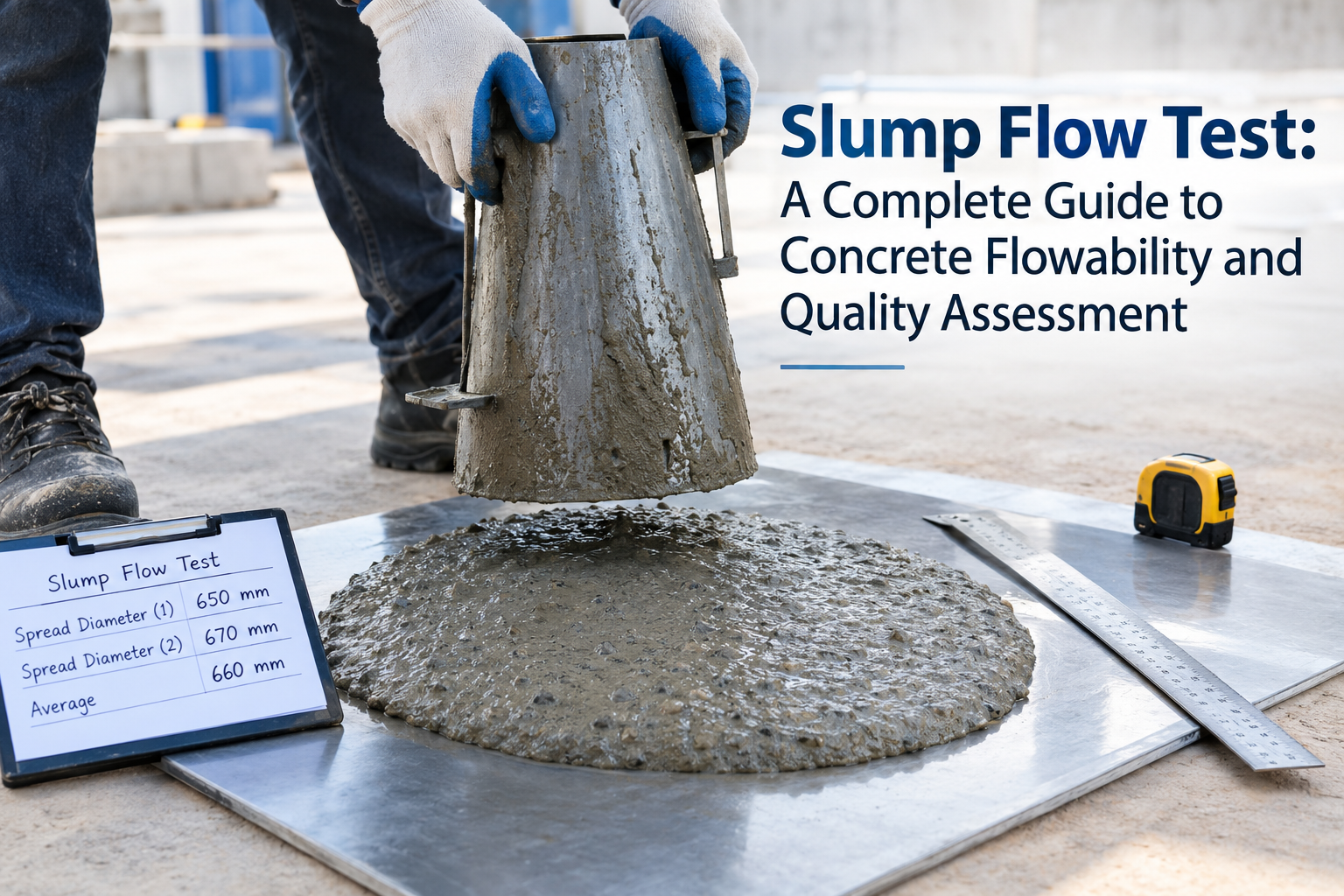
Slump Flow Test: A Complete Guide to Concrete Flowability and Quality Assessment
Introduction
Concrete performance depends on more than compressive strength alone. Before concrete hardens, its fresh properties determine how easily it can be transported, placed, compacted, and finished. Flowability is especially important when concrete must move around reinforcement, fill complex forms, or be placed in areas where conventional vibration may be difficult. Understanding the behavior of fresh concrete helps engineers and construction professionals select suitable mixtures and maintain consistent quality.
The flow characteristics of concrete are influenced by several factors, including water content, cementitious materials, aggregate grading, admixtures, temperature, and mixing conditions. A mixture that flows too little may be difficult to place, while excessive flow can create problems such as segregation and loss of uniformity. For this reason, practical testing is necessary before concrete is used on a construction project.
A slump flow test provides a useful way to evaluate the flowability of fresh concrete, particularly mixtures designed to spread under their own weight. The test gives an indication of how easily the concrete deforms and spreads after the supporting mould is lifted. When performed correctly, the result can help identify changes in mixture behavior and support quality control during concrete production and placement.
What Is Concrete Flowability
Flowability refers to the ability of fresh concrete to deform and move without requiring significant external force. It is different from simple workability, although the two properties are closely related. Workability describes the overall ease with which concrete can be handled, placed, and compacted, while flowability focuses more specifically on the ability of the fresh mixture to spread.
Highly flowable concrete can move into narrow spaces and around reinforcement more easily than stiff concrete. This characteristic is particularly useful in structures containing closely spaced reinforcement or complicated formwork. However, high flowability does not automatically mean better concrete. The mixture must remain cohesive while flowing so that its cement paste and aggregate remain properly distributed.
A concrete mixture should therefore be evaluated as a complete system. A large spread accompanied by visible separation of coarse aggregate or excessive water movement may indicate an unsuitable mixture. The desired result is usually a concrete that spreads smoothly while maintaining a consistent appearance.
Purpose of the Slump Flow Test
The main purpose of the test is to determine the spreading behavior of fresh concrete. It is commonly associated with highly flowable concrete, including self consolidating concrete. Instead of measuring the height of a remaining concrete cone as in a conventional slump test, the test measures the diameter of the spread after the mould is removed.
The measured spread provides an indication of the concrete's ability to flow under its own weight. This information can be used during mixture development, laboratory testing, production control, and field quality assessment.
The test can also help identify changes in concrete consistency. For example, if successive batches made with the same mixture proportions produce noticeably different results, the difference may indicate changes in water content, aggregate moisture, admixture dosage, temperature, or mixing conditions.
Equipment Required
The equipment used for the test is relatively simple. A standard slump cone or suitable mould is required to contain the fresh concrete before the test begins. A flat, rigid, level surface is also necessary to provide a stable testing area.
A measuring scale or rule is required to determine the final spread diameter. The surface should be clean and free from materials that could interfere with concrete movement.
A suitable container or sampling method is also required for obtaining a representative sample of fresh concrete. All equipment should be clean and dampened where appropriate before testing. Excess water should not remain on the testing surface because it can affect the movement of the concrete.
Preparing the Concrete Sample
Accurate results depend heavily on obtaining a representative sample. The concrete used for testing should represent the batch being evaluated. Sampling should be performed carefully so that coarse aggregate, cement paste, and other components are present in proportions similar to those in the complete batch.
The sample should be mixed sufficiently before testing to maintain uniformity. At the same time, unnecessary manipulation should be avoided because excessive handling can change the characteristics of fresh concrete.
Environmental conditions should also be considered. Temperature, wind, humidity, and the time between sampling and testing can influence concrete behavior. Highly flowable mixtures may be particularly sensitive to delays because chemical admixtures and hydration processes can gradually change consistency.
Test Procedure
The testing surface should first be placed on a firm and level foundation. The slump cone is positioned at the center of the surface. The cone and surrounding area should be clean before filling begins.
Fresh concrete is then placed into the cone according to the applicable testing procedure. Depending on the specified method, the concrete may be placed without the vibration or rodding used in some conventional slump procedures. The objective is to avoid introducing external forces that could alter the natural flow characteristics of the mixture.
Once the mould has been filled and the surface prepared as required, the cone is lifted vertically and steadily. The concrete then spreads outward across the testing surface.
After the concrete has stopped moving significantly, the spread diameter is measured. Measurements are generally taken across the spread in two directions at right angles to each other. The average of these measurements provides the reported slump flow value.
The concrete should also be observed during and after spreading. The tester should look for signs of segregation, excessive bleeding, uneven flow, or other unusual behavior. These observations can provide useful information that a single numerical measurement cannot show.
Measuring the Spread
The spread diameter is one of the most important measurements obtained from the test. If the concrete spreads evenly, two measurements taken perpendicular to each other should be reasonably similar.
For example, if the measured diameters are 650 millimeters and 670 millimeters, the average spread is 660 millimeters. The result should be recorded together with relevant information about the concrete batch, testing time, temperature, and mixture identification when required by the project quality system.
An uneven spread may indicate that the concrete was not distributed uniformly, that the testing surface was not level, or that the mixture has unusual flow characteristics. The test should therefore be performed carefully rather than treating the final number as the only important observation.
Factors Affecting Slump Flow
Several mixture and environmental factors can influence flowability. Water content is one of the most obvious factors. Increasing free water generally increases fluidity, but excessive water can reduce strength and stability and may increase segregation.
The quantity and characteristics of cementitious materials also affect the movement of fresh concrete. Fine particles influence paste volume, viscosity, cohesion, and the interaction between the cement paste and aggregates.
Aggregate properties are equally important. Aggregate size, shape, surface texture, grading, and moisture condition can change the resistance of concrete to movement. Well balanced aggregate grading can contribute to consistent flow while maintaining stability.
Chemical admixtures can have a significant effect on flowability. Water reducing admixtures are often used to increase fluidity without simply adding more mixing water. Their effectiveness depends on dosage, material compatibility, temperature, and other mixture conditions.
Temperature can also change fresh concrete behavior. Higher temperatures may accelerate hydration and cause a mixture to lose flowability more quickly. Cold conditions can slow chemical reactions and alter admixture performance.
Importance of Cohesion
Flowability should always be considered together with stability. Concrete that spreads rapidly but separates during movement may not perform well during placement.
Cohesive concrete maintains a relatively uniform distribution of cement paste and aggregate while flowing. When the mixture reaches the required area, it should remain stable rather than allowing coarse aggregate to collect in one location or water to rise excessively to the surface.
This is particularly important for self consolidating concrete. Such mixtures are designed to flow through complicated reinforcement arrangements without conventional vibration. Their ability to flow must therefore be balanced with resistance to segregation.
Understanding Test Results
A higher slump flow value generally indicates greater ability of fresh concrete to spread. A lower value indicates greater resistance to flow. However, the ideal result depends on the concrete mixture and its intended application.
A result should therefore be compared with the specified project requirements rather than judged in isolation. If a mixture consistently produces values within the required range and maintains good stability, it is more likely to provide predictable placement behavior.
A sudden change from previous results deserves attention. If the spread becomes unexpectedly high, possible causes may include additional water, changes in aggregate moisture, excessive admixture dosage, or differences in materials. If the spread becomes unexpectedly low, possible causes include reduced water availability, changes in temperature, insufficient admixture effectiveness, or increased material demand.
Slump Flow and Conventional Slump
The conventional slump test and slump flow measurement both examine fresh concrete behavior, but they are intended for different situations.
A conventional slump test primarily evaluates the consistency of concrete by measuring the vertical settlement of a concrete cone after the mould is removed. It is commonly used for concrete mixtures that retain a measurable shape after the cone is lifted.
Slump flow focuses on the horizontal spread of highly flowable concrete. Instead of concentrating on how much the concrete settles vertically, the test considers how far the concrete moves outward under its own weight.
The choice of test should therefore match the type of concrete being evaluated. Using an inappropriate test can provide information that does not accurately represent the property of interest.
Common Testing Errors
One common source of error is using an uneven or contaminated testing surface. Even a small amount of debris or standing water can affect the movement of concrete and influence the measured result.
Another issue is improper lifting of the cone. The mould should be lifted smoothly and vertically. Tilting, twisting, or moving it sideways can interfere with the natural spread of the concrete.
Testing delays can also produce inconsistent results. Fresh concrete changes with time, especially when admixtures are involved. Samples should therefore be tested according to the required time limits and procedures.
Inaccurate measurement is another concern. Measuring only one direction can give an incomplete representation of the spread. Taking measurements in two perpendicular directions and calculating the average provides a more reliable result.
Interpreting Concrete Stability
The appearance of the concrete after spreading should be examined carefully. A stable mixture generally shows a relatively uniform distribution of aggregate and paste.
If coarse aggregate collects around the outer edge while paste remains toward the center, this may indicate segregation. Excessive water appearing around the spread can also indicate instability.
The test result should therefore include both numerical and visual assessment when the applicable testing method or project requirements call for it. Two mixtures can produce similar spread diameters while behaving differently in terms of cohesion and stability.
Improving Flowability
When a concrete mixture does not achieve the required flow, simply adding water is not always an appropriate solution. Additional water changes the water to cementitious material ratio and can affect strength, durability, shrinkage, and other properties.
Mixture adjustments should instead consider the complete proportioning system. Aggregate grading, paste volume, material compatibility, and suitable chemical admixture dosage can all be evaluated.
Any modification should be followed by additional testing. A mixture that achieves greater flow but loses stability may require further adjustment. The goal is to obtain the required movement while preserving uniformity and performance.
Quality Control Applications
Regular testing can provide useful information about production consistency. When results are recorded for successive batches, patterns can be identified more easily.
Consistent results suggest that materials, batching, mixing, and environmental conditions are being controlled effectively. Significant variations can provide an early indication that one or more production variables require investigation.
Quality control personnel should consider test results alongside other fresh concrete measurements and production records. Looking at one value without understanding the conditions under which it was obtained can lead to incorrect conclusions.
Safety During Testing
Fresh concrete contains cementitious materials that can irritate the skin and eyes. Personnel performing the test should use suitable protective equipment and follow established site safety procedures.
The testing area should also be kept clear so that the operator can work without unnecessary hazards. Equipment should be handled carefully, particularly when the concrete sample is heavy.
After testing, concrete residue should be cleaned from the equipment and working area before it hardens. Proper cleaning maintains equipment condition and reduces the possibility of contamination during future tests.
Importance in Self Consolidating Concrete
Self consolidating concrete requires careful control of fresh properties because it is designed to flow and fill formwork without conventional mechanical vibration.
For this type of concrete, flowability must be sufficient to allow movement through reinforcement and into difficult areas. At the same time, the mixture must retain stability during transport and placement.
Slump flow measurement is therefore an important part of assessing the fresh behavior of such mixtures. It can help confirm whether a batch is behaving within the required range before placement begins.
Maintaining Reliable Results
Reliable testing requires consistency in every part of the procedure. The same equipment condition, sampling approach, testing sequence, measurement method, and recording practice should be maintained as far as practical.
Personnel should also be trained to recognize both numerical and visual characteristics of fresh concrete. A well performed test is not simply a matter of obtaining a measurement. It involves controlling the test conditions and accurately documenting what occurred.
Testing equipment should be checked regularly for cleanliness, damage, and dimensional accuracy. A damaged mould or unsuitable measuring device can introduce errors even when the procedure itself is performed correctly.
Conclusion
Flowability is an important property of fresh concrete because it influences placement, filling, finishing, and overall construction efficiency. Measuring the spread of highly flowable concrete provides valuable information about how a mixture behaves before it hardens.
The slump flow test is particularly useful for evaluating concrete that is designed to move under its own weight. However, the measured diameter should not be considered alone. The appearance, stability, sampling conditions, testing time, temperature, and mixture characteristics all contribute to a proper assessment.
Accurate testing supports better quality control by helping construction teams identify changes in concrete consistency before they affect placement. When the procedure is performed carefully and results are interpreted alongside other quality information, flowability testing becomes a practical tool for maintaining uniform fresh concrete performance.