
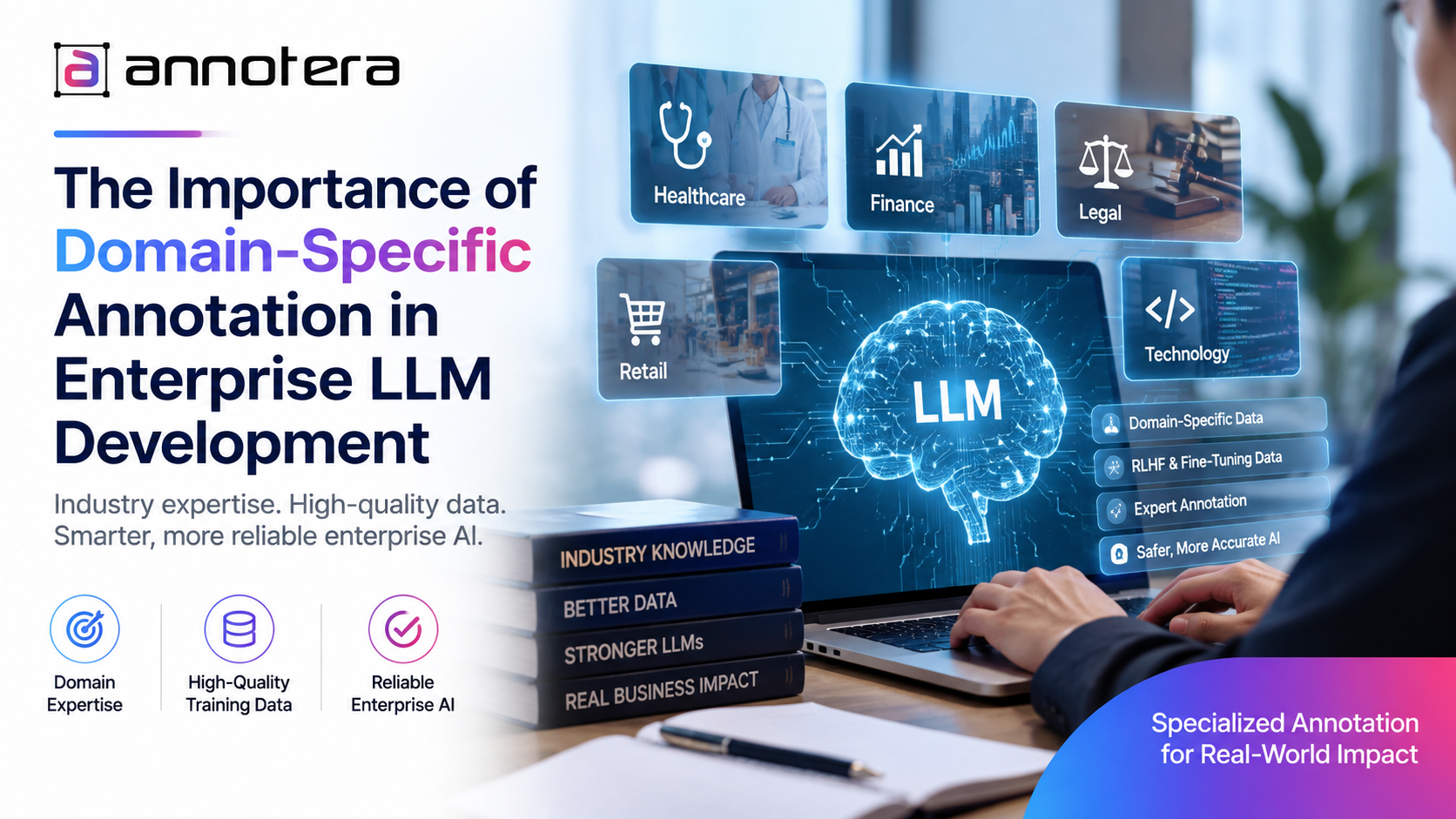
Large language models (LLMs) have moved beyond general-purpose chatbots and are increasingly being integrated into enterprise workflows such as customer support, legal research, financial analysis, healthcare documentation, software development, and knowledge management. However, an enterprise LLM cannot deliver reliable domain-specific results simply because it has been trained on a massive volume of general data.
Enterprise applications require models to understand specialized terminology, workflows, regulations, business logic, and user expectations. This is where domain-specific annotation becomes critical. By adding expert-driven labels, instructions, preferences, and evaluations to relevant datasets, organizations can help LLMs become more accurate, consistent, and aligned with real-world business requirements.
What Is Domain-Specific Annotation?
Domain-specific annotation is the process of labeling and evaluating data according to the requirements of a particular industry, business function, or use case.
For example, a healthcare LLM may need annotations that distinguish clinical symptoms, diagnoses, medications, procedures, and medical relationships. A financial model may need to understand financial terminology, transaction categories, risk indicators, and regulatory language. Similarly, a legal AI system may require carefully annotated contracts, clauses, case references, and legal reasoning.
Unlike generic labeling, domain-specific annotation requires annotators to understand the context behind the data. The objective is not simply to assign labels but to capture the meaning and relationships that matter within a particular domain.
Why General-Purpose Training Data Is Not Enough
General-purpose LLMs are trained on broad datasets covering numerous subjects and writing styles. This provides strong language capabilities, but enterprise applications often operate within narrower and more complex environments.
An enterprise model may encounter:
-
Industry-specific terminology and abbreviations
-
Internal policies and procedures
-
Proprietary documentation
-
Specialized customer queries
-
Regulatory requirements
-
Technical workflows
-
Domain-specific reasoning patterns
-
Organization-specific communication styles
Without relevant training examples, an LLM may misunderstand specialized terminology, generate generic responses, or produce plausible but incorrect information.
Research into enterprise LLM applications has also highlighted challenges related to internal knowledge, complex tasks, and enterprise-specific data structures.
Domain-specific annotation helps bridge this gap by transforming raw enterprise data into structured, meaningful training and evaluation resources.
How Domain-Specific Annotation Improves Enterprise LLMs
1. Improves Domain Accuracy
An LLM needs exposure to examples that represent how experts actually use language within a particular field.
Domain experts can identify terminology, relationships, intent, and acceptable responses that general-purpose annotation may overlook. Annotated examples can then be incorporated into supervised fine-tuning and evaluation datasets.
For example, an enterprise healthcare assistant should distinguish between medical terminology that may appear similar but have very different meanings. Expert annotation provides the contextual information needed to make those distinctions.
2. Strengthens Instruction Following
Enterprise users frequently expect LLMs to follow specific instructions regarding response format, tone, terminology, and business processes.
Domain-specific instruction-response pairs can teach models how to respond to particular enterprise scenarios. Annotators can evaluate whether an answer:
-
Addresses the user's actual intent
-
Uses appropriate terminology
-
Follows company guidelines
-
Includes required information
-
Avoids unsupported claims
-
Maintains the expected tone and format
This creates training data that reflects actual operational requirements rather than generic language patterns.
3. Supports Better RLHF and Preference Training
Human preference data is particularly valuable when an enterprise needs an LLM to behave according to specific standards.
With RLHF & fine-tuning data, domain experts can compare alternative model responses and identify which answer better satisfies business requirements.
For instance, two responses may both be grammatically correct, but one may contain inaccurate regulatory terminology or omit an important compliance consideration. A domain expert can recognize the difference and select the more appropriate response.
These preference judgments can help establish stronger alignment between model behavior and enterprise expectations.
4. Reduces Domain-Specific Hallucinations
Hallucination remains an important concern for enterprise AI applications. A model can generate fluent information that appears credible but is unsupported or incorrect.
Domain-specific datasets can help teams identify common hallucination patterns and create targeted examples for training and evaluation. Annotators can flag unsupported claims, incorrect terminology, missing context, and inappropriate conclusions.
This does not eliminate hallucinations entirely, but it provides a more systematic way to measure and address domain-specific failure modes.
Domain-Specific Annotation Across Enterprise Industries
Different industries require different annotation frameworks.
Healthcare: Clinical entities, medical relationships, symptoms, diagnoses, medications, procedures, and safety-sensitive responses may require specialist review.
Finance: Annotation may focus on financial terminology, risk classification, transaction information, market-related language, and regulatory content.
Legal: Contract clauses, legal entities, obligations, case references, and jurisdiction-specific terminology can require legal expertise.
Retail: Customer intent, product information, reviews, purchase behavior, support conversations, and recommendation-related responses can be annotated according to business objectives.
Technology: Coding tasks, technical documentation, API instructions, software troubleshooting, and code-generation outputs can be evaluated for correctness, security, and adherence to standards.
This diversity demonstrates why a single generic annotation framework is rarely sufficient for enterprise LLM development.
Building High-Quality Domain-Specific Datasets
Effective annotation starts with clearly defined objectives. Enterprises should first identify the tasks the model needs to perform and the failure modes that matter most.
A strong workflow typically includes:
-
Define the domain and use case: Establish the specific business problem the LLM must solve.
-
Develop annotation guidelines: Document labels, decision rules, edge cases, and examples.
-
Select qualified annotators: Use reviewers with appropriate domain knowledge for complex tasks.
-
Create representative datasets: Include common scenarios as well as difficult and long-tail examples.
-
Apply multi-level quality checks: Use peer review, calibration, adjudication, and consistency checks.
-
Build evaluation datasets: Maintain high-quality holdout examples for measuring model performance.
-
Continuously improve the dataset: Feed important production failure cases back into the annotation pipeline.
For specialized fine-tuning, domain-expert annotation is recognized as an important component of dataset construction.
The Role of Human Expertise in Enterprise LLM Development
Automation can accelerate annotation, but human expertise remains valuable when the task involves ambiguity, specialized knowledge, or subjective quality judgments.
Human reviewers can assess whether an answer is factually appropriate, contextually relevant, safe, and aligned with organizational requirements. They can also identify edge cases that automated systems may overlook.
A hybrid approach can therefore combine automated pre-labeling with human validation and expert review. This allows enterprises to increase annotation efficiency while maintaining quality where human judgment matters most.
How Annotera Supports Domain-Specific LLM Annotation
Annotera provides LLM & GenAI annotation services designed to support training, fine-tuning, evaluation, and alignment workflows. Its capabilities include supervised fine-tuning datasets, RLHF preference ranking, conversational annotation, multilingual evaluation, red-teaming, and domain-focused annotation.
For enterprise applications, Annotera can support annotation workflows across specialized areas including finance, healthcare, legal, coding, and other technical domains. Domain-trained teams, structured guidelines, and multi-level quality assurance can help organizations build datasets that reflect their specific AI requirements.
Conclusion
Enterprise LLM development is not simply about choosing a larger model or increasing the volume of training data. The model must understand the language, context, standards, and expectations of the environment in which it will operate.
Domain-specific annotation provides the bridge between general-purpose language capabilities and specialized enterprise performance. By combining expert knowledge with structured annotation, preference data, evaluation datasets, and continuous quality improvement, organizations can build LLM systems that are better aligned with their actual business requirements.
As enterprise AI adoption expands, high-quality LLM & GenAI annotation services and carefully curated RLHF & fine-tuning data will remain important components of developing reliable, domain-aware generative AI applications.