
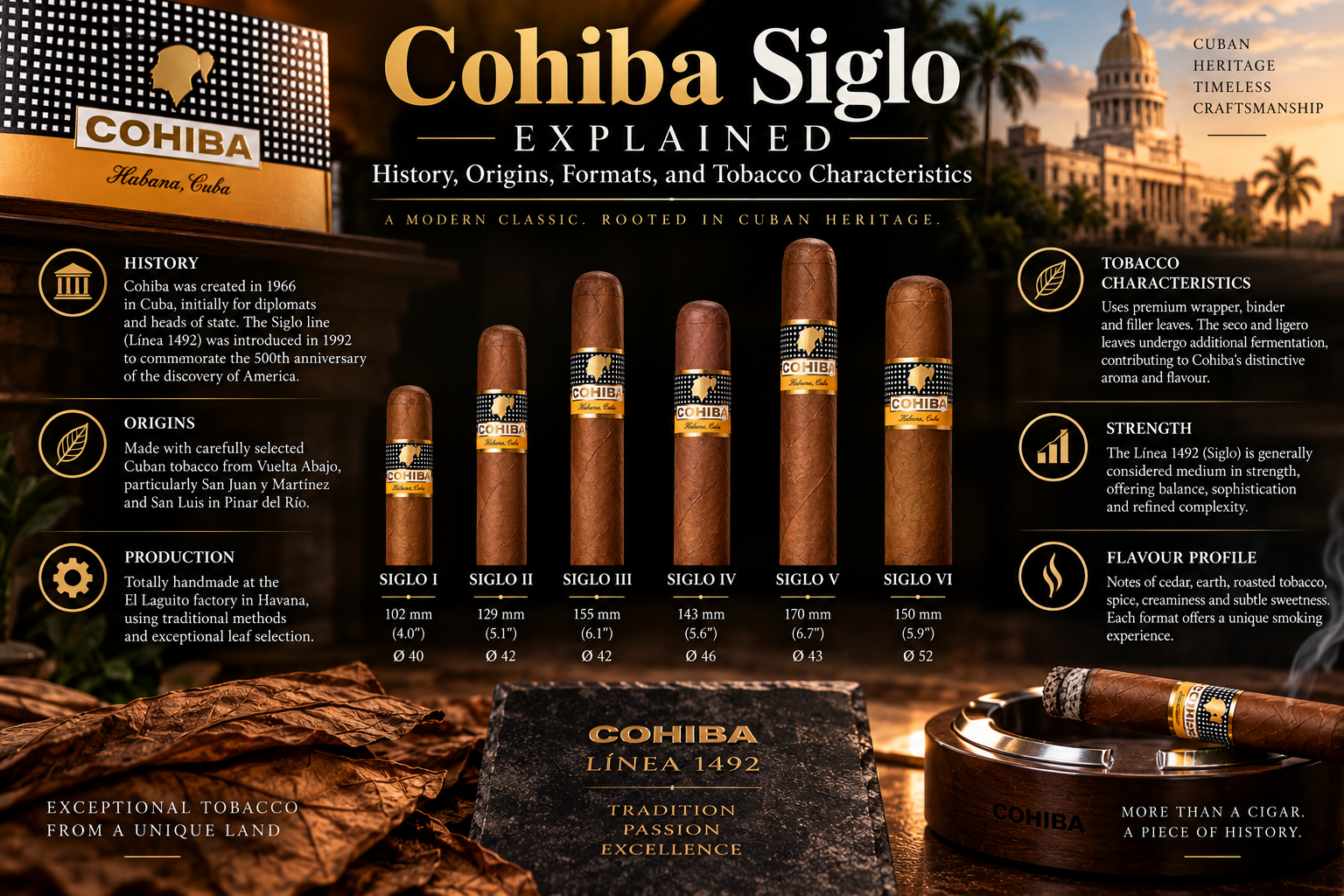
The Cohiba Siglo series is one of the best-known families within the Cuban Cohiba portfolio. Introduced as part of the Línea 1492, the series expanded Cohiba's traditional range with a collection of formats designed around a generally medium-bodied interpretation of the brand's tobacco blend.
The six principal Siglo formats, ranging from the compact Siglo I to the larger Siglo VI, demonstrate how changes in length and ring gauge can influence the character of a handmade cigar while retaining a common tobacco heritage.
The History Behind the Siglo Series
Cohiba was established in Cuba in 1966. For many years, the cigars were primarily reserved as official gifts for government figures and visiting diplomats. International commercialization began in 1982, bringing the brand into the wider premium cigar market. Production has historically been associated with the El Laguito factory in Havana.
The Siglo family arrived later. Habanos introduced the Línea 1492 in 1992, commemorating the 500th anniversary associated with Christopher Columbus's arrival in Cuba. The collection eventually developed into six principal formats, with the Siglo VI added in the early 2000s.
The name Línea 1492 therefore connects the series not only with Cohiba's modern history but also with the long historical association between Cuba and tobacco.
The Six Principal Siglo Formats
One of the defining characteristics of the Siglo series is its range of sizes.
The collection progresses from the relatively compact Siglo I through the longer Siglo II, III, IV and V, before reaching the substantially broader Siglo VI. The Siglo VI uses the Cañonazo format and measures approximately 150 mm in length with a 52 ring gauge. Habanos introduced the Siglo VI in 2002 before adding it to the regular range in 2003.
The differences between these formats are important because a cigar's dimensions affect its construction and combustion. A longer cigar provides more space for the tobacco blend to develop, while a larger ring gauge changes the proportion of wrapper, binder, and filler and can influence smoke volume and the way flavors develop.
Consequently, the Siglo series is not simply one cigar offered in six different lengths. Each format provides a somewhat different physical expression of the same broader Cohiba identity.
Tobacco Origins
The tobacco used for Cohiba is closely associated with Vuelta Abajo in Pinar del Río, Cuba. Habanos identifies the areas around San Juan y Martínez and San Luis as important sources for the carefully selected tobacco used in Cohiba production.
Vuelta Abajo is particularly significant in Cuban cigar production because of its long-established tobacco-growing tradition and distinctive agricultural conditions. Soil, climate, tobacco varieties, cultivation practices, and the expertise of growers all contribute to the characteristics of Cuban tobacco.
For Cohiba, the selection process is described by Habanos as exceptionally selective, with leaves chosen from premium tobacco-growing areas before being prepared for cigar production.
The Distinctive Cohiba Fermentation Process
A particularly notable aspect of Cohiba production is the additional fermentation applied to certain filler leaves.
Habanos states that seco and ligero, two of the three types of filler leaves used in Cohiba, undergo an additional fermentation stage. The company associates this process with the distinctive aroma and flavor of the brand.
Fermentation is an important stage in cigar production because it changes the physical and chemical characteristics of tobacco. The process can influence aroma, flavor, color, and the overall character of the finished leaf.
This additional treatment is one of the production details that differentiates Cohiba from many other Cuban cigar brands.
Handmade Production at El Laguito
Cohiba cigars are produced entirely by hand using long filler tobacco. Habanos identifies the historic El Laguito factory in Havana as the traditional production center for the brand.
Hand production involves considerable skill. Tobacco leaves must be selected, prepared, positioned, rolled, and finished to produce a properly constructed cigar. Consistency in construction can affect draw, combustion, smoke production, and the way the blend develops.
The craftsmanship therefore forms an important part of the identity of the Siglo series, alongside the origin and treatment of its tobacco.
Flavor and Smoking Characteristics
The Línea 1492 is generally presented by Habanos as having a medium-strength character, distinguishing it from the medium-to-full profile associated with the original Línea Clásica.
Flavor perception can vary between individual cigars, but Cohiba's tobacco is commonly associated with combinations of woody, earthy, roasted, herbal, spicy, and aromatic impressions. The balance can change as the cigar progresses.
The size of each Siglo also contributes to the experience. Smaller formats provide a more compact smoking period, while longer cigars allow the blend to evolve over a greater amount of time. Larger formats such as the Siglo VI introduce a broader ring gauge, which changes the physical relationship between the filler, binder, and wrapper.
Storage and tobacco aging can also influence how a particular cigar presents itself. As an agricultural product, tobacco naturally varies between crops and production periods.
What Makes the Siglo Series Distinctive?
Several characteristics come together to define the Siglo family:
-
Línea 1492 heritage: The series was introduced in 1992 as part of a major expansion of the Cohiba portfolio.
-
Six principal formats: The collection offers a progression from smaller cigars to the substantial Siglo VI.
-
Cuban tobacco: Cohiba uses carefully selected leaves associated with Vuelta Abajo, particularly San Juan y Martínez and San Luis.
-
Additional fermentation: Seco and ligero receive an additional fermentation treatment associated with Cohiba's characteristic profile.
-
Handmade construction: The cigars are produced entirely by hand with long filler tobacco.
-
Medium-strength character: The Línea 1492 is positioned as a generally medium-strength expression within the broader Cohiba range.
Final Perspective
The Cohiba Siglo series illustrates how history, tobacco selection, fermentation, craftsmanship, and cigar dimensions can work together to create a recognizable family of formats. {https://cohibaclub.co.uk/product/cohiba-siglo/}
From the compact Siglo I to the broader Siglo VI, the collection maintains a connection to Cohiba's Cuban tobacco heritage while allowing the same general blend philosophy to be expressed through different physical constructions.
Its history as part of the Línea 1492, combined with the selective sourcing of Vuelta Abajo tobacco and Cohiba's distinctive fermentation and handmade production methods, makes the Siglo series an important part of the broader story of Cuban cigar manufacturing.
As with all tobacco products, cigar smoking carries established health risks, including cancer, cardiovascular disease, and respiratory illness. Information about cigar history, production, or flavor characteristics does not reduce those risks.