
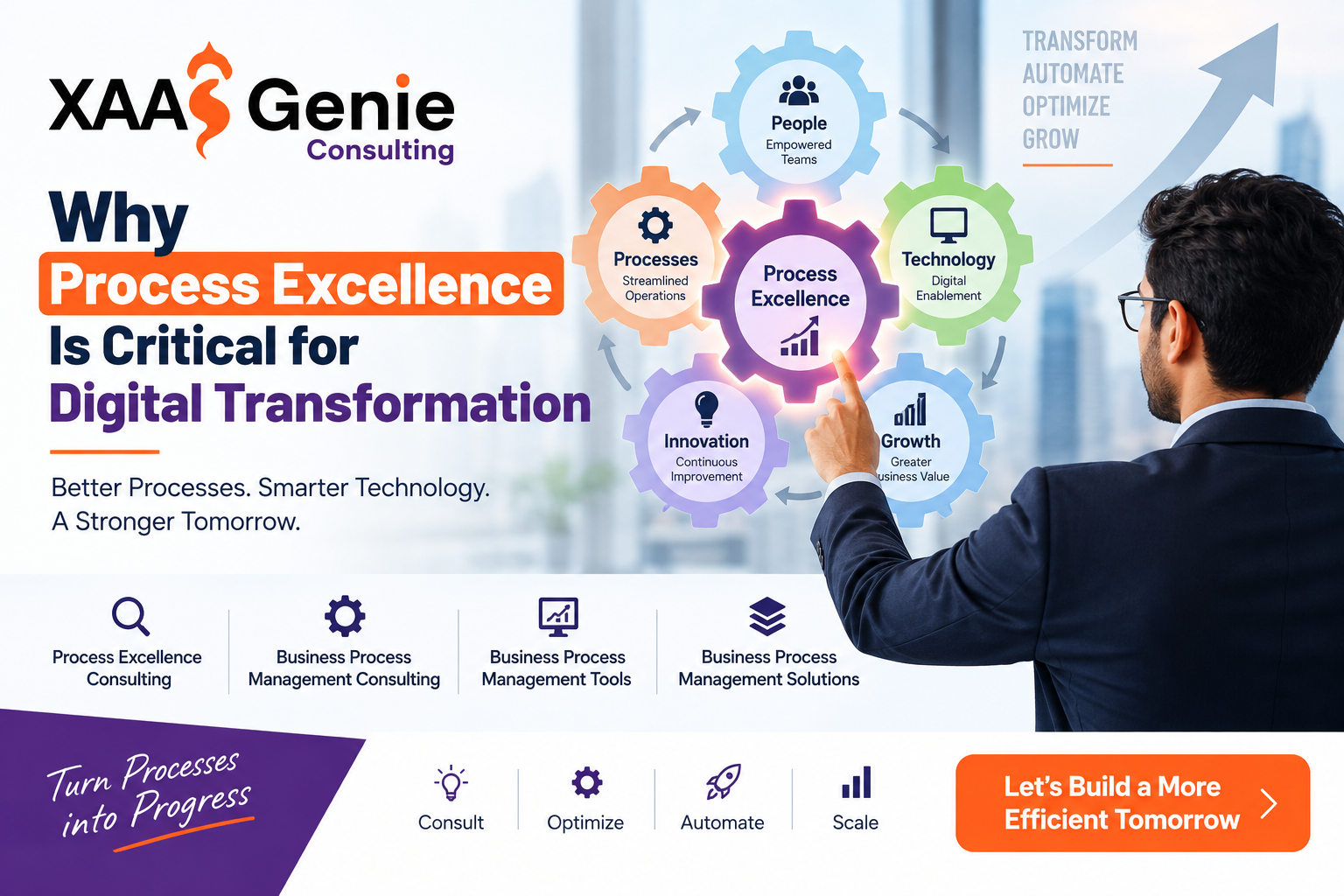
Digital transformation is often associated with new software, automation, cloud platforms, artificial intelligence, and connected systems. But technology alone does not guarantee better business performance. Process excellence provides the foundation that helps organizations ensure their technology investments actually improve the way work gets done.
When businesses digitize inefficient or fragmented processes without first understanding them, they can end up automating problems instead of solving them. Process excellence helps organizations examine existing workflows, identify bottlenecks, standardize operations, define performance measures, and then use technology to create more efficient processes.
For organizations planning a digital transformation journey, process excellence consulting can therefore play an important role in connecting people, processes, and technology.
What Is Process Excellence?
Process excellence is a structured approach to continuously improving business processes so that organizations can deliver better outcomes with greater efficiency, consistency, and visibility.
It typically involves:
- Process discovery and mapping
- Identifying bottlenecks and inefficiencies
- Standardizing workflows
- Eliminating unnecessary process steps
- Automating repetitive activities
- Establishing KPIs
- Improving cross-functional collaboration
- Continuously monitoring and optimizing processes
The goal isn't simply to make an individual task faster. It is to improve the end-to-end process and its business outcome.
APQC's 2026 research identifies business process management and continuous improvement as major areas of focus for process professionals, with organizations continuing to emphasize end-to-end process mapping, process maturity, measurement, and digital solutions.
Why Digital Transformation Needs Process Excellence
1. Technology Cannot Fix a Poorly Designed Process
One of the most common mistakes organizations make is introducing technology before understanding the underlying process.
For example, imagine a company with a complicated approval process involving multiple emails, spreadsheets, and manual approvals. Simply moving that process into a digital application may make it paperless, but it doesn't necessarily make it efficient.
Process excellence asks:
- Why does this approval exist?
- Who actually needs to approve it?
- Can certain steps be removed?
- Which decisions can be automated?
- Where are delays occurring?
- What information is required at each stage?
Once these questions are answered, technology can be used to redesign the workflow rather than simply digitize an inefficient one.
2. Process Excellence Connects Business Strategy With Technology
Digital transformation should support business objectives rather than becoming a technology exercise.
Organizations may invest in CRM systems, ERP platforms, workflow automation, analytics, AI, and low-code applications. But each technology investment should be connected to a specific business requirement.
Process excellence helps establish this connection.
For example:
Business goal → Process improvement → Technology → Measurement
A company may want to improve customer response times.
The process excellence approach could involve:
- Mapping the customer inquiry process.
- Identifying response delays.
- Standardizing lead or service-request handling.
- Automating assignment and notifications.
- Connecting CRM and customer-service systems.
- Tracking response-time KPIs.
This creates a much clearer path from digital investment to measurable business outcomes.
3. Business Process Management Provides the Framework
Business Process Management (BPM) provides organizations with a structured way to analyze, design, execute, monitor, and improve business processes.
BPM becomes particularly important during digital transformation because organizations often have processes spread across multiple departments and systems.
For example, a typical order-to-cash process may involve:
Sales → Order Management → Inventory → Finance → Billing → Customer Service
If every department uses different processes or disconnected systems, digital transformation can create additional complexity.
Business Process Management helps organizations look at the complete workflow rather than optimizing each department independently.
XAAS Genie provides BPM services covering areas such as platform strategy and assessments, visioning workshops, solution prototyping, implementation, migration, and low-code/no-code Centers of Excellence.
4. Business Process Management Tools Turn Process Design Into Action
Once processes have been analyzed and redesigned, organizations need appropriate technology to implement them.
Modern business process management tools can help organizations:
- Build digital workflows
- Automate approvals
- Create business applications
- Connect different systems
- Track process performance
- Manage forms and requests
- Improve visibility
- Reduce manual intervention
Low-code and no-code platforms are particularly useful for organizations that want to develop and modify business applications more rapidly.
XAAS Genie works across low-code/no-code and BPM platforms and describes its approach as combining process digitization, workflow automation, rapid prototyping, implementation, and ongoing support.
The important point is that the tool should follow the process strategy, not the other way around.
5. Process Excellence Helps Reduce Digital Transformation Risk
Digital transformation projects can become expensive when organizations attempt to change technology, processes, and organizational behavior simultaneously without a clear roadmap.
Process excellence can help reduce this risk by creating a structured transformation path:
Step 1: Discover
Understand current processes, systems, stakeholders, and pain points.
Step 2: Analyze
Identify bottlenecks, duplication, manual activities, and unnecessary approvals.
Step 3: Redesign
Create improved future-state workflows.
Step 4: Digitize
Select appropriate technology and convert redesigned processes into digital workflows.
Step 5: Automate
Automate repetitive and rule-based activities wherever appropriate.
Step 6: Measure
Track KPIs and process performance.
Step 7: Improve
Continuously optimize the process based on data and feedback.
This approach makes digital transformation a continuous improvement journey rather than a one-time technology implementation.
6. Business Process Management Consulting Helps Align People, Processes, and Technology
Technology implementations often fail to deliver their expected value when employees do not understand the new processes or when the technology doesn't reflect how teams actually work.
This is where business process management consulting can provide value.
A consulting-led approach can help organizations evaluate:
- Current-state processes
- Technology gaps
- Process ownership
- Automation opportunities
- Integration requirements
- Performance metrics
- Future-state workflows
- Change-management requirements
The objective is to create alignment between business requirements and technology capabilities.
XAAS Genie positions its BPM services around platform assessment, solution design, implementation, migration, and process digitization, with the objective of helping organizations accelerate transformation and improve productivity.
7. Process Excellence Creates Better Data for Decision-Making
Digital transformation generates enormous amounts of data. But data is only useful when it reflects well-structured business processes.
Consider a sales process where every salesperson records customer information differently. Even if the company has a sophisticated analytics platform, inconsistent data can make reporting difficult.
Process excellence can establish:
- Standard data-entry processes
- Defined process stages
- Consistent business rules
- Clear ownership
- Standard KPIs
- Automated data collection
This creates a stronger foundation for analytics and AI.
APQC's recent research also highlights measurement, data, KPIs, digital solutions, and AI among the issues shaping process and performance management in 2026.
8. Process Excellence Makes Automation More Effective
Automation is one of the most visible components of digital transformation.
However, organizations should avoid automating every manual activity simply because automation is possible.
A better approach is:
Understand → Simplify → Standardize → Automate → Measure
For example, if an employee spends hours manually transferring information between systems, automation could remove that repetitive work.
But if the underlying workflow contains unnecessary approvals or duplicated data entry, those issues should ideally be addressed before automation.
XAAS Genie also connects BPM with workflow automation and intelligent automation, including use cases across finance, HR, sales, procurement, and customer service.
Business Process Management Solutions for Digital Transformation
Organizations need flexible business process management solutions that can evolve as their requirements change.
Depending on the organization, these solutions may include:
- Workflow automation platforms
- Low-code/no-code applications
- CRM platforms
- ERP integrations
- Business intelligence and analytics
- Digital forms
- Approval automation
- Process monitoring
- Enterprise integrations
- AI-enabled automation
The right solution depends on the organization's processes, existing technology landscape, industry requirements, and transformation objectives.
XAAS Genie works with leading low-code/no-code and BPM technologies and provides enterprise solutions across areas including finance, HR, IT operations, procurement, sales, and marketing.
How XAAS Genie Approaches Process Excellence
XAAS Genie Consulting brings together process excellence, business process management, workflow automation, and digital transformation to help organizations modernize their operations.
Its BPM approach includes:
Process Assessment
Understanding existing workflows, business requirements, and technology environments.
Platform Strategy
Evaluating platforms and identifying technology approaches aligned with business goals.
Process Digitization
Converting manual or fragmented processes into structured digital workflows.
Low-Code/No-Code Development
Using low-code/no-code platforms to rapidly prototype and deploy business applications.
Workflow Automation
Reducing repetitive manual activities and improving process consistency.
Integration
Connecting applications and data to reduce silos across departments.
Continuous Improvement
Using process data and KPIs to identify opportunities for further optimization.
This approach is consistent with XAAS Genie's stated focus on combining BPM, low-code/no-code solutions, automation, and digital transformation.
Examples of Process Excellence in Digital Transformation
Manufacturing
A manufacturer can map production planning, procurement, quality, inventory, and order management processes before implementing automation.
Banking
Banks can redesign customer onboarding, loan processing, approvals, and service workflows before implementing digital applications.
Insurance
Insurers can optimize claims, underwriting, customer onboarding, and policy administration workflows.
Education
Educational institutions can digitize admissions, student services, approvals, emergency workflows, and administrative processes.
XAAS Genie has industry-focused solutions covering areas including banking and financial services, insurance, manufacturing, education, healthcare, and government.
Process Excellence Is a Continuous Journey
Digital transformation should not end when a new application goes live.
Business requirements change. Customers change. Regulations change. Technology changes. Organizations grow.
That means processes also need to evolve.
A strong process excellence program creates a continuous cycle:
Measure → Analyze → Improve → Automate → Monitor → Optimize
This allows organizations to continuously identify new opportunities for efficiency and innovation.
Final Thoughts
Digital transformation is ultimately about changing how an organization operates, not simply introducing new technology.
That is why process excellence is so important.
By understanding and optimizing processes before and during technology implementation, organizations can create stronger foundations for automation, analytics, integration, and AI.
Process excellence consulting, supported by the right business process management tools, business process management consulting, and business process management solutions, can help organizations connect their people, processes, and technology around measurable business objectives.
For organizations looking to move from fragmented workflows toward more connected and intelligent operations, XAAS Genie Consulting combines BPM, process optimization, workflow automation, and low-code/no-code capabilities to support digital transformation initiatives.