
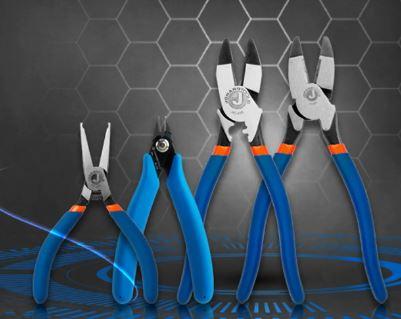
Pliers are among the most versatile hand tools used by technicians, electricians, installers, and maintenance professionals. From gripping and bending wire to reaching components in confined spaces, the right pair of pliers can make many technical tasks easier to control. However, not every pair is designed for the same application. Different jaw shapes, cutting edges, lengths, and specialized features make certain pliers better suited to particular jobs.
Understanding the different types of Pliers tools can help professionals select the right tool for their work. Jonard Tools offers a broad range of pliers designed for applications across telecommunications, fiber optics, security and alarm, electrical work, and other technical industries.
Here are 10 important types of pliers and what they are commonly used for.
1. Long Nose Pliers
Long nose pliers have narrow, elongated jaws that make them useful for reaching small components and wires in areas where standard pliers may not fit.
Their slim profile provides better access around terminals, connectors, and other components. Many long nose designs also feature textured or knurled jaws to improve grip.
For example, Jonard's long nose general use pliers use a slim chain nose design for confined areas and knurled jaws for gripping.
They are commonly useful for:
- Gripping small wires
- Bending wire
- Positioning components
- Forming wire loops
- Working around terminals
- Handling components in restricted spaces
2. Needle Nose Pliers
Needle nose pliers are closely related to long nose designs but generally emphasize a narrow, pointed profile for precision work.
They can be particularly useful when working with fine wires or small components where the technician needs controlled access.
Curved needle nose designs can provide additional visibility in confined spaces. Jonard's JIC-3385, for example, has a 60-degree bend designed for bending and forming fine wire in restricted areas. Its polished jaw surfaces are designed to help prevent wire nicking.
These characteristics make needle nose pliers useful for detailed manipulation rather than heavy duty gripping.
3. Long Nose and Side Cutting Pliers
Some pliers combine the narrow access of long nose jaws with integrated side cutters.
This combination allows a technician to grip a wire or component and then cut wire without changing tools. Jonard's JIC-842, for example, combines long nose jaws, serrated gripping surfaces, and side cutting blades.
This type can be useful when working with:
- Small wires
- Electrical conductors
- Telecom wiring
- Wire loops
- Components requiring both gripping and cutting
Combination functionality can also reduce the number of tools required for certain field tasks.
4. Lineman's Pliers
Lineman's pliers are designed for gripping and cutting applications that require substantial leverage.
They are commonly associated with electrical and utility work, where technicians may need to manipulate wires, cables, and other materials.
Some specialized models add additional functionality. For example, Jonard's JIC-685 lineman's pliers combine cutting with features intended for fish tape pulling and crimping.
When selecting this type of tool, consider the wire or material size and the manufacturer's specified cutting capacity.
5. Slip Joint Pliers
Slip joint pliers feature an adjustable pivot that allows the jaws to open to different positions.
This makes them useful when working with components of varying sizes. Instead of having a fixed jaw opening, the user can change the pivot position to accommodate a larger or smaller object.
Jonard's BCOMB slip joint side cut pliers, for example, provide two jaw positions and include gripping teeth and side cutting blades.
They can be useful for general maintenance and applications where versatility is important.
6. Cutting Pliers
Cutting pliers are designed primarily for severing wire or other specified materials.
Unlike general purpose pliers, their cutting edges are the primary working feature. The correct cutter should always be selected according to the material and diameter it is designed to handle.
Using a cutting tool beyond its rated capacity can damage the tool and produce poor results. Therefore, technicians should check manufacturer specifications before cutting unfamiliar materials.
7. Curved Long Nose Pliers
Curved long nose pliers add an angled nose to the traditional long nose design.
The angle can improve visibility and access when working around obstacles. Jonard's JIC-3026, for example, uses a 70-degree bend for work in confined areas and includes knurled jaws for gripping and wire forming tasks.
Curved designs can be especially useful when a straight pair of long nose pliers makes it difficult to see the working area.
8. Specialized Crimping Pliers
Some Pliers tools combine gripping with crimping or other specialized functions.
A multi-function tool can be useful for technicians who regularly perform several related operations. Jonard's JIC-22148, for example, combines long nose pliers with crimping, cutting, crushing, and a stripping hole for specified wire applications.
The advantage of a combination tool is that several functions can be available in one compact hand tool. However, each function should only be used within its specified application and capacity.
9. Wire Stripping and Specialty Pliers
Certain specialty pliers incorporate features for preparing specific types of wire.
For example, Jonard's short nose B-type pliers are designed for working with 22–24 AWG wire and include features for stripping insulation and crushing insulation.
Other specialized designs can incorporate stripping holes, crushing slots, or other features for telecommunications and electrical applications.
These tools are particularly valuable when technicians repeatedly perform the same specialized preparation task.
10. Precision and Confined Space Pliers
Some applications require more than basic gripping. Technicians may need to work around small components, tight terminals, or delicate wires where visibility and control are limited.
Precision oriented pliers may feature:
- Narrow jaws
- Curved noses
- Serrated or knurled surfaces
- Spring loaded handles
- Specialized jaw shapes
- Fine wire handling capabilities
For example, Jonard's curved needle nose design uses a spring loaded handle and a 60-degree bend to assist with fine wire work in confined spaces.
These features show why selecting pliers based on the working environment can be just as important as selecting them based on the material being handled.
How to Choose the Right Pliers
With so many different designs available, choosing the correct pair begins with identifying the task.
Consider these factors:
- Application: Determine whether you need to grip, bend, cut, strip, crimp, or manipulate a component.
- Jaw design: Narrow jaws are useful for confined spaces, while wider jaws may provide greater gripping surfaces.
- Cutting capability: If cutting is required, confirm that the tool is rated for the material and size involved.
- Reach: Long or curved noses can provide better access around obstacles.
- Handle design: Ergonomic grips can improve comfort and control during repeated use. Jonard notes that many of its pliers use ergonomic handles with dipped plastic grips for comfort and torque.
- Material and construction: Professional tools may use materials and heat-treatment processes selected for strength and durability. For example, several Jonard long nose designs use heat treated tool steel or chrome vanadium steel.
Building a Useful Pliers Toolkit
A professional toolkit does not need to contain every type of plier. Instead, select tools according to the tasks you perform most frequently.
A basic selection might include general purpose pliers, long nose or needle nose pliers, side cutting pliers, and a specialized pair suited to your industry. Technicians working in telecommunications, electrical, fiber optic, or security applications may then add specialty designs based on their daily requirements.
The goal is to have the right combination of access, grip, cutting capability, and precision without carrying unnecessary tools.
Conclusion
Pliers are much more than simple gripping tools. The wide range of designs available today allows technicians to select tools for specific requirements, from general maintenance and wire handling to precision work in confined spaces.
Needle nose pliers and Long nose pliers are valuable when access and precision are important, while side cutting, slip joint, lineman's, and specialty designs provide additional capabilities for different applications. By understanding the purpose of each type and matching the tool to the task, professionals can build a practical collection of Hand tools pliers that supports efficient and controlled work.