
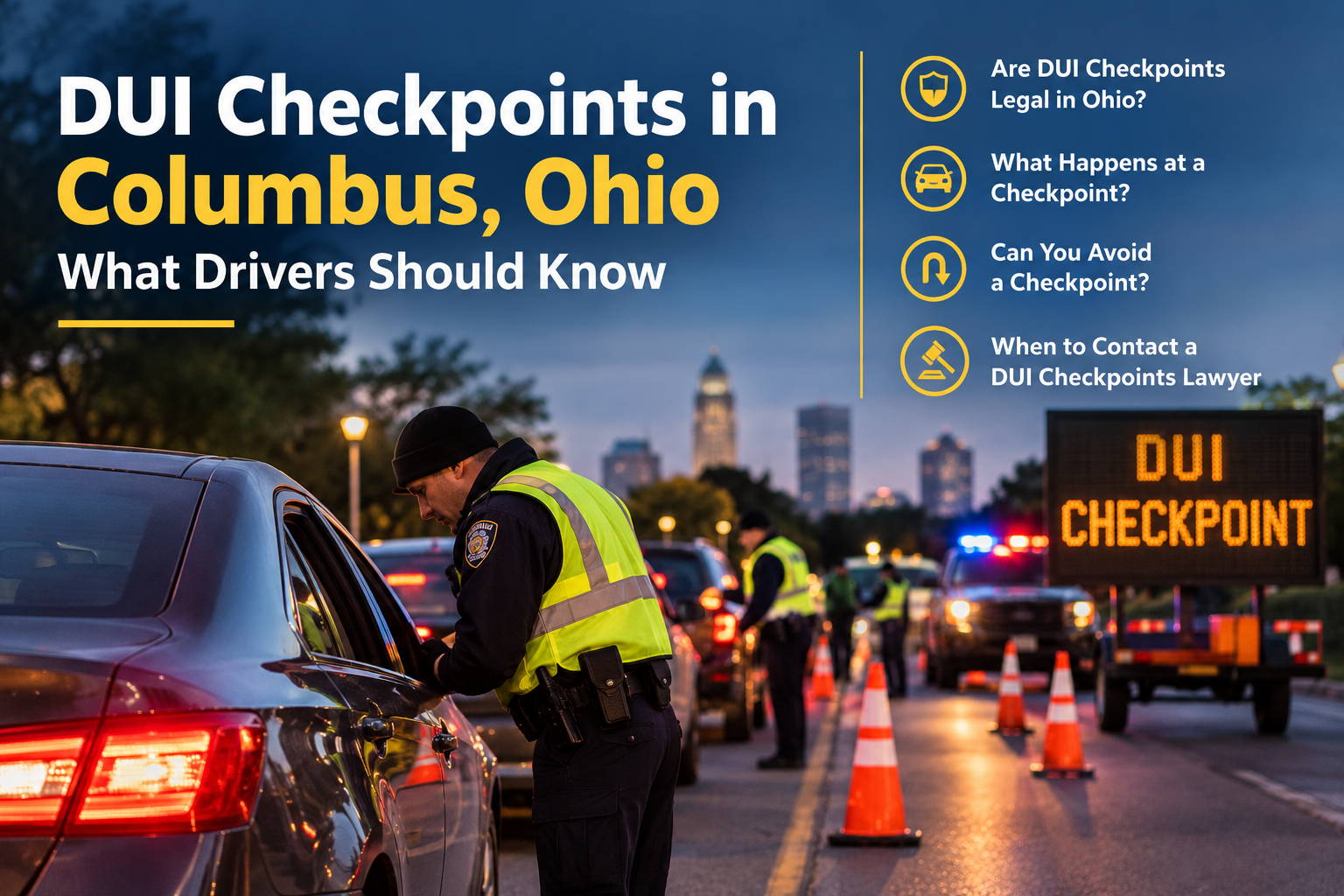
DUI Checkpoints in Columbus, Ohio: What Drivers Should Know
If you are driving in Columbus, Ohio, you may occasionally encounter a sobriety checkpoint. These checkpoints are generally used by law enforcement to identify drivers who may be operating a vehicle while impaired by alcohol or drugs.
Unlike an ordinary traffic stop, a sobriety checkpoint can involve stopping vehicles without officers first observing a specific traffic violation. Ohio courts have recognized sobriety checkpoints when they are conducted under appropriate procedures, including advance warning, uniformed officers, a predetermined location and time, and neutral criteria for selecting vehicles. [1]
Understanding what happens at a checkpoint can help you make informed decisions if you encounter one.
What Is a DUI Checkpoint?
A DUI checkpoint, also called a sobriety checkpoint or OVI checkpoint, is a temporary law-enforcement operation designed to identify potentially impaired drivers.
In Ohio, the term OVI is commonly used instead of DUI. OVI generally refers to operating a vehicle under the influence of alcohol or drugs.
At a checkpoint, officers may briefly stop vehicles according to predetermined procedures. Depending on what an officer observes during the interaction, the driver may be asked additional questions or subjected to further investigation.
A checkpoint stop does not automatically mean that a driver will be arrested or charged with OVI.
Are DUI Checkpoints Legal in Ohio?
Ohio courts have allowed sobriety checkpoints when they are conducted in a manner that complies with constitutional requirements.
The existing information on Columbus DUI checkpoints identifies several important factors, including:
-
Warning signs for approaching drivers
-
Uniformed law-enforcement officers
-
A predetermined location and time
-
Neutral criteria for deciding which vehicles are stopped
These requirements are intended to prevent checkpoints from becoming arbitrary stops of individual drivers. The legality of a particular checkpoint can depend on the circumstances surrounding how it was established and operated.
If you believe a checkpoint stop was improperly conducted, discussing the circumstances with a dui checkpoints Lawyer may help you understand what legal issues could apply to your case.
What Happens When You Approach a DUI Checkpoint?
The exact procedure can vary depending on the checkpoint.
Typically, drivers may encounter warning signs and uniformed officers as they approach the checkpoint. An officer may briefly interact with the driver and determine whether additional investigation is necessary.
If the officer develops reasonable grounds to investigate possible impaired driving, the interaction can become more extensive.
For example, an officer may investigate possible signs of impairment and may ultimately request chemical testing when legally authorized.
It is important to remember that being stopped at a checkpoint is not the same thing as being convicted of OVI.
Can You Avoid a DUI Checkpoint in Ohio?
Ohio case law has recognized that a driver may have the ability to turn around and avoid a checkpoint before being stopped, provided the maneuver itself is lawful.
However, attempting to avoid a checkpoint does not give a driver permission to violate traffic laws. An unsafe U-turn, illegal turn, speeding, or another traffic violation could create a separate reason for police interaction.
If you encounter a checkpoint, drive safely and follow applicable traffic laws.
What Should You Do at a DUI Checkpoint?
If you encounter a sobriety checkpoint, staying calm and driving safely is important.
Consider the following general steps:
1. Follow Traffic Laws
Approach the checkpoint normally and obey posted signs, traffic signals, and instructions from officers.
2. Keep Your Documents Available
You may be asked for your driver's license and other required documentation.
3. Do Not Volunteer Unnecessary Information
Answer lawful questions appropriately, but avoid making unnecessary statements about drinking or drug use.
4. Do Not Argue at the Checkpoint
If you believe the checkpoint or stop was improper, arguing with officers on the roadside generally will not resolve the legal issue. The circumstances can instead be reviewed later.
5. Pay Attention to What Happens
Details such as the location, warning signs, officer instructions, questions asked, and events leading to an arrest may become relevant when an OVI case is reviewed.
What If You Are Arrested for OVI After a Checkpoint?
An arrest following a checkpoint can lead to significant legal and administrative consequences.
Ohio OVI cases may involve issues concerning chemical testing, field sobriety testing, the circumstances of the stop, and the driver's conduct before and during the investigation.
Ohio law also provides specific rules concerning testing and administrative license suspensions. The consequences can depend on the circumstances of the case, including whether a test was taken or refused and the driver's prior history.
If you were arrested after a checkpoint, a dui checkpoints attorney ohio can review the circumstances surrounding the stop and explain what defenses or legal challenges may be available.
What Should You Look for When Searching for DUI Checkpoints Near Me?
People often search for dui checkpoints near me after hearing about a checkpoint in their area or after receiving an OVI charge.
If you are looking for legal help rather than simply checkpoint information, consider an attorney who handles Ohio OVI and DUI defense and is familiar with the courts where your case is pending.
For someone facing an OVI charge in Columbus, working with a dui checkpoints attorney columbus ohio may provide an opportunity to review the specific circumstances of the checkpoint, stop, testing, and arrest.
Can a DUI Checkpoint Stop Be Challenged?
Potentially, yes. The circumstances of a checkpoint can become an issue in an OVI case.
For example, an attorney may examine whether the checkpoint followed established procedures, whether neutral criteria were used, what warning was provided to approaching drivers, and what occurred during the individual stop.
The fact that a person was stopped at a checkpoint does not by itself establish that every aspect of the checkpoint or subsequent investigation was legally proper.
The appropriate legal analysis depends on the facts of the individual case.
Ohio OVI Laws Can Change
Ohio OVI laws and procedures can change through legislation and court decisions. For that reason, information found online should not be treated as a substitute for advice about a specific case.
The Ohio Revised Code contains current statutory provisions governing motor-vehicle offenses and related law-enforcement procedures. For example, Ohio Revised Code § 4511.043 addresses certain citations for secondary traffic offenses during authorized checkpoint operations.
If you have recently been stopped or arrested, an attorney can review the current law and the facts of your case.
When Should You Contact an OVI Attorney?
Consider speaking with an Ohio OVI attorney promptly if you:
-
Were arrested after a sobriety checkpoint
-
Were asked to perform field sobriety tests
-
Took or refused a chemical test
-
Received an administrative license suspension
-
Believe the checkpoint was not properly conducted
-
Have questions about the legality of the stop
-
Are facing an OVI charge in Columbus or elsewhere in Ohio
A timely review can help identify important facts while they are still available.
Columbus DUI Checkpoint Defense
A checkpoint investigation can raise different legal questions from a conventional traffic stop. The circumstances surrounding the checkpoint, the initial interaction, field sobriety testing, chemical testing, and arrest may all be relevant.
Attorney Adam Burke represents clients facing criminal charges in Columbus and surrounding areas and handles Ohio OVI/DUI defense matters. The firm's existing OVI resources discuss Ohio OVI law, testing, and potential consequences.
If you were stopped or arrested at a DUI checkpoint in Columbus, obtaining case-specific legal advice can help you understand your options.
Frequently Asked Questions
Are DUI checkpoints legal in Columbus, Ohio?
Ohio courts have permitted sobriety checkpoints when they satisfy applicable constitutional requirements. Factors can include advance warning, uniformed officers, predetermined time and location, and neutral selection criteria.
Can I turn around before reaching a DUI checkpoint?
Ohio case law has recognized that drivers may be able to lawfully turn around and avoid a checkpoint before being stopped. However, the maneuver itself must comply with traffic laws and must be performed safely.
Can police arrest me at a DUI checkpoint?
A checkpoint stop can lead to further investigation and potentially an arrest if officers develop sufficient grounds to believe an offense has occurred. Being stopped at a checkpoint does not automatically mean you will be arrested.
Do I need a DUI checkpoints Lawyer after an OVI arrest?
If you were arrested after a checkpoint, an attorney can review the circumstances of the stop, checkpoint procedures, testing, and arrest to determine what legal issues may be relevant to your case.
How do I find DUI checkpoints near me?
Searches for dui checkpoints near me may provide information about publicly announced checkpoints, but availability and locations can change. If you were personally stopped or arrested, legal advice should focus on the facts of your individual case.
What is an OVI in Ohio?
OVI stands for Operating a Vehicle Under the Influence of Alcohol or Drugs of Abuse. Ohio uses the term OVI for offenses commonly referred to as DUI or DWI in other jurisdictions.
Can a DUI checkpoint be challenged?
Depending on the facts, legal issues involving the checkpoint's operation or the subsequent investigation may be raised in an OVI case. An attorney can review the specific circumstances and applicable law.
Should I contact a DUI checkpoints attorney Columbus Ohio after an arrest?
If you were arrested at a Columbus-area checkpoint, consulting a dui checkpoints attorney columbus ohio can help you understand the charges, potential consequences, and legal issues specific to your case.
Conclusion
DUI checkpoints are a recognized law-enforcement tool in Ohio, but they must be conducted according to applicable legal requirements. If you encounter a checkpoint, drive safely, follow lawful instructions, and avoid unnecessary confrontation.
If you are arrested or charged with OVI after a checkpoint, the details of the stop and investigation may matter. Speaking with an Ohio OVI defense attorney can help you understand the legal process and your available options.