
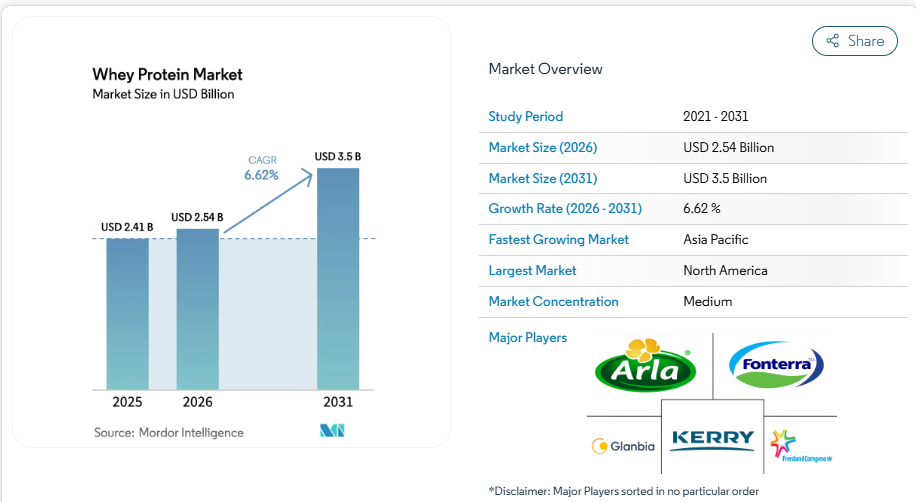
According to Mordor Intelligence, the whey protein market size is expected to grow from USD 2.54 billion in 2026 to reach USD 3.50 billion by 2031, registering a CAGR of 6.62% between 2026 and 2031. A shift toward higher-value whey formats is shaping growth, expanding demand across sports, infant, and clinical nutrition, and advances in membrane-separation technologies. Clean-label preferences and new consumer formats are also broadening whey protein's appeal beyond traditional sports nutrition.
Premium Whey Formats Reshape Market Value
The whey protein market is increasingly being influenced by value-mix improvements rather than volume growth alone. Processors are investing in membrane-separation systems that allow liquid whey to be directed into higher-margin ingredients, particularly whey protein isolates and hydrolysates.
These formats offer manufacturers opportunities to develop products with differentiated nutritional and functional characteristics. Their growing use across specialized nutrition categories is supporting premiumization throughout the whey protein value chain.
Isolates and Hydrolysates Gain Demand Across Nutrition Categories
Whey protein isolates and hydrolysates are gaining traction among brands operating in sports nutrition, infant formula, and clinical nutrition.
Their positioning reflects demand for protein ingredients that can support specific formulation requirements. As manufacturers move toward more specialized products, advanced whey processing is becoming increasingly important to market competitiveness.
U.S. Cheese Surplus Supports Whey Processing
The availability of whey as a co-product of cheese manufacturing remains an important factor for the industry. A record cheese surplus in the United States contributed to higher monthly whey output during 2024.
According to the data supplied for the market, monthly whey output increased from 93.6 million pounds in January 2024 to 97.8 million pounds in December 2024. This greater availability can support competitive input costs while providing processors with additional whey streams that can be redirected toward higher-value products.
Clean-Label Demand Broadens Whey Protein's Appeal
Whey protein is increasingly being positioned around transparency and quality rather than only athletic performance. Clean-label preferences are encouraging brands to communicate ingredient sourcing, formulation quality, and testing practices more prominently.
Direct-to-consumer brands are also using third-party testing results as part of their product positioning. This approach can strengthen consumer confidence and contribute to a broader premium narrative around whey-based products.
Clear-Whey Beverages Create New Consumption Occasions
The introduction of clear-whey beverages is expanding the ways consumers can incorporate whey protein into their daily routines.
Unlike traditional thick protein shakes, clear-whey products are designed around a lighter beverage experience. This format can appeal to consumers seeking convenient protein intake without the sensory profile associated with conventional protein drinks.
The development of such formats is helping whey protein move into broader mainstream wellness applications.
Whey Protein Moves Beyond Traditional Sports Nutrition
Sports nutrition remains an important application for whey protein, but the consumer base is becoming more diverse. Mainstream wellness consumers are increasingly interested in convenient sources of high-quality protein as part of everyday nutrition.
This broadening audience creates opportunities across food and beverages, supplements, and other functional nutrition categories. Product formats, flavor systems, and transparent testing are becoming increasingly important as brands compete for these consumers.
Get More Insights in Trends In English: https://www.mordorintelligence.com/industry-reports/global-whey-protein-market?utm_source=gracebook
Large-Scale Protein Hubs Reshape Competition
Competitive intensity is increasing as major dairy and nutrition companies invest heavily in protein-processing capabilities. Companies such as Fonterra, Glanbia, and Arla Foods are establishing large-scale protein hubs to strengthen production capabilities and capture opportunities in higher-value ingredients.
At the same time, regional specialists and plant-protein companies are emphasizing sustainability and differentiated sourcing. This creates a competitive environment where scale, processing expertise, and product positioning increasingly intersect.
Processing, Traceability, and Flavor Become Strategic Priorities
Technology and product development are becoming central competitive factors in the whey protein market. Companies are focusing on:
-
Advanced membrane-separation systems
-
Specialized processing for isolates and hydrolysates
-
Traceability across the supply chain
-
Flavor-masking technologies
-
Clean-label formulation
-
Product formats designed for mainstream consumers
Flavor masking is particularly relevant as manufacturers seek to make higher-protein formulations more appealing without compromising the desired nutritional positioning.
Whey Protein Market Segmentation
The whey protein market is segmented by product type, form, application, and geography.
By product type, the market includes:
-
Whey Protein Concentrate
-
Whey Protein Isolate
-
Whey Protein Hydrolysate
By form, the market covers:
-
Powder
-
Liquid
Applications include:
-
Animal feed
-
Food and beverages
-
Personal care and cosmetics
-
Supplements
Geographically, the market spans North America, Europe, Asia-Pacific, South America, and the Middle East and Africa, reflecting differences in dairy production, protein consumption, processing infrastructure, and end-use demand.
Whey Protein Market Forecast Through 2031
The whey protein market is projected to expand from USD 2.54 billion in 2026 to USD 3.50 billion by 2031, registering a 6.62% CAGR during the forecast period.
Future growth will depend increasingly on how efficiently manufacturers convert available whey streams into specialized, higher-value ingredients. Isolates and hydrolysates are expected to remain important as demand expands across sports, clinical, and infant nutrition.
Meanwhile, clear-whey beverages, clean-label positioning, direct-to-consumer brands, and improved traceability can continue broadening the consumer base. Processing efficiency and product differentiation will remain important as established dairy companies compete with regional specialists and alternative protein players.
According to Mordor Intelligence, the whey protein market is evolving from a volume-oriented dairy co-product business toward a more specialized ingredient market where processing technology, functionality, transparency, and consumer-focused innovation increasingly determine value creation.
Discover detailed market size, forecasts, segmentation, competitive analysis, product trends, and regional insights from Mordor Intelligence.
Japanese Report: https://www.mordorintelligence.com/ja/industry-reports/global-whey-protein-market?utm_source=gracebook