
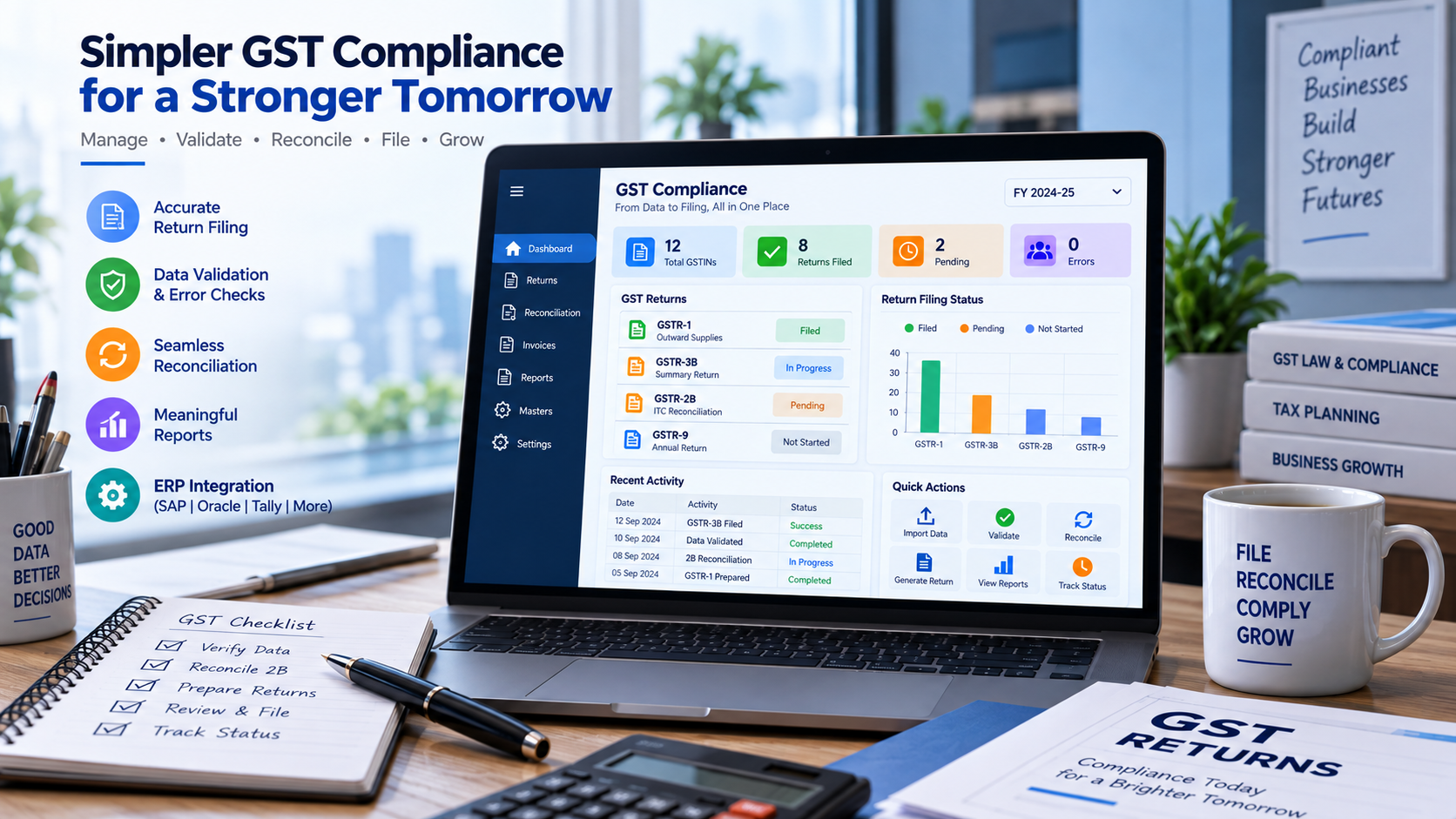
Choosing the best GST software for return filing depends on more than how quickly a return can be submitted. Businesses also need to consider how the software handles accounting data, validation, reconciliation, reporting, integrations, and the review process before filing.
GST returns contain detailed transaction information, and the quality of the underlying data directly affects the filing process. The GST Portal allows eligible taxpayers to prepare GSTR-1 online, use offline tools, or use third-party applications through the GST ecosystem.
For that reason, businesses evaluating GST software should look at the complete workflow rather than focusing on one feature.
What Should Good GST Return Filing Software Handle?
The right software should fit into the way a business already manages its financial records.
A basic filing tool may help transfer information into return forms. A more complete compliance system can connect accounting or ERP data with validation, reconciliation, return preparation, and reporting.
The key areas to examine include:
-
Data import and integration
-
GST data validation
-
Return preparation
-
Purchase reconciliation
-
ITC review
-
Filing status tracking
-
Compliance reporting
-
Security and access controls
The importance of each feature will depend on the size of the business, transaction volume, number of GST registrations, and existing accounting systems.
Data Integration Comes Before Return Filing
One of the first questions to ask is where the GST data will come from.
Many businesses already maintain their sales and purchase records in accounting software or ERP systems. If employees have to export information, modify spreadsheets, and manually enter the same data into a GST application, the process becomes more complicated.
ERP integration can reduce these additional steps.
Webtel's ERP-integrated GST solution states that it supports direct data imports from SAP S/4HANA, Oracle, Microsoft Dynamics, Tally, Busy, Excel, and other ERP systems. It also describes workflows for generating GST returns from imported sales and purchase data.
Businesses should therefore check whether a GST solution is compatible with the accounting platforms they already use.
Validation Is an Important Part of the Workflow
Before a return is filed, transaction data should be reviewed for missing or inconsistent information.
For example, invoice records may contain incorrect GSTINs, incomplete tax information, duplicate entries, or other data issues. If these problems are identified only during the final filing stage, correcting them can take additional time.
GST software with validation tools can bring these checks earlier in the process.
Webtel describes data validation and GST number validation for debtors and creditors within its ERP-integrated GST solution. Its GST filing software also lists enhanced data validation as one of its features.
Validation does not remove the need for professional review. It helps organise the review process and identify records that need attention.
Reconciliation Can Affect the Quality of the Filing
Return preparation and reconciliation are separate activities.
Reconciliation involves comparing information from different records to identify differences. For GST compliance, this can include comparing purchase records with information available through GST systems and reviewing potential differences in input tax credit.
This matters because the GST Portal provides specific data and filing workflows that need to be considered when preparing returns. For example, GSTR-1 contains outward supply information including invoice details, credit and debit notes, exports, amendments, and HSN/SAC summaries.
A GST solution should therefore make it easier to investigate differences before the return is finalised.
Webtel's ERP-integrated solution describes reconciliation between purchase registers and GSTR-2A/2B, as well as comparisons involving GSTR-1, e-way bills, e-invoices, and GSTR-3B.
Businesses should check what types of reconciliation the software actually supports rather than assuming every product provides the same functionality.
Support for GSTR-1 and GSTR-3B
The software should fit the returns applicable to the business.
GSTR-1 is the statement of outward supplies. The GST Portal allows taxpayers to prepare it online or upload a JSON file created using the offline tool. After reviewing the consolidated information, the taxpayer can proceed with filing through the prescribed authentication process.
GSTR-3B has its own preparation and filing workflow on the GST Portal. The portal provides facilities to preview the return, file it using the applicable authentication method, and download the filed return.
A GST application should make preparation easier without obscuring the underlying filing requirements.
When evaluating software, check which return forms are supported and whether the product is suitable for the filing frequency and taxpayer categories relevant to your business.
Reporting Helps Finance Teams Review Compliance
Filing software should also provide useful visibility after data has been imported and processed.
A finance team may need to know:
-
Which returns are prepared
-
Which returns are pending
-
Which records require review
-
What reconciliation differences remain
-
What filing activities have been completed
Without clear reporting, teams may have to maintain separate spreadsheets simply to track compliance work.
Webtel's GST filing solution describes a dashboard for tracking return status, while its ERP-integrated solution includes custom reporting for sales and purchase registers and GST return data.
This type of reporting becomes more useful as transaction volumes and the number of registrations increase.
Security Should Be Part of the Evaluation
GST software handles financial and transactional information, so businesses should examine how the application protects data.
Questions worth asking include:
-
Where is the software deployed?
-
What access controls are available?
-
How is data encrypted?
-
Does the provider support IP restrictions?
-
What security certifications or audits are applicable?
-
How are credentials and API access managed?
Webtel's ERP-integrated GST page describes features including TLS 1.2 support, IP whitelisting, 256-bit SSL encryption, VAPT audits, and ISO certifications. These are claims made by Webtel about its own solution and should be evaluated alongside the business's internal security requirements.
A Simple Way to Compare GST Software
Rather than selecting software based on a long feature list, businesses can map the product against their actual workflow.
| Evaluation area | What to check |
|---|---|
| Data import | Can it connect with your accounting or ERP system? |
| Validation | Can it identify incomplete or inconsistent GST data? |
| Reconciliation | Can it compare relevant purchase and GST records? |
| Return preparation | Does it support the returns your business needs? |
| Reporting | Can teams track filing and reconciliation status? |
| Integration | Can data move without unnecessary manual re-entry? |
| Security | Are access and data protection controls appropriate? |
| Scalability | Can the workflow handle growing transaction volumes? |
This approach makes the comparison more practical because a feature only matters when it addresses an actual business requirement.
When ERP Integration Makes More Sense
ERP integration becomes particularly relevant for businesses with large transaction volumes.
Consider a company that processes thousands of invoices each month. If its GST team has to export the data, clean it manually, upload it to another application, and then reconcile the results separately, the compliance process can become fragmented.
An integrated system can connect the source data with GST preparation and reconciliation.
Webtel describes its ERP-integrated GST solution as supporting multiple ERP environments and return workflows including GSTR-1, GSTR-3B, GSTR-9, GSTR-9C, and other GST forms.
For businesses using an ERP system, this makes integration capability an important selection criterion rather than an optional extra.
Common Mistakes When Selecting GST Software
A few selection mistakes are easy to avoid.
Choosing based only on price
The cheapest software may not support the integrations, reconciliation features, or reporting capabilities required by the business.
Focusing only on filing
Submitting returns is one part of GST compliance. Data preparation and reconciliation may require substantial work before filing.
Ignoring the existing ERP
If the organisation already uses SAP, Tally, Oracle, Microsoft Dynamics, or another accounting system, compatibility should be checked before implementation.
Assuming automation means no review
Automated validation and reconciliation can reduce repetitive work, but finance and tax teams still need to review exceptions and final information.
Not checking scalability
A solution that works for a small transaction volume may not provide the same workflow efficiency when the business expands.
The Right Software Depends on the Workflow
There is no single feature that determines whether GST software fits every business.
A small business with straightforward records may have different requirements from a company managing multiple GST registrations, large invoice volumes, and an ERP-based finance operation.
The evaluation should therefore start with the existing process. Identify where data comes from, where errors occur, how reconciliation is performed, how returns are reviewed, and how filing status is tracked.
From there, compare software against those requirements.
For businesses looking for a broader workflow covering data preparation, validation, reconciliation, and return filing, GST software for return filing can be considered as one option alongside other solutions in the market.
Frequently Asked Questions
What should I look for in GST return filing software?
Look for data integration, validation, reconciliation, return preparation, reporting, security, and compatibility with your existing accounting or ERP system.
Can GST software integrate with ERP systems?
Some solutions provide ERP integration. Webtel states that its ERP-integrated GST solution supports systems including SAP, Oracle, Microsoft Dynamics, Tally, Busy, Excel, and other ERP platforms.
Does GST software handle reconciliation?
Many GST applications provide reconciliation features, but the scope differs between products. Webtel describes GSTR-2A/2B reconciliation with purchase registers and other GST-related reconciliation workflows.
Does software replace the GST Portal?
GST software can support data preparation and filing workflows, but businesses remain subject to the applicable GST rules and filing procedures. The official GST Portal provides the filing environment and guidance for forms such as GSTR-1 and GSTR-3B.
Conclusion
Choosing GST software for return filing should start with the full compliance workflow rather than the filing button itself.
Data integration, validation, reconciliation, reporting, security, and scalability can all affect how efficiently a business manages GST work. The most suitable solution will depend on the organisation's transaction volume, accounting environment, GST registrations, and internal review process.
A careful feature and workflow comparison can help businesses choose software that fits their existing operations instead of forcing the finance team to build another disconnected process.