
Building a career in Cyber Security can be challenging for freshers because employers often look for evidence of practical understanding. A strong project portfolio can help bridge the gap between classroom learning and workplace expectations. Projects allow candidates to apply security concepts, work with relevant tools, analyze simulated problems, and document possible solutions. They also give freshers practical examples to discuss during interviews. Students pursuing a Cyber Security Course in Chennai can choose projects based on their interests and use them to demonstrate skills in areas such as network defense, vulnerability management, application security, monitoring, and incident response.
How Can Projects Make a Fresher's Resume More Meaningful?
A project adds context to the technical skills listed on a resume. Instead of simply mentioning networking or vulnerability assessment, a candidate can explain how those skills were applied to solve a particular security problem. A good project should have a clear goal, defined scope, suitable tools, documented results, and practical recommendations. Candidates should also understand the project thoroughly because interviewers may ask detailed questions about their decisions. A few well-developed projects can therefore provide more useful interview material than a long list of unrelated technologies.
Could a Network Defense Project Demonstrate Core Skills?
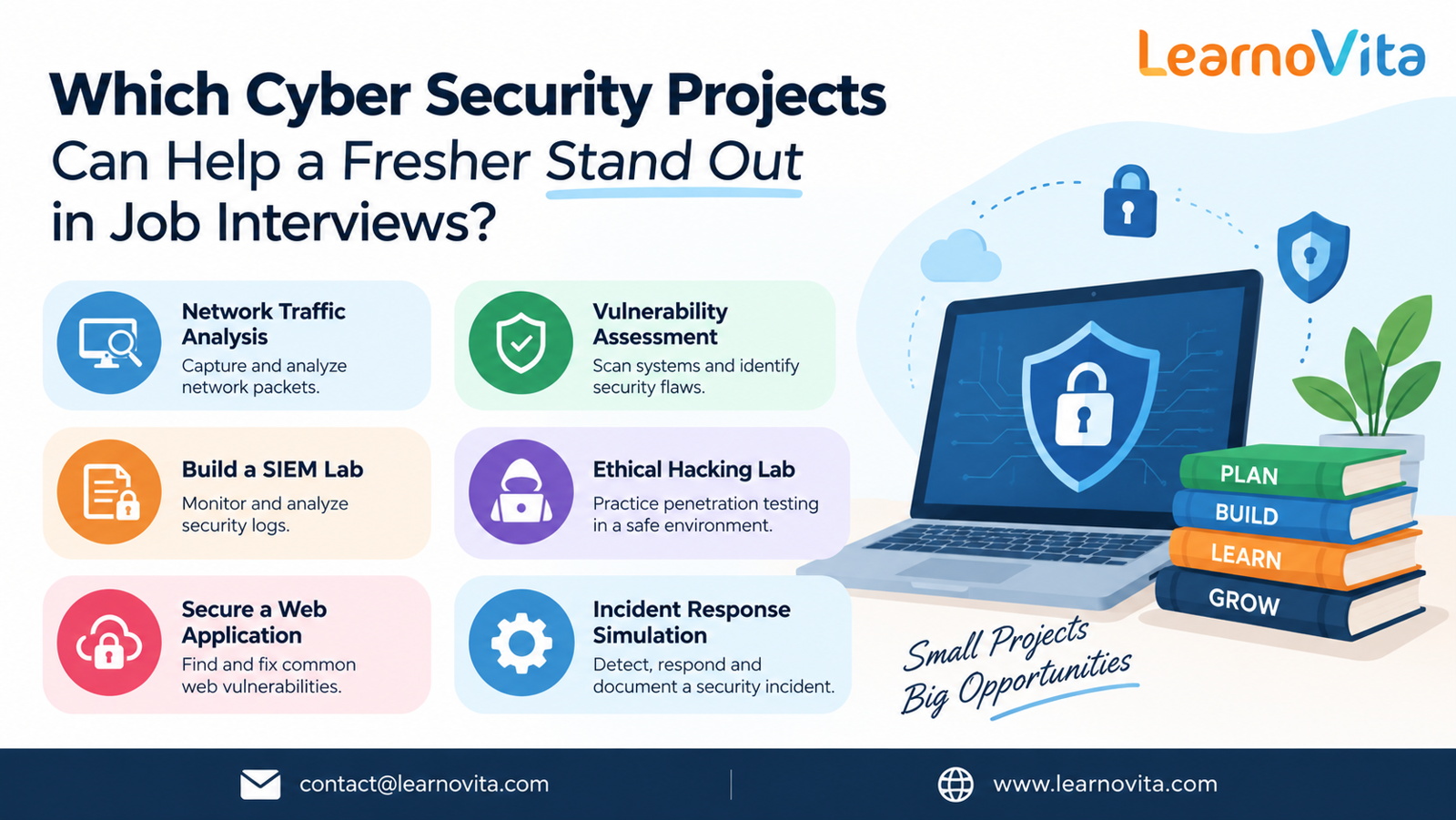
Network defense is a suitable project area for beginners because it builds on basic networking knowledge. A candidate can create an authorized lab environment and study sample traffic, communication protocols, and unusual connection patterns. The project can examine how controls such as firewalls, segmentation, secure configurations, and access restrictions contribute to network protection. Tools such as Wireshark can be used for learning and analysis in an appropriate environment. The final report can explain the observations and defensive recommendations, giving the fresher a practical topic to discuss during an interview.
Why Is Vulnerability Assessment Useful for Beginners?
Vulnerability assessment introduces freshers to a structured approach for finding and addressing security weaknesses. Candidates can work with deliberately vulnerable applications or systems created for educational purposes. They can identify issues, understand their possible impact, categorize the findings, and suggest remediation. The final documentation can include the problem, evidence, risk explanation, and recommended corrective action. Learners undertaking Cyber Security Training in Bangalore can use this type of project to demonstrate their understanding of security assessments while developing skills in technical reporting and risk communication.
Can a Phishing Awareness Project Show Security Understanding?
A phishing awareness project can help beginners explore the human side of Cyber Security. Candidates can develop a simulated awareness exercise using fictional messages and explain how users can recognize suspicious communication. Topics can include misleading URLs, unexpected attachments, urgent requests, suspicious login prompts, and social engineering techniques. A short awareness guide or checklist can be included as the project outcome. This approach demonstrates that security is not only about software and infrastructure; educating users is also an important part of protecting organizational systems and information.
What Skills Can a Security Monitoring Project Develop?
Security monitoring projects can introduce freshers to the process of reviewing system activity and identifying events that may require investigation. Candidates can work with sample logs from systems or applications and look for patterns such as repeated authentication failures or unusual access activity. They can categorize events and create a basic incident summary based on their observations. This project can help develop attention to detail and analytical thinking. It can also be useful for candidates preparing for security operations roles after completing Cyber Security Training in Hyderabad.
How Can Web Security Projects Help During Interviews?
Web security projects allow freshers to explore how application design can influence security. Candidates can use intentionally vulnerable applications created for learning and study topics such as authentication, authorization, input validation, and session management. Rather than focusing only on identifying a weakness, the project should explain why the problem exists and how it can be prevented. A documented report can include the issue, possible impact, and recommended security control. This gives candidates a practical example when interviewers ask about application security concepts.
What Can an Incident Response Simulation Demonstrate?
Incident response projects can show how a candidate approaches a security problem logically. A fresher can create a fictional scenario involving suspicious account activity, an unusual system event, or a simulated security alert. The project can cover detection, evidence collection, analysis, containment, recovery, and lessons learned. Candidates can also recommend steps to reduce the likelihood of similar incidents. Such a project can help freshers practice answering scenario-based questions because they already have experience thinking through a security event in a structured learning environment.
Is Identity and Access Management a Practical Project Idea?
Identity and Access Management is a useful project area because access control is central to protecting systems and data. Freshers can design a simulated organization with different departments and user roles, then assign permissions based on job responsibilities. The project can demonstrate concepts such as least privilege, role-based access control, password policies, and multi-factor authentication. Candidates can explain why users should receive only the access they require. This type of project is relatively easy to document and can help beginners demonstrate their understanding of an important security principle.
Should Cloud Security Be Included in a Fresher's Portfolio?
Cloud security projects can introduce candidates to modern infrastructure security. A beginner can work with an authorized cloud learning environment and explore areas such as identity permissions, storage protection, logging, monitoring, or secure configuration. The project can compare appropriate and inappropriate configurations and explain the risks associated with weak settings. Candidates should avoid using real organizational data or testing systems without permission. A well-documented cloud project can demonstrate that the fresher understands how security controls apply to cloud-based services.
How Can Freshers Use Security Tools Effectively?
Tools should be selected based on the project's requirements rather than simply added to a resume. Network projects may involve Wireshark or Nmap in authorized environments, while application security projects can use educational tools such as OWASP ZAP. Candidates interested in monitoring can explore appropriate log-analysis platforms. The important point is to understand the results produced by the tool. During an interview, freshers should be able to explain why they selected a particular tool, what information it provided, and how that information supported their findings.
What Is the Best Way to Explain a Project to an Interviewer?
A clear project explanation should follow a logical sequence. Candidates can begin with the problem or objective, describe the environment and approach, explain the tools used, present their findings, and finish with recommendations. Interviewers may ask about challenges, limitations, or alternative approaches. Freshers should be prepared to answer these questions honestly. They should also clearly identify personal, academic, or training projects instead of presenting them as professional experience. Good communication can make technical knowledge easier for interviewers to understand and evaluate.
How Can a Cyber Security Course Guide Project Selection?
A Cyber Security Course can help beginners understand the concepts required to build relevant projects. Fundamentals such as networking, Linux, authentication, vulnerability management, security monitoring, incident response, and cloud security can provide several project directions. Learners can then select projects based on the type of role they want to pursue. Combining course knowledge with practical project work allows candidates to identify their strengths and improve areas where they need more practice. A focused portfolio can also make job preparation more organized.
Conclusion
A strong project portfolio can help Cyber Security freshers demonstrate practical knowledge even before they gain professional experience. Network defense, vulnerability assessment, phishing awareness, security monitoring, web security, incident response, identity management, and cloud security all offer useful project opportunities. Freshers should focus on projects they understand well, complete all testing in authorized environments, and document their work clearly. When candidates can confidently explain the problem, process, findings, and security recommendations, their projects become useful evidence of their readiness for entry-level Cyber Security roles.