
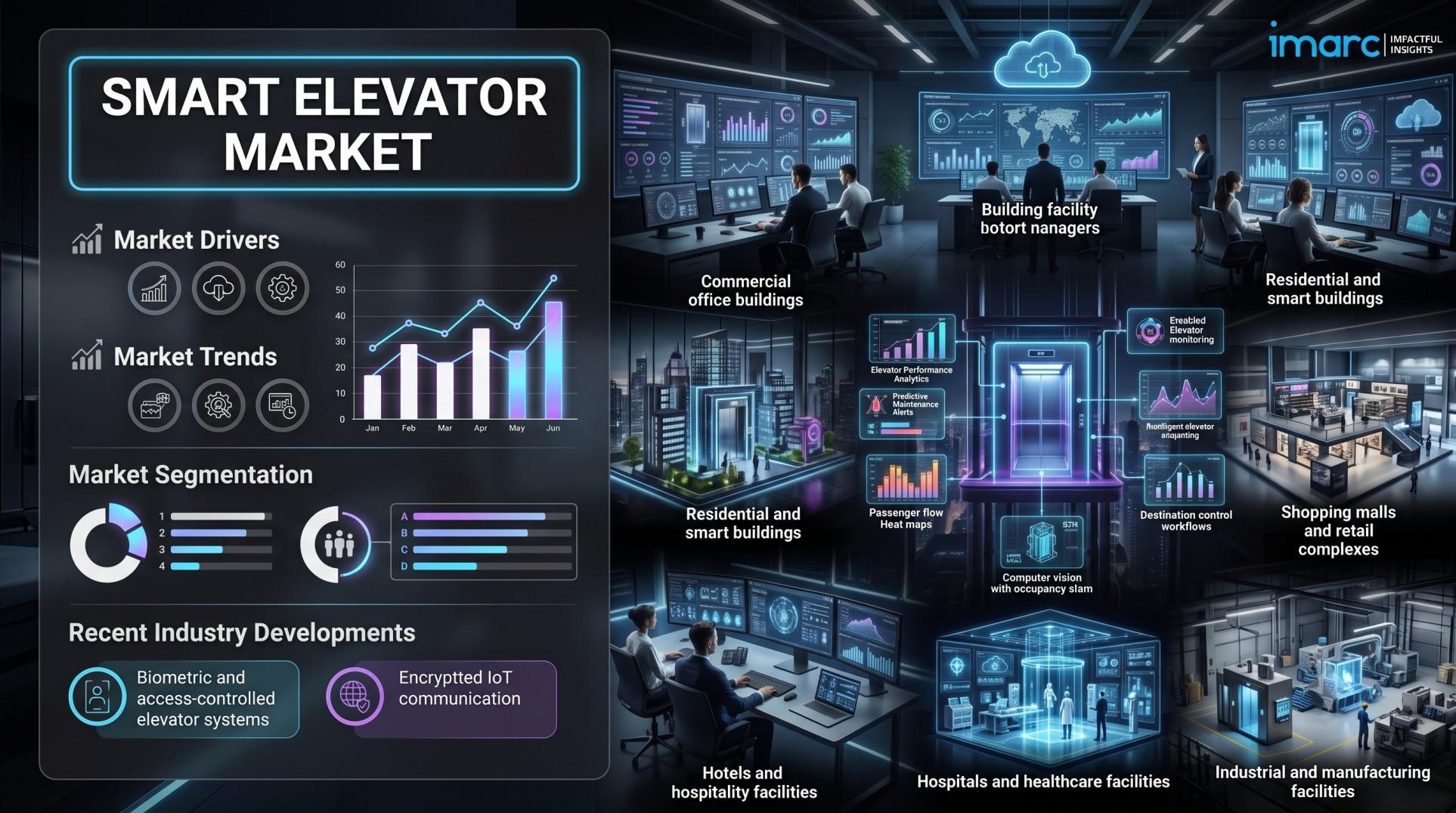
IMARC Group, a leading global market research and management consulting firm, has published its latest market intelligence report on the smart elevator market. The global smart elevator market size reached USD 32.7 Billion in 2025. Looking forward, IMARC Group expects the market to reach USD 62.5 Billion by 2034, exhibiting a growth rate (CAGR) of 7.25% during 2026-2034, driven by rapid urbanization, rising population density in cities, growing emphasis on sustainability and energy efficiency, and increasing accessibility requirements tied to an aging global population. Significant advancements in IoT integration, predictive maintenance algorithms, and touchless interfaces are reinforcing this growth trajectory. North America currently leads global adoption, supported by smart city initiatives and stringent building codes, while Asia Pacific is expanding rapidly on the back of large scale vertical construction across China, India, and Japan.
The broader momentum behind this market reflects a structural shift in how buildings are designed and operated. As cities densify and horizontal space becomes scarce, vertical construction is no longer just a real estate trend but an operational necessity, placing elevators at the center of building performance rather than treating them as a passive utility. Regulatory pressure around energy efficiency and accessibility is reshaping procurement decisions, pushing building owners toward regenerative drives, destination dispatch systems, and connected monitoring platforms. At the same time, the competitive landscape is undergoing one of its most significant structural realignments in decades, with major global players pursuing consolidation to capture recurring service revenue rather than one time installation sales. The convergence of digitalization, sustainability mandates, and urban infrastructure investment is positioning smart elevators as a strategically important category within the broader smart building ecosystem.
Smart Elevator Market at a Glance
- Current market size: USD 32.7 Billion
- Projected market size: USD 62.5 Billion
- Growth Rate 2026-2034: CAGR of 7.25%
- Leading solution segment: Control systems, covering security control and elevator control systems
- Leading application segment: Commercial buildings, including offices, retail centers, and mixed use developments
- Leading region: North America, supported by smart city initiatives and strict building codes
- Fastest expanding region: Asia Pacific, driven by high rise construction across China, India, and Japan
How AI is Reshaping the Future of the Smart Elevator Market
- Predictive maintenance at scale: Leading manufacturers including KONE and Otis have already implemented AI based predictive maintenance globally, including across the United States, using sensor data to detect wear patterns and schedule interventions before failures occur, reducing unplanned downtime for building operators.
- Condition monitoring platforms: AI driven diagnostic systems are increasingly paired with digital twin frameworks that correlate elevator usage, vibration, and performance data in real time, allowing facility managers to shift from fixed schedule servicing to condition based maintenance.
- Touchless and adaptive interfaces: Machine learning is being applied to destination dispatch systems and biometric access controls, enabling elevators to dynamically allocate cars based on real time passenger demand while supporting voice activation and gesture based floor selection.
Grab a sample PDF of this report: https://www.imarcgroup.com/smart-elevator-market/requestsample
Smart Elevator Market Trends and Drivers
The core driver of demand remains accelerating urbanization and the resulting shift toward vertical construction. As populations concentrate in dense urban centers with limited horizontal space, high rise residential and commercial towers are becoming the default building form, creating sustained demand for elevator systems capable of handling high passenger volumes while minimizing wait times and energy consumption.
A parallel structural driver is the tightening regulatory landscape around building energy performance. Smart readiness assessment frameworks in major economies are increasingly measuring a building's ability to optimize energy use, adapt to occupant needs, and respond to grid signals, placing elevator automation and monitoring systems squarely within the scope of compliance rather than treating them as optional upgrades.
This regulatory tightening is setting the stage for a broader transformation across the value chain, as manufacturers invest in energy efficient components and connected monitoring capabilities to meet evolving building codes. This dynamic is increasingly shaping the consolidation and capacity decisions covered in the competitive landscape sections below.
Global Regulatory, Trade, and Sustainability Landscape Shaping Demand
- EU Energy Performance of Buildings Directive (recast): The revised EPBD entered into force in May 2024 and must be transposed into national law by member states by 29 May 2026, introducing EU wide minimum energy performance standards for buildings and lowering the threshold for mandatory building automation from above 290 kW to above 70 kW by 2030.
- EU Smart Readiness Indicator: Now being piloted across 16 member states with more than a thousand properties assessed, the Smart Readiness Indicator evaluates building automation and monitoring systems, including elevator control functions, against energy efficiency, maintenance, and occupant comfort criteria, and is expected to become mandatory for large non-residential buildings under the recast EPBD.
- US Section 179D energy efficient building deduction: For qualifying retrofits beginning construction before the mid 2026 statutory deadline, commercial building owners can claim deductions ranging from roughly USD 0.59 to USD 1.19 per square foot for meeting energy performance thresholds, rising several times higher when prevailing wage and apprenticeship requirements are met, directly incentivizing smart building system upgrades including elevator modernization.
- US Energy Efficiency and Conservation Block Grant programme: Federally funded through the Department of Energy, this programme continues to support smart building modernization projects at the state and institutional level, funding upgrades such as automation systems and advanced building analytics that increasingly extend to vertical transportation infrastructure.
Key Government Schemes and Policy Programs Supporting the Industry
- India, Production Linked Incentive and Smart Cities push: India's elevator and vertical mobility sector, valued at close to USD 15 Billion and forecast to expand significantly, is lobbying for expanded PLI coverage for local manufacturing under Budget 2026, alongside continued support from the Smart Cities Mission and the Atal Mission for Rejuvenation and Urban Transformation, which are fueling 10 to 15 percent annual growth in vertical development across Tier II and Tier III cities.
- India, PLI Scheme for White Goods: While targeted primarily at air conditioners and LED components, this scheme has attracted 84 companies committing over Rs 10,478 crore in investment, building a component manufacturing ecosystem in electronics and control systems that adjacently benefits smart elevator control and access system suppliers localizing production in India.
- United States, Federal Smart Buildings Accelerator: Administered by the Department of Energy, this programme has provided federal facilities with technical support and assessments to promote adoption of smart building technologies, including automation systems relevant to elevator modernization across government owned properties.
- United States, state level modernization grants: Programmes such as the Energy Efficiency and Conservation Block Grant have funded institutional smart building upgrades, including a recent award of up to USD 403,000 to a US university for building automation and advanced analytics improvements.
- Saudi Arabia, Vision 2030 Giga projects: Large scale developments including Diriyah Gate, the Red Sea Project, and Qiddiya are driving substantial demand for passenger elevators, with Schindler securing a contract in 2024 to supply 134 Schindler 5500 elevators along with escalators and moving walks for a single multi purpose development in Riyadh.
Smart Elevator Industry Segmentation
Analysis by Solution:
- Control Systems (Security Control System, Elevator Control System)
- Access Control System (Maintenance Systems, Communication Systems)
- Services (Support and Maintenance, New Deployments, Modernization)
Control systems represent the largest segment, encompassing destination dispatch systems, predictive maintenance algorithms, and energy management software that together optimize elevator performance and reduce passenger wait times through real time demand analysis.
Analysis by Application:
- Residential
- Commercial
- Industrial
- Institutional
- Others
Commercial buildings hold the largest share, driven by high foot traffic in office towers, retail centers, and mixed use developments where destination dispatch and cloud based monitoring directly improve tenant satisfaction and operational efficiency.
Regional Analysis:
- North America: United States, Canada
- Asia Pacific: China, Japan, India, South Korea, Australia, Indonesia, and others
- Europe: Germany, France, United Kingdom, Italy, Spain, Russia, and others
- Latin America: Brazil, Mexico, and others
- Middle East and Africa
North America currently leads the market, supported by smart city initiatives in cities such as New York, Chicago, and San Francisco, alongside stringent building codes governing energy efficiency and accessibility.
Competitive Landscape
The competitive environment is undergoing its most significant structural shift in decades. The report profiles major companies including Fujitec Co. Ltd., Hitachi Lift India Pvt. Ltd., Hyundai Elevator Co. Ltd., KONE Corporation, Mitsubishi Electric US, Inc., Nidec Elevator, Otis Elevator Co., Schindler India Pvt. Ltd., TK Elevator, and Toshiba Elevators and Building Systems Corporation.
Service revenue has become the industry's primary profit engine, with Otis reporting that service represented 65 percent of its most recent full year net sales but drove 91 percent of segment operating profit, a pattern echoed across other listed players in the sector, reinforcing why recurring maintenance contracts rather than new installations are increasingly the strategic battleground among top manufacturers.
Market Concentration Analysis
- The global smart elevator market is undergoing active consolidation among its top players. In April 2026, Finland's KONE Corporation agreed to acquire Germany's TK Elevator in a deal valued at approximately EUR 29.4 Billion, or roughly USD 34.4 Billion, creating the world's largest elevator and escalator company by combined annual sales exceeding EUR 20.5 Billion and over 100,000 employees.
- The KONE-TK Elevator combination would reduce the number of major global competitors from four to three, a shift that rival Schindler is formally challenging on antitrust grounds, while some analysts suggest fewer major bidders per contract could ultimately benefit Otis's competitive position.
- Consolidation is not limited to the top tier. European private equity firm EQT launched an approximately USD 2.7 Billion tender offer in 2025 to take Japan's Fujitec private, while TK Elevator separately finalized a USD 185.3 Million joint venture to build regional elevator and escalator manufacturing capacity, indicating that mid tier players are also restructuring to defend share against the largest global manufacturers.
What Does The Full Report Cover?
- Historical performance and outlook across solution and application segments
- Detailed breakdown of regional and country level market dynamics
- Porter's Five Forces analysis covering competitive rivalry, supplier power, and buyer power
- Profiles of major players with strategic positioning and product portfolio analysis
- Assessment of key market drivers, restraints, and emerging opportunities
- Impact analysis of regulatory and sustainability trends on smart building adoption
- Strategic recommendations for stakeholders across the value chain
Recent News and Developments in Smart Elevator Market
- April 2025: Schindler Elevator Corporation launched the Schindler 5000, a machine room less elevator designed for low to mid rise offices, hotels, and hospitals, expanding its portfolio of connected vertical transportation solutions in the United States.
- December 2025: KONE introduced its High-Rise MiniSpace DX elevator, later making its regional debut in Melbourne's BLVD tower at Melbourne Square, showcasing compact, energy saving next generation high rise elevator technology.
- 2025: Otis secured a government contract to modernize lifts for the NSW Land and Housing Corporation, upgrading aging social housing infrastructure with improved safety, reliability, and smart maintenance technology.
- April 2026: KONE Corporation announced its agreement to acquire TK Elevator in a deal worth approximately USD 34.4 Billion, with KONE's Extraordinary General Meeting formally approving the transaction in June 2026.
- 2025: EQT launched an approximately USD 2.7 Billion tender offer to take Japan's Fujitec private, reflecting continued private equity interest in mid tier elevator manufacturers.
- August 2024: Schindler Olayan announced it would supply 134 Schindler 5500 elevators along with escalators and moving walks to phase one of The Avenues development in Riyadh, Saudi Arabia, supporting Vision 2030 Giga project infrastructure.
Note: If you require specific details, data, or insights that are not currently included in the scope of this report, we are happy to accommodate your request. As part of our customization service, we will gather and provide the additional information you need, tailored to your specific requirements. Please let us know your exact needs, and we will ensure the report is updated accordingly to meet your expectations.
Key Questions This Report Answers
- How big is the smart elevator market currently, and what is its growth outlook?
- Which solution and application segments hold the largest market share?
- Which region leads global adoption of smart elevators, and why?
- How are energy performance regulations reshaping elevator modernization decisions?
- What role is artificial intelligence playing in predictive maintenance and passenger experience?
- How is the competitive landscape being reshaped by major consolidation activity?
- What government schemes and policy programs are supporting industry growth across major regions?
About Us
IMARC Group is a global management consulting firm that helps the world's most ambitious changemakers to create a lasting impact. The company provides a comprehensive suite of market entry and expansion services. IMARC offerings include thorough market assessment, feasibility studies, company incorporation assistance, factory setup support, regulatory approvals and licensing navigation, branding, marketing and sales strategies, competitive landscape and benchmarking analyses, pricing and cost research, and procurement research.
Media and Sales Contact
IMARC Group
Email: sales@imarcgroup.com
United States: +1-201-971-6302
India: +91-120-433-0800
United Kingdom: +44-753-714-6104