
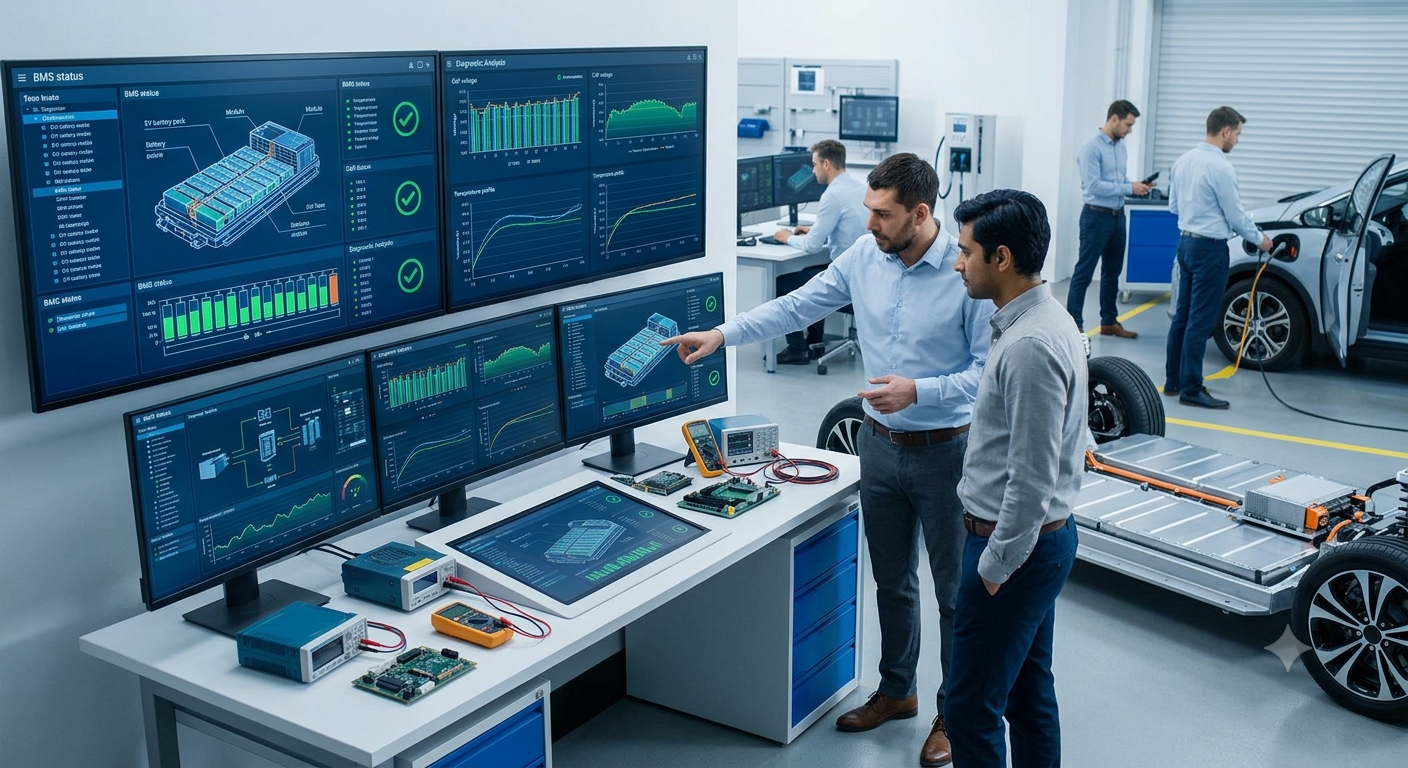
Battery health drives every conversation an EV fleet has with its riders and operators. When degradation goes unmonitored, complaint volume climbs fast, and BMS support becomes the difference between a proactive fleet and a reactive one.
Why Battery Complaints Are Rising Across EV Fleets
Degradation isn't rare. It's expected. Geotab's analysis of over 22,700 electric vehicles found an average annual degradation rate of 2.3%, with high-power DC fast charging nearly doubling that rate compared to low-power charging. Without dedicated monitoring, fleets only learn about these patterns after a rider files a complaint.
That reactive cycle is expensive. Every unresolved battery alert becomes a support ticket, a churn risk, or a warranty dispute. Consequently, the fastest way to reduce complaint volume is to close the gap between when a battery issue starts and when someone notices it.
What BMS Support Actually Covers
Effective BMS support is not a single task. It spans the full battery lifecycle, from charge-cycle tracking to failure prediction:
- Continuous monitoring of state of health (SOH) and state of charge (SOC) trends
- Charge-cycle and thermal-stress tracking across fleet vehicles
- Real-time alerting on abnormal degradation, voltage imbalance, or overheating
- Root-cause diagnostics when a battery underperforms its expected curve
- Coordination with OEMs and warranty teams once a hardware fault is confirmed
Because these tasks touch onboard sensors, telematics, and connected apps, IoT and smart device monitoring forms the backbone of any serious BMS support program.
How Outsourced BMS Support Reduces Complaint Volume
Outsourced teams catch degradation earlier because monitoring never stops. A 24/7 desk flags anomalies at 3 a.m. just as readily as at 3 p.m., so issues get resolved before a rider ever notices a range drop.
Trained agents also triage faster. Instead of routing every battery alert to an internal engineer, technical support teams already fluent in BMS diagnostics can separate a genuine cell fault from a software glitch within minutes, not days.
Scale matters too. As fleets grow, so does alert volume, and internal teams rarely grow at the same pace. Outsourcing through managed IT services lets fleet operators add monitoring capacity without adding headcount, which keeps response times flat even as the fleet expands.
In-House vs. Outsourced BMS Support
| Factor | In-House BMS Support | Outsourced BMS Support |
|---|---|---|
| Coverage hours | Typically business hours only | 24/7, including holidays and peak periods |
| Time to detect degradation | Often reactive, post-complaint | Proactive, alert-driven |
| Scaling cost | Rises with fleet size and headcount | Flexes with usage, no new hires needed |
| Diagnostic speed | Depends on internal specialist availability | Dedicated BMS-trained agents on standby |
| Warranty coordination | Handled ad hoc | Structured workflow with OEM communication |
Where BMS Support Fits Into the Broader E-Mobility Stack
BMS support rarely operates in isolation. It works alongside charging infrastructure monitoring, telematics, and app support, all of which shape whether a rider trusts the platform at all.
Fleets that treat battery monitoring as one piece of a connected support model, rather than a standalone function, tend to scale faster with fewer support bottlenecks.
Getting Started with Outsourced BMS Support
Battery complaints don't need to be a fixed cost of running an EV fleet. With proactive monitoring, faster diagnostics, and structured warranty coordination, Ev tech support turns a reactive support queue into a predictable operation. provider like SupportSave builds this exact model for EV fleets, charging networks, and rider platforms that need battery issues caught before they become complaints.