
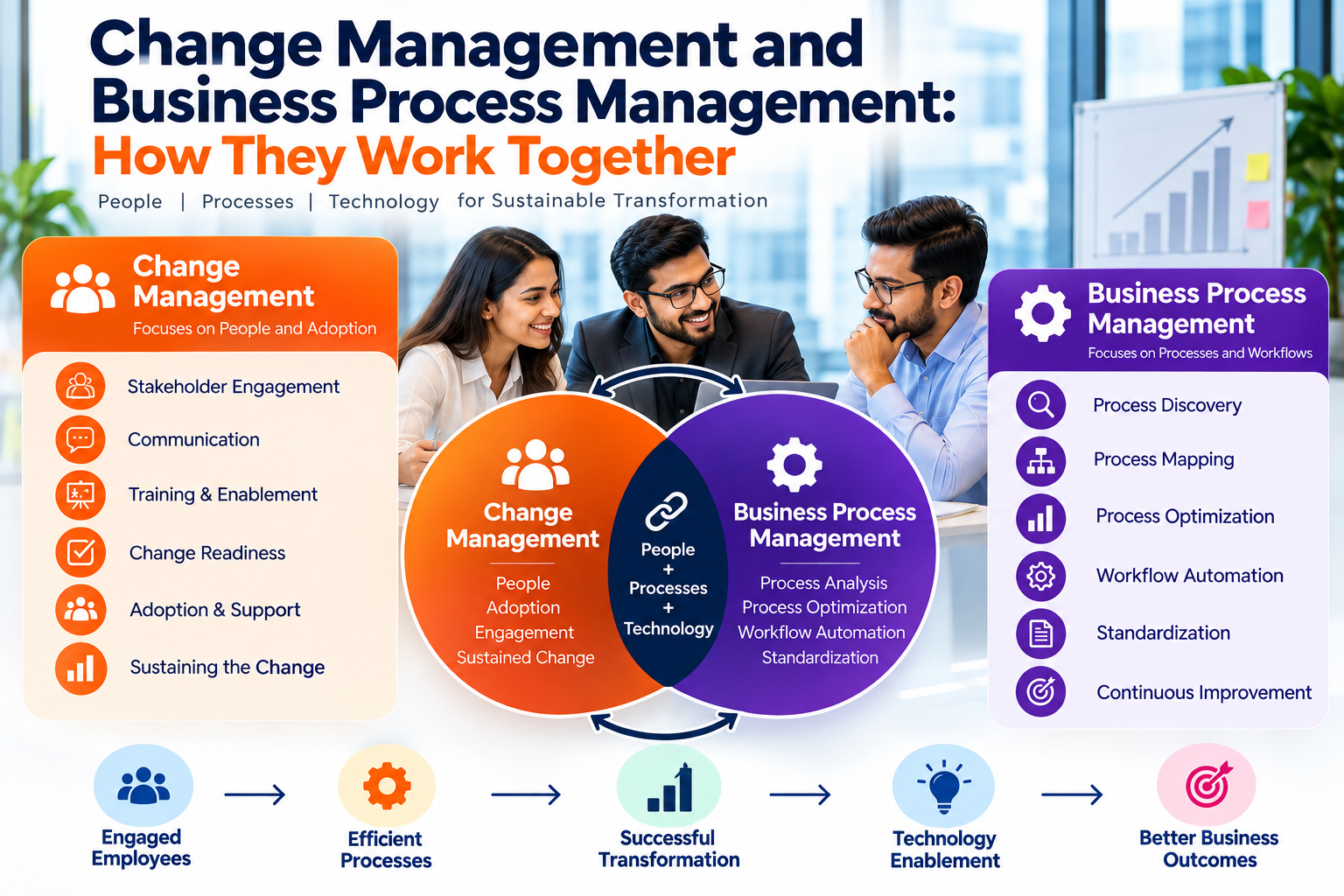
Change management and Business Process Management (BPM) address two closely connected parts of business transformation: people and processes. BPM helps organizations analyze, redesign, optimize, and automate workflows, while change management helps employees and stakeholders understand, adopt, and sustain those changes.
When these disciplines work together, businesses can approach digital transformation more systematically—aligning people, processes, and technology instead of treating technology implementation and employee adoption as separate activities.
XAAS Genie Consulting's current service and content portfolio places strong emphasis on BPM, workflow automation, process optimization, low-code/no-code solutions, and digital transformation. Its BPM content describes process analysis, optimization, standardization, and automation as foundations for operational improvement.
What Is Change Management?
Change management services is a structured approach for helping people and organizations move from an existing way of working to a new one.
Business changes can include:
- Implementing a CRM or ERP
- Automating manual workflows
- Introducing AI or automation
- Moving from spreadsheets to digital applications
- Redesigning approval processes
- Integrating business systems
- Introducing low-code/no-code applications
- Restructuring operational responsibilities
- Implementing new policies or procedures
The technology may enable the change, but employees ultimately need to understand and adopt the new processes.
This is where change management services become relevant.
What Is Business Process Management?
Business Process Management focuses on understanding and improving how work gets done across an organization.
A typical BPM initiative can involve:
- Discovering existing processes
- Mapping workflows
- Identifying bottlenecks
- Analyzing process performance
- Redesigning inefficient workflows
- Standardizing processes
- Automating repetitive activities
- Monitoring results
- Continuously improving the process
XAAS Genie describes BPM as a foundation for process digitization and optimization and provides capabilities around platform strategy, visioning, solution prototyping, implementation, migration, and low-code/no-code Centers of Excellence.
Change Management vs. Business Process Management
Although they are closely related, they solve different problems.
| Change Management | Business Process Management |
|---|---|
| Focuses on people and adoption | Focuses on processes and workflows |
| Helps employees understand change | Analyzes how work is performed |
| Supports communication and training | Identifies process bottlenecks |
| Manages transition | Redesigns and optimizes workflows |
| Supports adoption | Supports automation |
| Monitors behavioral adoption | Monitors process performance |
| Helps sustain change | Enables continuous process improvement |
Neither replaces the other.
A business may have an excellent process design but struggle with adoption. Similarly, employees may be well trained on a new system while the underlying process remains inefficient.
Combining the two addresses both sides.
Why Should Change Management and BPM Work Together?
1. Process Changes Affect People
Consider a manual purchase approval process:
Employee Request → Email → Manager → Procurement → Finance
A BPM initiative might redesign it as:
Digital Request → Automated Routing → Approval → Procurement → Finance
The new workflow may be more structured and automated, but employees now have to work differently.
They may need to understand:
- Where to submit requests
- Which information is required
- Who approves the request
- How notifications work
- How escalations happen
- Where to track status
BPM improves the workflow. Change management helps people adopt it.
2. Automation Changes Employee Responsibilities
Automation can remove repetitive tasks, but it can also change roles and responsibilities.
For example, an automated CRM workflow could handle:
- Lead assignment
- Follow-up reminders
- Notifications
- Data updates
- Approval routing
- Reporting
XAAS Genie currently describes CRM solutions that are configured around actual sales processes, with lead/deal automation, reporting, and sales-team enablement.
From a BPM perspective, these are process improvements.
From a change-management perspective, employees need to understand what has changed in their daily workflow.
The Change Management Process Within a BPM Project
A practical change management process can run alongside the BPM lifecycle.
Stage 1: Understand the Current Process
BPM teams map the existing workflow.
Change management teams identify:
- Stakeholders
- Process owners
- End users
- Teams affected
- Potential concerns
- Training requirements
This creates a shared understanding of the current state.
Stage 2: Design the Future Process
BPM specialists redesign the workflow.
At the same time, change management teams ask:
How will this new process affect employees?
This can reveal potential adoption challenges before implementation.
Stage 3: Communicate the Change
Employees should understand:
- Why the process is changing
- What is changing
- When it will happen
- How their responsibilities will change
- What support will be available
Communication should be connected to the actual process changes rather than being treated as a separate corporate announcement.
Stage 4: Train Users
Training should reflect the new workflow.
Instead of simply teaching employees how to click through software, organizations can train them on:
New Process + New Technology + New Responsibilities
This is particularly important during CRM, ERP, workflow automation, and low-code/no-code implementations.
Stage 5: Implement and Support
Once the new process goes live, employees may encounter issues that were not visible during design.
Organizations can collect:
- User feedback
- Support requests
- Process exceptions
- Adoption data
- Workflow performance data
BPM teams can use this information to improve the process, while change management teams can address adoption issues.
Stage 6: Measure and Improve
Transformation shouldn't necessarily end at go-live.
Organizations can monitor both:
People metrics
- Adoption
- Training completion
- User engagement
- Feedback
- Support requests
Process metrics
- Processing time
- Approval time
- Error rates
- Automation rates
- SLA performance
- Process exceptions
This creates a continuous improvement cycle.
How BPM Supports Change Management
BPM can make change management more concrete.
Instead of telling employees:
"We're transforming the business."
Organizations can show them:
Current Workflow → Future Workflow → What Changes → Why It Changes → How It Works
Process maps and workflow diagrams can help employees understand exactly what is different.
This can make communication and training more practical.
How Change Management Supports BPM
The relationship also works in the opposite direction.
A technically optimized process may still fail to deliver its intended benefits if employees don't use it as designed.
Change management can support BPM by helping with:
- Stakeholder alignment
- Process ownership
- Communication
- Training
- Adoption
- Feedback
- Reinforcement
- Continuous improvement
This helps turn a redesigned process into an operational practice.
Change Management + Workflow Automation
Workflow automation is one area where the two disciplines frequently intersect.
XAAS Genie discusses BPM together with RPA, intelligent automation, workflow automation, and Zoho-based solutions for areas including finance, HR, sales, procurement, and customer service.
For example, a company might automate an employee onboarding process:
Before Automation
HR email → Manager → IT → Finance → HR records → Employee
After Automation
Employee data → Automated workflow → Task assignment → Notifications → Approvals → Completion
The BPM component determines how the process should work.
The automation component executes the workflow.
The change management component helps HR, IT, managers, and employees adapt to the new process.
Change Management + Low-Code/No-Code
Low-code/no-code platforms can accelerate process digitization, but faster implementation does not automatically guarantee adoption.
XAAS Genie positions low-code/no-code solutions alongside BPM and workflow automation to help organizations digitize and optimize business operations.
When implementing a low-code application, organizations still need to consider:
- Who will use the application?
- Which processes are changing?
- What training is required?
- Who owns the process?
- How will users provide feedback?
- What governance is required?
- How will the solution evolve?
This is where change management complements the technical implementation.
The Role of a Change Management Consultant
A change management consultant can help organizations coordinate the people side of transformation.
Depending on the project, their responsibilities may include:
Stakeholder Analysis
Identifying the people and teams affected by the transformation.
Change Impact Assessment
Understanding how new processes, systems, or technologies will affect different roles.
Communication Planning
Creating communication strategies for different stakeholder groups.
Training Strategy
Defining what employees need to learn and when.
Adoption Planning
Developing approaches for encouraging and measuring adoption.
Resistance Management
Identifying concerns and addressing them through communication, involvement, training, or process adjustments.
Post-Implementation Support
Helping teams adapt after the new process or technology goes live.
A consultant can therefore act as a bridge between business leadership, process owners, technology teams, and end users.
A Practical Framework: People + Process + Technology
A useful way to connect change management and BPM is through three areas:
People
Change Management
- Communication
- Training
- Stakeholder engagement
- Adoption
- Feedback
Process
BPM
- Process discovery
- Process mapping
- Optimization
- Standardization
- Continuous improvement
Technology
Digital Transformation
- Workflow automation
- CRM/ERP
- Low-code/no-code
- System integration
- Analytics
- AI
The three areas should work together.
If technology changes but the process doesn't, organizations may automate inefficient work.
If the process changes but people aren't prepared, adoption can suffer.
If people are trained but technology doesn't support the redesigned process, manual work may continue.
How XAAS Genie Consulting Connects These Areas
XAAS Genie Consulting's current positioning brings together BPM, workflow automation, low-code/no-code solutions, CRM transformation, and digital transformation. Its content emphasizes aligning people, processes, and technology to create scalable operational improvements.
For example, XAAS Genie describes its approach to manufacturing transformation around BPM, workflow automation and low-code/no-code technologies, with an emphasis on process visibility, standardized workflows and operational efficiency.
This type of process-first approach can help businesses ask an important question before implementing technology:
"What should the process look like?"
Rather than:
"Which technology should we install?"
Once the desired process is clear, technology and change-management activities can be aligned around it.
When Should Businesses Combine Change Management and BPM?
Businesses should consider combining both disciplines when a transformation affects both how work is performed and how employees perform that work.
Common examples include:
- CRM implementation
- ERP implementation
- Business process automation
- Digital transformation
- Workflow redesign
- Low-code/no-code implementation
- AI adoption
- Department-wide process changes
- Legacy-system replacement
- Enterprise system integration
The larger and more cross-functional the transformation, the more important coordination between people, processes, and technology becomes.
Common Mistakes to Avoid
Automating Before Understanding the Process
Automation can accelerate an inefficient workflow if the underlying process hasn't been reviewed.
Treating Training as the Entire Change Strategy
Training is important, but adoption also depends on communication, process design, leadership, support, and user experience.
Ignoring Process Owners
Employees closest to the workflow often understand practical issues that may not appear in high-level process documentation.
Measuring Only Technology Implementation
A system being technically live does not necessarily mean the organization has achieved its intended operational outcomes.
Ending Change Management at Go-Live
Employees often need additional support after implementation as they encounter real-world scenarios.
Final Thoughts
Change management and Business Process Management work best as complementary disciplines.
BPM helps answer:
How should the work be performed?
Change management helps answer:
How will people adopt the new way of working?
Technology helps answer:
How can the redesigned process be enabled, automated, connected, and measured?
Together, these disciplines create a more connected approach to digital transformation.
For organizations looking to combine change management services, BPM, workflow automation, process optimization, and digital transformation, XAAS Genie Consulting's process-focused approach provides a relevant framework for connecting business requirements with technology and operational improvement.