
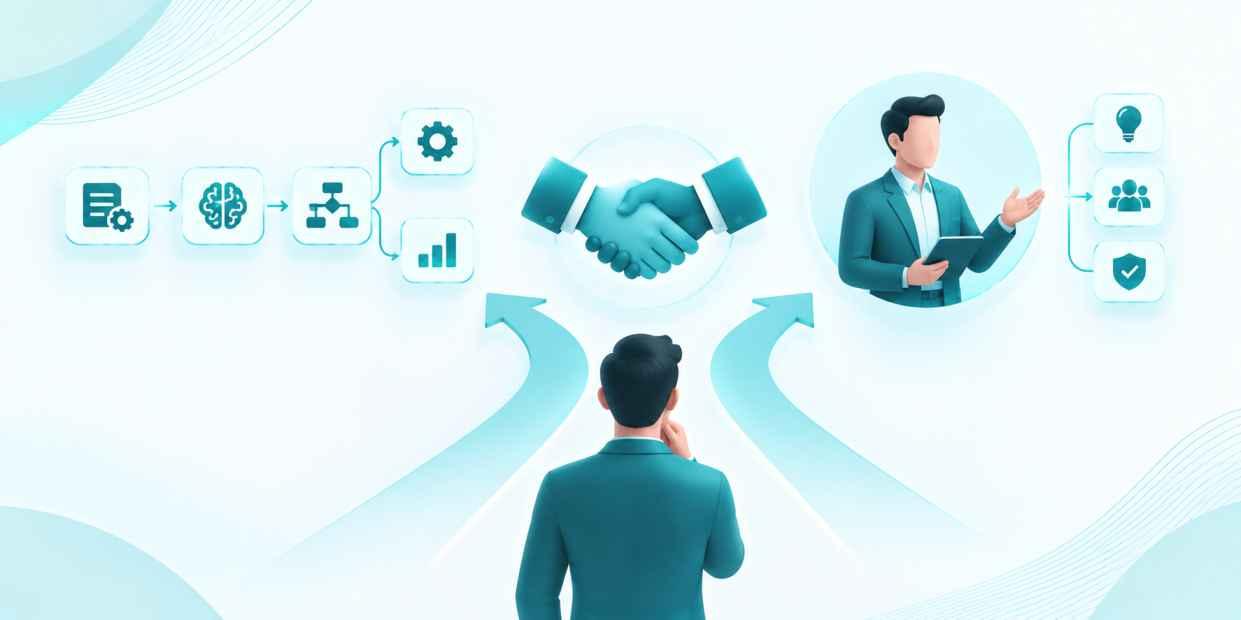
Tech companies don't need convincing that AI matters — most already have engineers experimenting with it. The real question is different: who do you bring in when your team has the skill but not the bandwidth, the domain depth, or the production track record to ship AI safely at scale?
1. Why Is This Different for Tech Companies?
Generic AI consulting guides assume you're starting from zero. Tech companies usually aren't — you already have engineers, a codebase, and opinions about your stack.
The real evaluation question isn't "do we understand AI." It's whether a partner can:
- Slot into your existing architecture
- Respect your engineering standards
- Hand back a system your own team can maintain
Most guides skip this stack-compatibility angle entirely.
2. Why Do Most AI Initiatives Fail to Deliver ROI?
The data is consistent across independent sources:
- Gartner: only 28% of AI use cases fully meet ROI expectations; 20% fail outright
- MIT Project NANDA: 95% of organizations deploying generative AI saw zero measurable return
- Gartner (separate survey): 63% of organizations aren't confident their data management is AI-ready
The pattern: failure starts with data and integration, not model choice. A partner who audits your data before quoting a timeline catches this early. One who skips straight to a proposal builds on top of the problem.
3. What Types of AI Consulting Partners Exist?
| Type | Best for | Watch out for |
| Big Four / Global SI | Enterprise-wide, heavily regulated rollouts | Slow (8–12 months), expensive ($150K–$500K+), overkill for most product teams |
| Boutique AI specialists | Validating a use case or shipping a fast pilot | Smaller teams, limited parallel capacity |
| Platform-tied consultancies | Teams already standardized on AWS/Azure/etc. | May recommend what they know, not what fits |
| Web3/AI-native specialists | Products touching on-chain data, tokenized assets, smart-contract logic | Rarely covered in generic guides — but critical if your stack is decentralized |
This last category is where a firm like PrimaFelicitas, built across both blockchain and AI development, has an edge a pure-AI consultancy doesn't.
4. Traditional AI vs. GenAI/Agentic AI — Different Evaluation Needed
Years of experience building forecasting models or recommendation engines doesn't automatically transfer to deploying LLMs or autonomous agents.
- Traditional ML → judged on precision, recall, drift monitoring
- GenAI/agentic AI → needs a partner who can explain output-quality evaluation, hallucination control, prompt versioning, and autonomy boundaries
This matters more under the EU AI Act's high-risk provisions, which apply based on what a task does, not what industry you're in — a scheduling agent is low-risk; the same agent evaluating employee performance isn't.
5. Deal-Breakers Before You Sign
Two answers should never be vague:
- IP ownership — who owns the source code, prompts, fine-tuned models, and documentation once the engagement ends
- Data governance — how data moves through the system, where it's stored, which regulations apply (GDPR, EU AI Act, industry-specific rules)
Everything else is negotiable. These two aren't.
6. What to Weigh Once Deal-Breakers Are Cleared
- Production track record — ask for systems still running today, not proof-of-concept decks
- Technology-agnostic recommendations — a real partner can name a platform they've recommended against, and why
- Named delivery team — confirm who actually does the work, and the continuity plan if key people leave
- Knowledge transfer — your engineers should be able to maintain the system independently within a defined window
- Milestone-based pricing — fixed deliverables and outcome-based checkpoints beat open-ended hourly billing
7. Build In-House, Hire a Partner, or Go Hybrid?
- Hybrid usually wins if your team has the skill but not the hours — bring in a partner for discovery and build, then transition ownership internally
- Specialist partner is the only realistic path when the project needs expertise you genuinely lack — e.g., Web3-integrated AI agents
- Pure in-house only makes sense when you already have both skill and bandwidth — rarer than most engineering leads assume
8. Red Flags That Should End the Conversation
- ROI numbers offered before any discovery work happens
- Same tech stack recommended to every client regardless of the problem
- No answer on how they monitor performance or handle drift after launch
- Delivery team stays anonymous until after signing
- Every reference sounds like a flawless success story
9. Questions to Ask Before Signing
- What happens if we hit day 90 and results aren't there — have you ever redirected a failing engagement?
- If any work is subcontracted, who touches our data, and under what agreement?
- What's your process if an autonomous agent takes an action it shouldn't have, once live?
- What happens to our data, prompts, and fine-tuned models on your systems once the engagement ends?
- Who's responsible for reclassifying the system's risk level if scope changes post-deployment?
10. How to Run the Selection Process
- Build a long list — use production case studies and technical content, not just search rankings
- Write a problem-first RFP — describe your data, constraints, and success metrics; don't prescribe the solution
- Run technical deep-dive sessions — with your own engineers in the room, not just leadership
- Negotiate beyond price — ownership, support terms, and exit conditions matter as much as the rate card
11. Where AI and Blockchain Intersect
If your product involves on-chain data, decentralized identity, or smart-contract-driven logic, a generalist AI consultancy will spend your budget learning infrastructure it doesn't already understand. This is where a firm operating across Web3 and AI consulting— rather than treating them as separate practices — closes a gap most AI-only or blockchain-only vendors can't.
FAQs
What's the difference between an AI consulting partner and an AI development vendor?
A consulting partner helps define strategy and evaluate feasibility; a development vendor builds and deploys. Many firms, including PrimaFelicitas, cover both under one roadmap.
How long does onboarding an AI consulting partner usually take?
A focused discovery and scoping phase runs a few weeks; full implementation timelines depend on scope and integration complexity.
Do tech companies need a different evaluation process than non-tech businesses?
Yes — stack compatibility, codebase ownership, and engineering-team fit matter more than they do for non-technical buyers.
How do you evaluate a partner for agentic AI versus traditional ML work?
Ask how they test output quality, control autonomous actions, and monitor behavior after deployment — criteria traditional ML evaluation doesn't cover.