
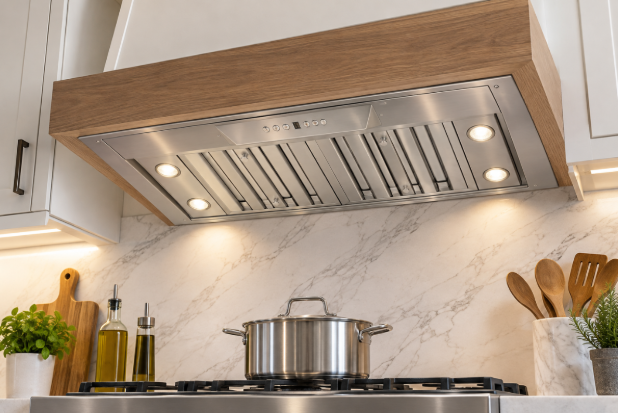
A range hood insert is designed to provide ventilation while being integrated into a custom cabinet or hood enclosure. Unlike a finished wall-mounted or island hood, an insert is largely concealed within the surrounding structure, allowing homeowners to create a more built-in appearance.
Choosing the right insert requires more than matching the appliance width to the cooktop. Airflow, cabinet dimensions, ductwork, filter type, lighting, noise, and cooking habits can all affect how well the system performs. For homeowners considering a 36 hood insert, understanding these factors before installation can help ensure the ventilation system fits both the kitchen design and cooking requirements.
What Is a Range Hood Insert?
A 36 hood insert is the ventilation component installed inside a custom-built cabinet, wood hood, or other enclosure. The enclosure provides the visible exterior, while the insert contains the blower, filters, controls, lighting, and other ventilation components.
This configuration can be useful when homeowners want the ventilation system to blend into the cabinetry rather than becoming a dominant visual feature.
Because the insert is installed within another structure, accurate measurements are particularly important. The cabinet opening, insert dimensions, duct connection, and available installation space all need to work together.
Choosing the Correct Insert Size
One of the most important considerations is understanding the difference between cooktop size, cabinet opening, and insert size.
For example, a 36 hood insert surface does not necessarily require a 36-inch insert. Proline's current guidance for inserts recommends an insert that is approximately two inches smaller than the cabinet opening. A 36-inch cabinet opening, for instance, would correspond to a 34-inch insert.
This distinction is important because the insert must physically fit inside the enclosure while still providing appropriate ventilation coverage.
Before ordering, homeowners should carefully measure the planned opening and compare those measurements with the manufacturer's installation specifications.
Consider Your Cooking Habits
Ventilation requirements vary considerably depending on how a kitchen is used.
Someone who primarily prepares low-temperature meals may have different requirements from a homeowner who regularly uses multiple burners, high heat, frying, grilling, or other cooking methods that generate larger amounts of smoke and grease.
Higher-CFM systems can provide greater airflow, but maximum airflow is not automatically the best choice for every kitchen. The blower should be selected according to the cooking surface, fuel type, ductwork, kitchen layout, and typical cooking activity.
Current Proline insert options include models with configurations ranging from around 600 CFM to 1,200 CFM, providing different levels of ventilation for different cooking needs.
Pay Attention to Ductwork
A powerful blower cannot compensate for poorly planned ductwork. The length, diameter, configuration, and number of bends in the duct run can all affect airflow.
Whenever possible, ducting should provide a direct route to the exterior with appropriately sized ductwork and as few unnecessary turns as practical.
The location of the insert should therefore be considered during the kitchen planning stage rather than after the cabinetry has already been built. Coordination between the hood manufacturer, cabinet professional, and installer can help avoid compatibility problems.
Choosing Between CFM Options
CFM, or cubic feet per minute, indicates the volume of air the blower can move. It is one of the specifications homeowners should compare when selecting an insert.
A lower-CFM model may be appropriate for moderate cooking, while frequent high-heat cooking may justify a more powerful blower.
Proline's insert range currently includes options such as the Hurricane with 600- or 1,200-CFM configurations, the UMOD with 600 or 1,200 CFM options, and the Vortex with customizable blower configurations from 600 to 1,200 CFM.
The correct choice should take the entire ventilation system into account rather than focusing on the CFM number alone.
Filter Design and Maintenance
Filters capture grease and other particles before they enter the ductwork. Their design can affect both ventilation performance and routine maintenance.
Baffle filters are commonly used in higher-performance range hoods because their design is intended to collect grease while allowing air to continue moving through the system. Many modern models also feature dishwasher-safe filters, making regular cleaning more convenient.
The appropriate cleaning schedule depends on how frequently the hood is used and the type of cooking performed. A kitchen where frying and high-heat cooking are frequent may require more regular filter cleaning than one used primarily for lighter meals.
Lighting and Controls Matter Too
Although ventilation is the primary function, other features can influence everyday usability.
Integrated lighting can illuminate the cooking surface, which is particularly helpful when the hood forms part of a custom enclosure. LED lighting is common because it provides bright task illumination while generally consuming less energy than older lighting technologies.
Controls should also be easy to reach and operate. Depending on the model, users may find push-button controls, electronic controls, touch panels, or other configurations.
These details may seem secondary when choosing an insert, but they become important when the hood is used every day.
Noise Level and Blower Location
Noise is another factor worth considering, particularly in open-plan kitchens where the cooking area connects directly to living or dining spaces.
A stronger blower may produce more noise depending on its design and operating speed. Some systems can use inline or remote blower configurations, placing the blower farther away from the hood and potentially reducing perceived noise at the cooking area.
The installation configuration should be reviewed before selecting the equipment because blower location can affect ductwork requirements, access, and installation complexity.
Think About the Custom Enclosure
An insert only works properly when the surrounding enclosure is designed around it. Cabinet dimensions, interior clearance, structural support, ventilation openings, and access for installation or servicing all need to be considered.
The enclosure should not restrict the airflow required by the hood. It should also provide sufficient space for the duct connection and electrical components according to the manufacturer's specifications.
This is why insert selection should ideally happen before the custom hood or cabinetry is fabricated.
Insert Hood vs. Island Range Hood
An insert and an island range hood serve different design approaches.
An insert is concealed within custom cabinetry or a hood structure. An island hood, by contrast, is a complete finished unit suspended above a cooking island.
If the cooktop is positioned against a wall, a custom insert may provide a clean integrated appearance. If the cooktop is located on an island, a finished island hood may be more appropriate because it is specifically designed for ceiling-mounted installation.
Planning the Installation
Installation should be planned around the manufacturer's specifications rather than relying on general assumptions. The required mounting height, electrical connection, duct size, blower configuration, and enclosure dimensions can vary between models.
Before construction begins, confirm the insert's exact dimensions and installation requirements. This can prevent situations where the custom enclosure is completed but the selected ventilation equipment does not fit.
Professional installation can also be valuable when ductwork, electrical connections, or custom cabinetry are involved.
Conclusion
A range hood insert can provide effective kitchen ventilation while allowing the visible hood structure to match the surrounding cabinetry and overall kitchen design. The key is selecting the equipment based on more than appearance. Homeowners comparing complete island ventilation systems can also review guides such as Best 36 Inch Island Range Hoods to understand how finished island models differ in design, airflow, and configuration. Homeowners should evaluate the available cabinet space, cooktop size, cooking habits, CFM, ductwork, filters, controls, lighting, noise, and installation requirements before making a decision. Accurate measurements are especially important because the insert must fit securely within its custom enclosure.