
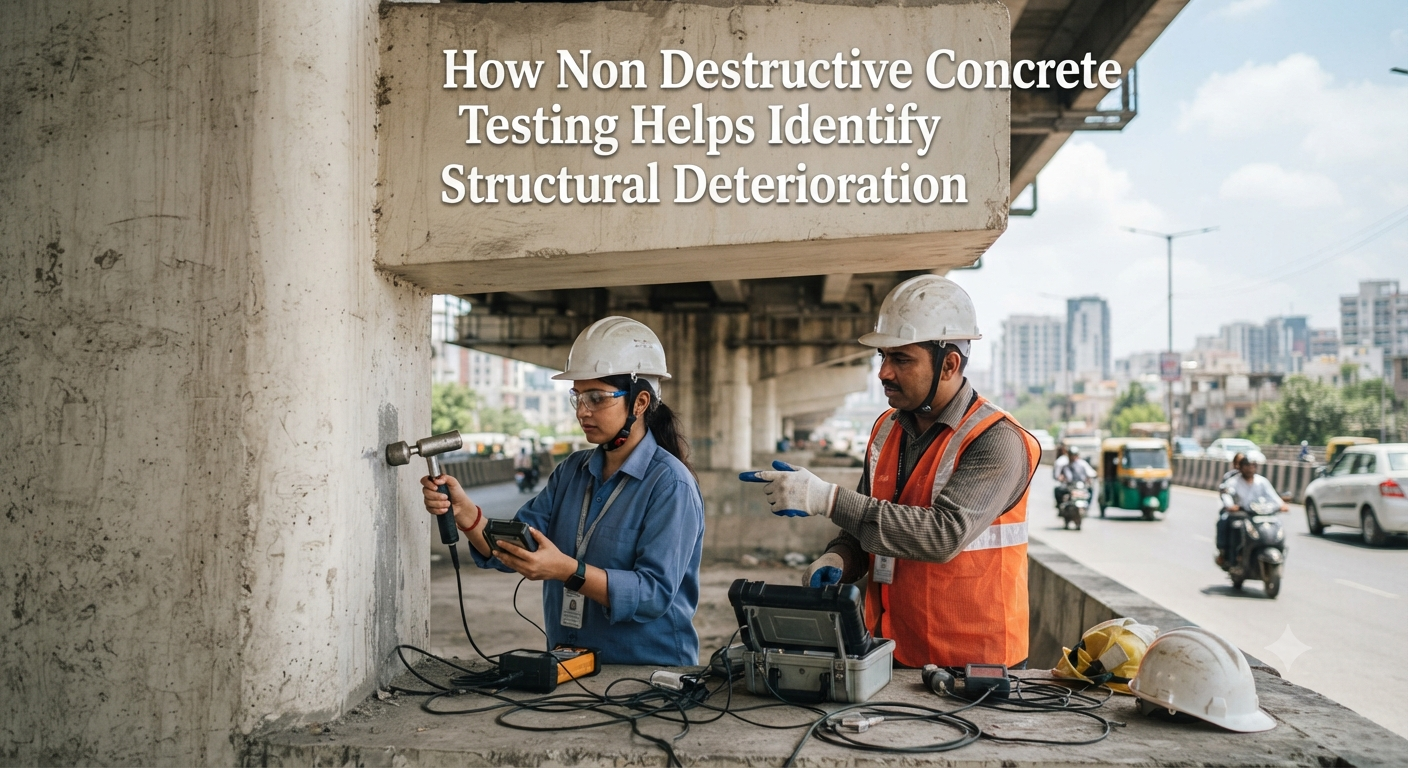
Buildings are exposed to weather, moisture, temperature changes, chemical influences, vibration, and regular usage throughout their service life. Over time, these factors can gradually affect concrete and other structural components. While some deterioration is visible through cracks, spalling, discoloration, or corrosion stains, many problems develop inside the concrete and may remain unnoticed until they become more serious.
Non destructive concrete testing provides engineers with practical methods to investigate the condition of concrete without causing significant damage to the structure. By using specialized testing techniques, professionals can gather information about concrete quality, possible internal defects, uniformity, and other indicators of deterioration. This information can then support structural inspections, maintenance planning, and repair decisions.
Understanding Structural Deterioration
Structural deterioration refers to the gradual decline in the condition or performance of structural elements. Reinforced concrete buildings can deteriorate because of several factors, including water penetration, reinforcement corrosion, carbonation, poor-quality materials, construction defects, environmental exposure, and inadequate maintenance.
Early deterioration may not always be obvious during a visual inspection. For example, corrosion of reinforcement can develop beneath the concrete surface before visible cracking or spalling appears. Similarly, internal voids, honeycombing, or areas of poor compaction may not be readily identified from the exterior.
A detailed investigation therefore often combines visual observations with suitable testing methods. This approach allows engineers to develop a clearer understanding of the condition of structural elements.
Role of Non Destructive Concrete Testing
The primary advantage of non destructive concrete testing is that it allows engineers to examine existing concrete while minimizing physical damage. Instead of extensively breaking or removing concrete, specialized equipment can be used to collect information about its condition.
These techniques can help identify variations in concrete quality, potential weaknesses, internal discontinuities, and other signs associated with deterioration. The results are normally interpreted together with visual observations, structural drawings, site history, and other relevant information.
Testing through non destructive concrete testing does not replace engineering judgment. Rather, it provides additional evidence that can help professionals determine whether further investigation, repair, rehabilitation, or structural monitoring may be appropriate.
Common Testing Methods Used for Concrete Assessment
Different testing techniques provide different types of information. Selecting the appropriate method depends on the structural element, suspected problem, site conditions, and purpose of the investigation.
Rebound Hammer Testing
A rebound hammer is commonly used to assess the surface hardness of concrete and identify variations across different areas. The readings can help engineers identify zones that may require closer examination.
However, rebound values can be influenced by factors such as surface condition, moisture, age, and concrete characteristics. Therefore, results should be interpreted carefully rather than treated as a direct measurement of overall structural strength.
Ultrasonic Pulse Velocity Testing
Ultrasonic Pulse Velocity, or UPV, involves transmitting ultrasonic pulses through concrete and measuring their travel time. Differences in pulse velocity can provide information about concrete uniformity and possible internal discontinuities.
The technique can be useful for investigating areas that may contain cracks, voids, honeycombing, or variations in concrete quality. When combined with other inspection findings, it can contribute to a more comprehensive condition assessment.
Cover Meter Testing
Cover meters can help determine the approximate location and depth of reinforcement within reinforced concrete members. This information can be useful when assessing reinforcement arrangements and investigating potential durability concerns.
Understanding concrete cover is particularly important when considering reinforcement corrosion and long-term protection of steel reinforcement.
Detecting Hidden Signs of Deterioration
One of the major challenges in building maintenance is identifying problems before they become visibly severe. Moisture can penetrate concrete through cracks and pores, creating conditions that may contribute to reinforcement corrosion. As corrosion progresses, the expanding reinforcement can exert pressure on surrounding concrete, eventually resulting in cracking and spalling.
Testing can help identify areas that deserve additional attention even when surface damage appears limited. Engineers can compare test readings across different sections of a structure and identify unusual variations.
For example, if one section of a slab produces significantly different readings from surrounding areas, the location may warrant further investigation. Such information can help direct repair efforts toward areas where deterioration is more likely to be present.
Supporting Structural Inspections
A structural inspection generally begins with a visual assessment. Engineers look for cracks, dampness, exposed reinforcement, concrete delamination, spalling, leakage, corrosion stains, and other visible signs of distress.
Testing can supplement these observations by providing information that cannot be obtained from visual inspection alone. This combination can make the investigation more systematic.
For buildings experiencing recurring defects, testing results can also provide useful information for developing a maintenance or rehabilitation strategy. In older buildings, periodic assessments may help identify changes in condition over time.
Importance Before Concrete Repair
Repairing concrete without understanding the underlying cause can lead to recurring problems. For example, simply repairing a visible crack may not address water ingress, reinforcement corrosion, movement, or another underlying issue.
Testing can help engineers understand the condition of the surrounding concrete before deciding on an appropriate repair approach. Depending on the findings, recommendations may involve localized repairs, waterproofing, corrosion-related treatment, strengthening, rehabilitation, or continued monitoring.
For this reason, an investigation should focus not only on visible defects but also on the factors contributing to deterioration.
Benefits for Building Owners and Maintenance Teams
Building owners, housing societies, facility managers, and property administrators can benefit from condition assessments because they provide technical information for maintenance planning.
Key benefits include:
-
Identifying areas requiring closer inspection
-
Detecting potential internal concrete defects
-
Supporting informed repair decisions
-
Reducing unnecessary destructive investigation
-
Understanding variations in concrete condition
-
Supporting long-term maintenance planning
-
Helping prioritize areas requiring attention
-
Providing additional information during structural assessments
For a professional structural investigation, Gopinath Nambiar & Associates can combine inspection findings with suitable assessment techniques to understand existing building conditions and support appropriate engineering recommendations.
Factors That Can Affect Test Results
Testing results should always be interpreted within the context of the structure. Concrete age, moisture content, surface condition, aggregate type, reinforcement, temperature, testing location, and previous repairs can influence readings.
Consequently, a single test result should not normally be considered in isolation. Engineers generally evaluate multiple readings and compare them with visual observations and available structural information.
Where necessary, additional investigation or selective destructive testing may be recommended to confirm findings. The objective is to obtain reliable information while using the least intrusive investigation approach appropriate for the situation.
Why Early Assessment Matters
Early identification of deterioration can help building owners understand developing problems before they become more extensive. Regular inspection is particularly relevant for older structures, buildings exposed to harsh environmental conditions, and properties where cracks, leakage, corrosion, or other recurring defects have been observed.
An assessment can also help establish whether a defect is localized or part of a wider pattern. This distinction is important when planning repairs because the appropriate solution depends on the extent and cause of deterioration.
By combining visual inspection with suitable testing methods, engineers can develop a more informed picture of the structure's condition.
Conclusion
Structural deterioration can develop gradually and may not always be visible from the surface. Non destructive concrete testing provides engineers with useful information about concrete condition while minimizing damage to existing structural elements.
Methods such as rebound hammer testing, ultrasonic pulse velocity testing, and cover meter testing can support the investigation of concrete quality, internal irregularities, reinforcement location, and potential deterioration. However, test results should be interpreted alongside visual inspection, structural information, and professional engineering judgment.
For building owners and maintenance teams, timely assessment can support better-informed decisions about repairs, rehabilitation, strengthening, and ongoing monitoring. Gopinath Nambiar & Associates provides structural engineering services that can support building condition assessments and related technical investigations.
FAQs
Q1. What is non destructive concrete testing?
It refers to testing techniques used to assess concrete condition without significantly damaging the structural element. Methods can provide information about surface characteristics, concrete uniformity, internal discontinuities, and reinforcement-related conditions.
Q2. Can non destructive testing detect all concrete defects?
No. Different techniques identify different characteristics, and no single method can detect every possible defect. Engineers may therefore combine several testing methods with visual inspection and, where necessary, other forms of investigation.
Q3. Is rebound hammer testing enough to assess a building?
Rebound hammer testing can provide useful information about surface hardness and variations in concrete, but it should not normally be considered sufficient by itself for a complete structural assessment. Other information and testing methods may be required depending on the building and suspected defects.
Q4. When should concrete testing be considered?
Testing may be considered when visible cracks, leakage, corrosion, spalling, unusual deterioration, or other structural concerns are observed. It can also be useful during structural audits, rehabilitation projects, maintenance planning, or assessment of older buildings.
Q5. Does concrete testing damage the building?
Many non-destructive techniques are designed to minimize damage to existing concrete. However, the exact level of investigation depends on the testing method and the condition being investigated. In some cases, engineers may recommend limited additional testing to confirm specific findings.