
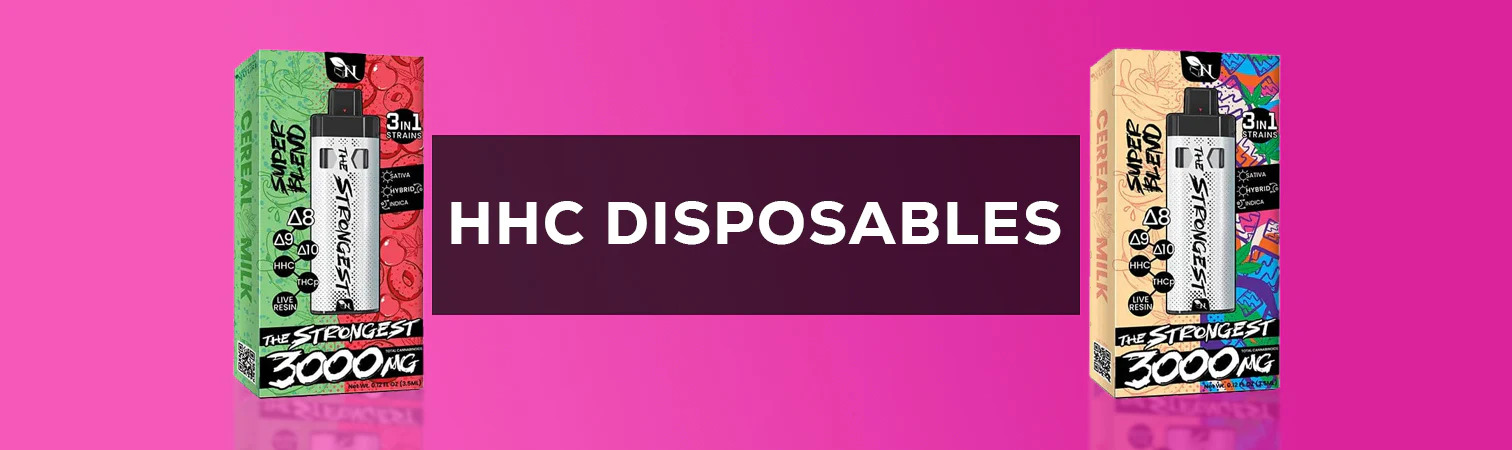
HHC has emerged as a semi-synthetic cannabinoid used in products such as vape cartridges, disposable devices, edibles, and other cannabinoid formulations. Unlike conventional nicotine vapes, an HHC disposable vape contains hexahydrocannabinol, or HHC, as the cannabinoid of interest. HHC is chemically related to THC and has been investigated for cannabinoid activity, although the human evidence base remains considerably smaller than the research available for THC.
Current scientific reviews describe HHC as a hydrogenated derivative of THC, while noting substantial gaps in knowledge concerning human pharmacology, metabolism, toxicity, and long-term effects.
What Is HHC?
Hexahydrocannabinol, commonly abbreviated as HHC, is a cannabinoid that can occur naturally in trace amounts but is commercially produced primarily through chemical transformation of other cannabinoids. Contemporary commercial production has commonly involved hemp-derived CBD as a starting material.
HHC exists in different stereoisomeric forms, including 9R-HHC and 9S-HHC. Research indicates that these forms can have different pharmacological activity. In particular, preclinical evidence suggests that 9R-HHC has THC-like activity at cannabinoid receptors, while the 9S form is considerably less active.
This distinction is important because two products labeled simply “HHC” may not necessarily contain identical proportions of the different HHC forms.
What Is an HHC Disposable Vape?
An HHC disposable vape is a self-contained electronic vaping device containing an HHC formulation. Depending on the product, the formulation may contain HHC distillate along with carrier ingredients and flavoring compounds.
The hardware generally incorporates several basic components:
- An integrated battery
- A liquid reservoir
- A heating element or coil
- An airflow system
- A mouthpiece
- An activation mechanism
Some devices are draw-activated, while others may incorporate additional controls or rechargeable batteries.
The hardware specification does not determine the pharmacological properties of HHC itself. Those properties depend on the cannabinoid formulation, its chemical composition, concentration, and the proportions of different HHC isomers.
How HHC Differs From Delta-9 THC
HHC and delta-9 THC are chemically related cannabinoids, but they are not identical compounds. HHC is a hydrogenated derivative of THC, and laboratory and animal research indicates that some HHC forms interact with cannabinoid receptors in ways broadly comparable to THC.
The available evidence does not support assuming that HHC has exactly the same potency or effects as delta-9 THC. Research has generally found lower potency for HHC overall, with significant differences between individual stereoisomers.
Importantly, human research remains limited. A comprehensive review published in Drug Testing and Analysis noted that human pharmacology and metabolism of HHC still require further investigation.
What Research Says About HHC Effects
The evidence surrounding HHC continues to develop. Preclinical studies have demonstrated cannabinoid-like activity, and more recent human research has provided additional information about its effects and metabolism.
A 2025 forensic study examining inhaled and orally administered HHC reported measurable HHC and metabolites in participants and found effects on psychomotor function comparable in some respects to THC. The study also demonstrated that HHC can cross-react with some cannabinoid drug-testing methods.
These findings are relevant when interpreting claims about HHC products. They do not establish HHC as medically safe or provide a basis for assuming that all commercial HHC formulations produce identical effects.
Why Product Composition Matters
One important issue with an HHC disposable vape is that the label may not communicate the entire chemical composition.
Commercial HHC production can result in mixtures of different HHC stereoisomers. Products may also contain other cannabinoids, residual compounds, or substances associated with the manufacturing process if purification is incomplete.
Germany's Federal Institute for Risk Assessment has noted that HHC products can, in principle, contain synthesis by-products, catalyst residues, other phytocannabinoids, and extraction residues.
For this reason, independent laboratory testing and detailed certificates of analysis can be useful when evaluating the stated cannabinoid composition of a product.
HHC Disposable Vape Specifications
The hardware specifications of HHC disposable devices can vary substantially between manufacturers. Common specifications include:
HHC concentration: Indicates the amount or percentage of HHC claimed by the manufacturer.
Liquid capacity: Describes the quantity of formulation contained in the reservoir.
Battery capacity: Rechargeable models may specify battery capacity in milliamp-hours.
Puff rating: Some products advertise a particular number of puffs. This is a manufacturer estimate rather than a guaranteed number of real-world inhalations.
Coil type: Devices may use conventional or mesh heating elements.
Flavor: HHC formulations can be combined with fruit, mint, dessert, beverage, or other flavor profiles.
Charging: Some disposable-style devices include rechargeable batteries and a charging port.
Because these specifications are product-specific, packaging and manufacturer documentation should be used to verify them rather than assuming that all HHC disposables have the same configuration.
Safety and Research Limitations
The biggest limitation surrounding HHC is the relatively small body of human evidence. Scientific reviews have repeatedly highlighted the lack of comprehensive data on human pharmacology, long-term toxicity, and metabolism.
Germany's Federal Institute for Risk Assessment likewise reports that HHC has not yet been sufficiently characterized toxicologically and that important questions concerning acute and chronic toxicity remain.
This uncertainty is particularly relevant to products containing concentrated cannabinoid extracts. A product's “hemp-derived” description does not by itself establish that its inhalation effects or long-term safety have been adequately studied.
HHC and Drug Testing
Another consideration is drug testing. HHC metabolites can interact with some cannabinoid screening methods.
A 2025 study found cross-reactivity of HHC with on-site urine and oral-fluid cannabinoid tests.
Therefore, the assumption that an HHC product will necessarily be invisible to a conventional cannabis drug test is not supported by current evidence.
Legal Status Can Vary
The legal status of HHC has changed in different jurisdictions and should not be inferred solely from descriptions such as “hemp-derived” or “legal cannabinoid.”
For example, Germany placed HHC under its New Psychoactive Substances Act in June 2024, according to its Federal Institute for Risk Assessment.
In the United States, the legal position also requires careful attention to current federal and state law. In May 2026, the U.S. Drug Enforcement Administration published a final rule specifically listing HHC in Schedule I of the Controlled Substances Act. The rule stated that HHC was already considered a Schedule I controlled substance under the existing tetrahydrocannabinol classification and separately added HHC to the list.
Because regulations can change and may differ between jurisdictions, current local law should always be checked before interpreting the status of an HHC product.
What to Look for on an HHC Product Label
When researching an HHC disposable vape, the product label can provide important information about its composition and hardware.
Look for:
- Exact cannabinoid name
- HHC concentration
- Total liquid volume
- Batch or lot number
- Manufacturer information
- Laboratory testing or certificate-of-analysis information
- Ingredient information
- Battery and charging details
- Required warnings
- Applicable regulatory information
A detailed certificate of analysis can be particularly useful because it may identify cannabinoid concentrations and certain contaminants that are not apparent from the front of the package.
Conclusion
An HHC disposable vape combines a self-contained electronic vaping device with a formulation containing hexahydrocannabinol. HHC is chemically related to THC and has demonstrated cannabinoid activity, but the scientific literature continues to identify substantial gaps in knowledge regarding human pharmacology, long-term safety, and toxicity. For anyone researching HHC products, the most useful information comes from the complete product label, independent laboratory testing, cannabinoid composition, and current jurisdiction-specific regulations. Zmarksthespot provides a relevant category reference, while scientific and government sources are more appropriate for understanding HHC's pharmacology, safety considerations, and legal status.