
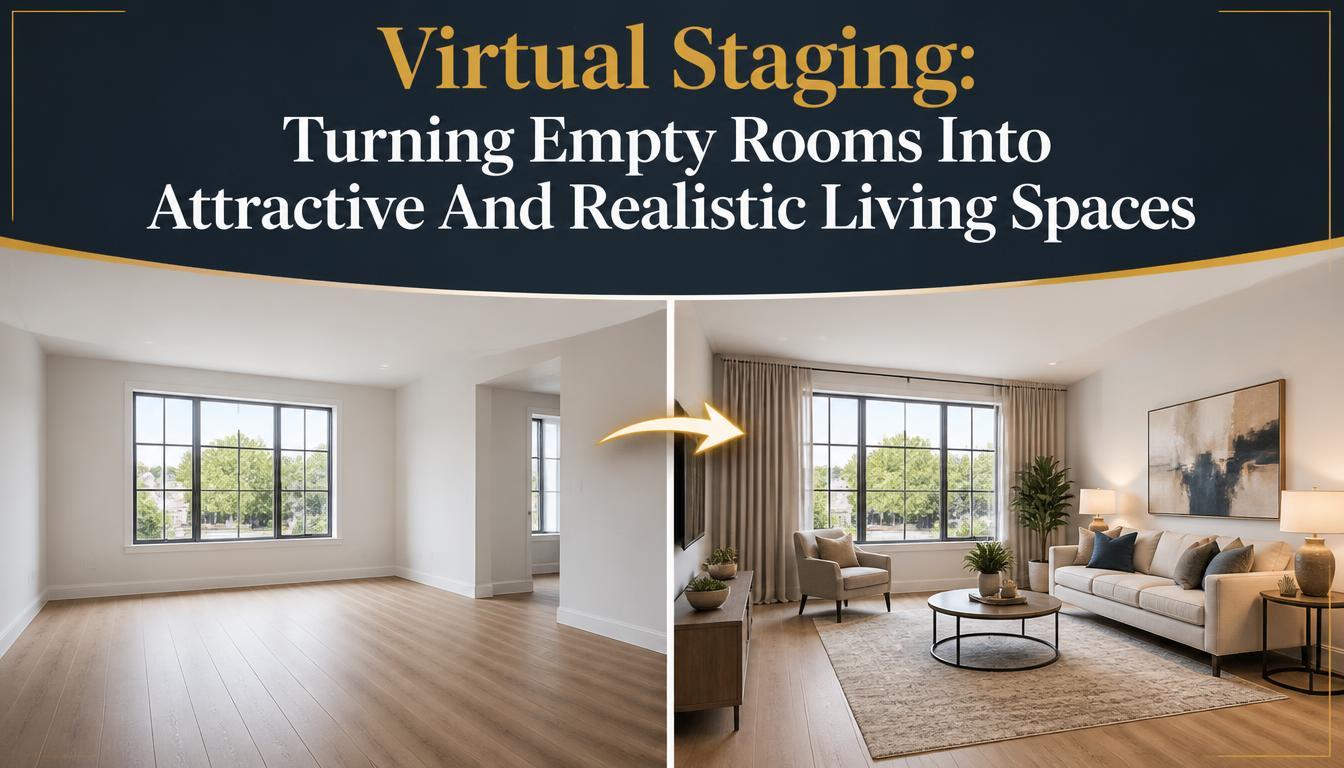
In an empty room, it may not be easy for buyers to imagine how the future owner will use the space. Even if they can see the square footage and get a rough idea of the room’s purpose from the pictures, it will be hard to visualize how to furnish the space and what items to bring. Physical staging can help, but it can also be costly and time-consuming, as it requires additional furniture, its delivery and installation, and its removal at the end of the showing. Virtual staging, on the other hand, replaces physical staging by digitally furnishing empty rooms in photos. This allows a buyer to see how the space can be used without extra effort and expenses.
SMA Archviz works with real estate and design teams that use virtual home staging to present empty properties more clearly. The goal is simple: give buyers a better idea of the finished space while keeping the property easy to market and update.
What Does The Data Actually Say About Staging's Impact On Buyers?
Staging can affect how buyers respond to a property listing. The National Association of Realtors' 2025 Profile of Home Staging conducted a survey. In its 2025 Profile of Home Staging, NAR asked 1,266 real estate professionals. According to NAR's 2025 Profile of Home Staging, it discovered that 83% of buyers' agents stated that staging influences buyers' ability to connect with the property as their long-term residence.
That finding applies to staging in general. The more specific question is how virtual home staging differs from physical staging. These two cannot be used interchangeably, as they can have different costs, setup, flexibility, and overall presentation to the buyers, making them the best choices to make the home more attractive.
Why Has Virtual Staging Become So Widely Used So Quickly?
The cost and logistics of physical staging can make it difficult to use on every listing. Furniture needs to be rented, delivered, arranged, and then taken away. Virtual interior design gets rid of a lot of that work by giving sellers another way to show what an empty or occupied room might be like.
A few practical differences drive its use:
- Physical staging usually requires furniture rental, delivery, setup, and a commitment that can last several weeks.
- Digital staging can often be completed and delivered within hours.
- Occupied homes can be virtually staged without moving or replacing existing furniture.
- Multiple design styles can be tested on the same room without physically restaging the property each time.
- Listing updates are easier because new staged images can be created without arranging another furniture delivery.
SMA Archviz’s virtual staging services therefore solve a practical logistics problem. They may not fully replace physical staging in terms of buyer perception. But their speed, flexibility, and lower logistical burden make them useful for properties where traditional staging is difficult.
Does Digital Staging Measure Up To Physical Staging In Buyers' Eyes?
Not entirely, at least according to agents' current perceptions. The same NAR 2025 report found that 57% of buyers' agents said traditional physical staging was "much more" or "more important" to their clients than virtual alternatives.
This difference is important to acknowledge. Digital home staging may be a good addition to home staging, as it allows changes quickly and simply without using any furniture. Nevertheless, the NAR survey results prove that real estate agents still believe that staging with real furniture appeals more to their customers. It may help to furnish empty houses, but it cannot replace the experience of looking at the real interior.
What Makes Realistic Staging Different From Obviously Fake Digital Furniture?
The accuracy in terms of scale, lighting, and proportions is one of the most critical aspects of digital staging. Incorrect furniture size or placement, among other errors, can make the image look artificial.
Realistic virtual staging requires the accurate use of the room’s measurements, furniture placements, and lighting to create an accurate image that does not look like it was artificially generated on top of the photo.
| Factor | Physical Staging | Virtual Staging |
| Setup time | Days to weeks | Hours |
| Agent-reported buyer preference | Higher (57% favor it) | Growing, but still secondary |
| Works on occupied homes | Limited | Yes |
| Multiple style options per room | Requires re-staging | Easy to generate |
Conclusion
Virtual staging is not a full substitute for physical staging. The results suggest that most agents feel that physical staging better contributes to buyer needs in the majority of cases. On the other hand, virtual home staging is significantly more convenient in terms of time, cost, and overall practicality. Virtual design based on accurate room dimensions gives sellers and agents a practical option when physical staging is difficult or not realistic. It may not replace physical staging in every case, but it can solve problems that traditional staging cannot.