
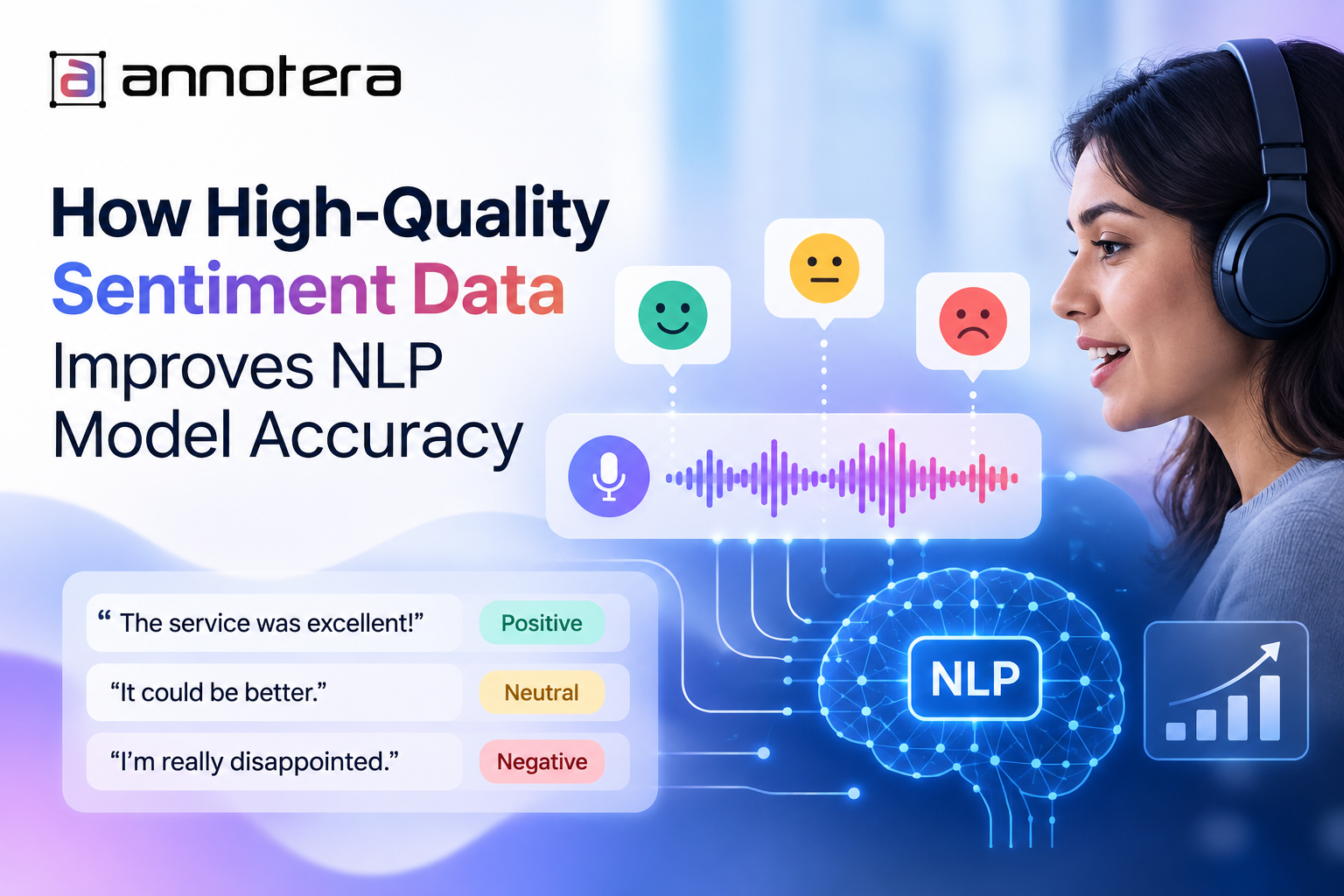
How High-Quality Sentiment Data Improves NLP Model Accuracy
Natural Language Processing (NLP) has transformed how businesses understand and interact with human language. From analyzing customer reviews and social media conversations to powering chatbots and voice assistants, NLP models increasingly need to understand not only what people say but also how they feel.
This is where sentiment data becomes critical.
Sentiment analysis models are trained to identify emotions, opinions, attitudes, and subjective viewpoints in text or speech. However, the accuracy of these models depends heavily on the quality of the data used during training. Poorly labeled, inconsistent, or biased sentiment datasets can cause models to learn incorrect patterns and produce unreliable predictions.
High-quality sentiment annotation, therefore, is not simply a data preparation task. It is a foundation for building more accurate, robust, and context-aware NLP systems.
What Is Sentiment Data?
Sentiment data consists of text, audio, or other language samples labeled according to the sentiment or emotional meaning they express. Common sentiment categories include:
-
Positive
-
Negative
-
Neutral
-
Mixed
-
Happy
-
Angry
-
Sad
-
Frustrated
-
Excited
More sophisticated datasets can include aspect-level sentiment, where individual opinions are linked to specific aspects of a product, service, or experience.
For example, a customer may write:
"The camera quality is excellent, but the battery life is disappointing."
A basic sentiment model may struggle because the statement contains both positive and negative opinions. High-quality annotation can identify the sentiment associated with each aspect, enabling an NLP model to learn this distinction.
Why Sentiment Data Quality Matters for NLP
Machine learning models learn patterns from their training datasets. If the labels are inaccurate, inconsistent, or overly simplistic, the model can learn the wrong relationships between language and sentiment.
Research has repeatedly highlighted the importance of annotation quality. A 2024 analysis of NLP dataset creation practices noted that erroneous annotations, biases, and other dataset artifacts can affect the accuracy and trustworthiness of machine learning systems.
Similarly, recent research on sentiment annotation has found that human annotators can disagree because sentiment is often subjective and context-dependent. Factors such as ambiguous language, fatigue, interpretation differences, and unclear annotation criteria can introduce inconsistencies into datasets.
This makes systematic quality control essential.
1. Improves Label Accuracy
The first advantage of high-quality sentiment data is straightforward: better labels produce better learning signals.
Professional annotation processes use clearly defined guidelines to distinguish between sentiment categories. Annotators can be trained to recognize linguistic nuances, context, negation, sarcasm, intensifiers, and domain-specific terminology.
For example:
"I wouldn't say the product is terrible."
A simple keyword-based approach might classify this sentence as negative because of the word "terrible." A trained annotator, however, can recognize that the overall sentiment may be neutral or mildly positive depending on the surrounding context.
Consistent labeling helps NLP models learn these relationships more effectively.
2. Helps Models Understand Context
Human language rarely expresses sentiment through isolated words.
Words such as "great," "fine," or "interesting" can have different meanings depending on context. Consider:
"Great, another software update that broke everything."
The word "great" is positive in isolation but conveys sarcasm in this context.
High-quality sentiment datasets can include examples involving sarcasm, negation, rhetorical questions, idioms, and contextual sentiment. This gives NLP models exposure to the complexities of real-world communication.
Consequently, models become less dependent on individual keywords and better at understanding relationships between words and context.
3. Reduces Annotation Noise
Annotation noise occurs when labels contain mistakes, inconsistencies, or unnecessary ambiguity.
Even a relatively small amount of noisy data can influence model learning, particularly when the dataset is limited or the problematic examples represent recurring linguistic patterns.
Quality assurance processes such as multiple-annotator review, consensus checks, adjudication, and sample validation can help identify problematic labels before they enter the final training dataset.
However, quality does not necessarily mean removing every difficult example. Recent sentiment research emphasizes that ambiguous cases can represent genuine complexity in human language. Eliminating all difficult examples may create an unrealistically clean dataset that does not reflect real-world usage.
The objective should therefore be controlled, well-documented ambiguity rather than artificial uniformity.
4. Supports Aspect-Based Sentiment Analysis
High-quality sentiment data is particularly valuable for Aspect-Based Sentiment Analysis (ABSA).
Instead of assigning one sentiment to an entire sentence or review, ABSA identifies specific entities or aspects and determines the sentiment associated with each one.
For example:
"The delivery was fast, but customer support was unhelpful."
An accurately annotated dataset can associate:
-
Delivery → Positive
-
Customer support → Negative
This allows businesses to identify precisely what customers like or dislike.
Research presented at LREC 2026 examined how annotation sources affect ABSA tasks and evaluated annotations from experts, students, crowdworkers, and LLMs, highlighting the importance of annotation reliability for downstream NLP performance.
5. Improves Model Evaluation
High-quality sentiment data is useful not only for training but also for testing and evaluating NLP models.
A benchmark dataset with reliable labels provides a stronger reference point for measuring precision, recall, F1-score, and other performance metrics.
If the evaluation dataset itself contains inconsistent labels, a model may appear less accurate than it actually is—or worse, appear highly accurate because it has learned the same biases or errors present in the benchmark.
Therefore, carefully curated validation and test datasets are essential for meaningful model evaluation.
6. Supports Multilingual and Voice-Based NLP
Modern NLP systems increasingly operate across languages, accents, communication styles, and modalities.
Sentiment annotation can extend beyond written text to include audio sentiment annotation, where speech samples are labeled according to emotions, speaker intent, tone, and sentiment.
For organizations developing conversational AI, customer-service assistants, voice analytics platforms, and speech-enabled applications, partnering with an experienced audio annotation company can help create structured datasets for training and evaluating speech-based AI systems.
Professional audio annotation outsourcing services can also provide scalable access to trained annotators, multilingual resources, quality-control workflows, and domain-specific labeling capabilities.
Best Practices for Building High-Quality Sentiment Data
Organizations developing sentiment datasets should consider several quality measures:
Define Clear Annotation Guidelines
Specify exactly how positive, negative, neutral, mixed, and other sentiment categories should be interpreted.
Train Annotators
Annotators should understand the project's objectives, domain terminology, edge cases, and labeling rules.
Use Multiple Annotators
Having multiple people review selected samples can reveal disagreements and identify unclear examples.
Measure Agreement
Metrics such as Cohen's kappa or Krippendorff's alpha can help evaluate consistency between annotators.
Include Real-World Complexity
Datasets should represent sarcasm, negation, slang, code-switching, ambiguity, and domain-specific language where relevant.
Implement Quality Control
Regular audits, gold-standard samples, consensus reviews, and adjudication can help maintain annotation consistency throughout a project.
How Annotera Supports High-Quality Sentiment Data
Building a reliable sentiment dataset requires more than assigning positive or negative labels. It requires a structured workflow that combines trained human judgment, clear guidelines, contextual understanding, and quality assurance.
Annotera helps businesses develop high-quality training data for NLP and conversational AI applications through scalable annotation workflows. From text and sentiment annotation to speech and audio datasets, its human-in-the-loop approach can support organizations working with increasingly complex language AI systems.
Whether a business is training a customer-service chatbot, developing conversational AI, analyzing consumer feedback, or building speech intelligence applications, reliable sentiment data can provide the foundation for better model performance.
Conclusion
NLP model accuracy begins with the quality of the data behind the model.
High-quality sentiment data enables AI systems to recognize contextual meaning, distinguish subtle emotional signals, handle complex language, and make more reliable predictions. Conversely, inconsistent or noisy labels can introduce errors that become embedded in the model throughout the training process.
As NLP evolves toward more sophisticated, multilingual, multimodal, and conversational applications, the importance of carefully curated sentiment datasets will only increase.
For organizations looking to scale these efforts, professional audio annotation outsourcing services and experienced data annotation partners can provide the expertise and quality controls needed to transform raw language data into dependable AI training resources.
Better sentiment data leads to better language understanding—and better language understanding leads to more capable AI.