
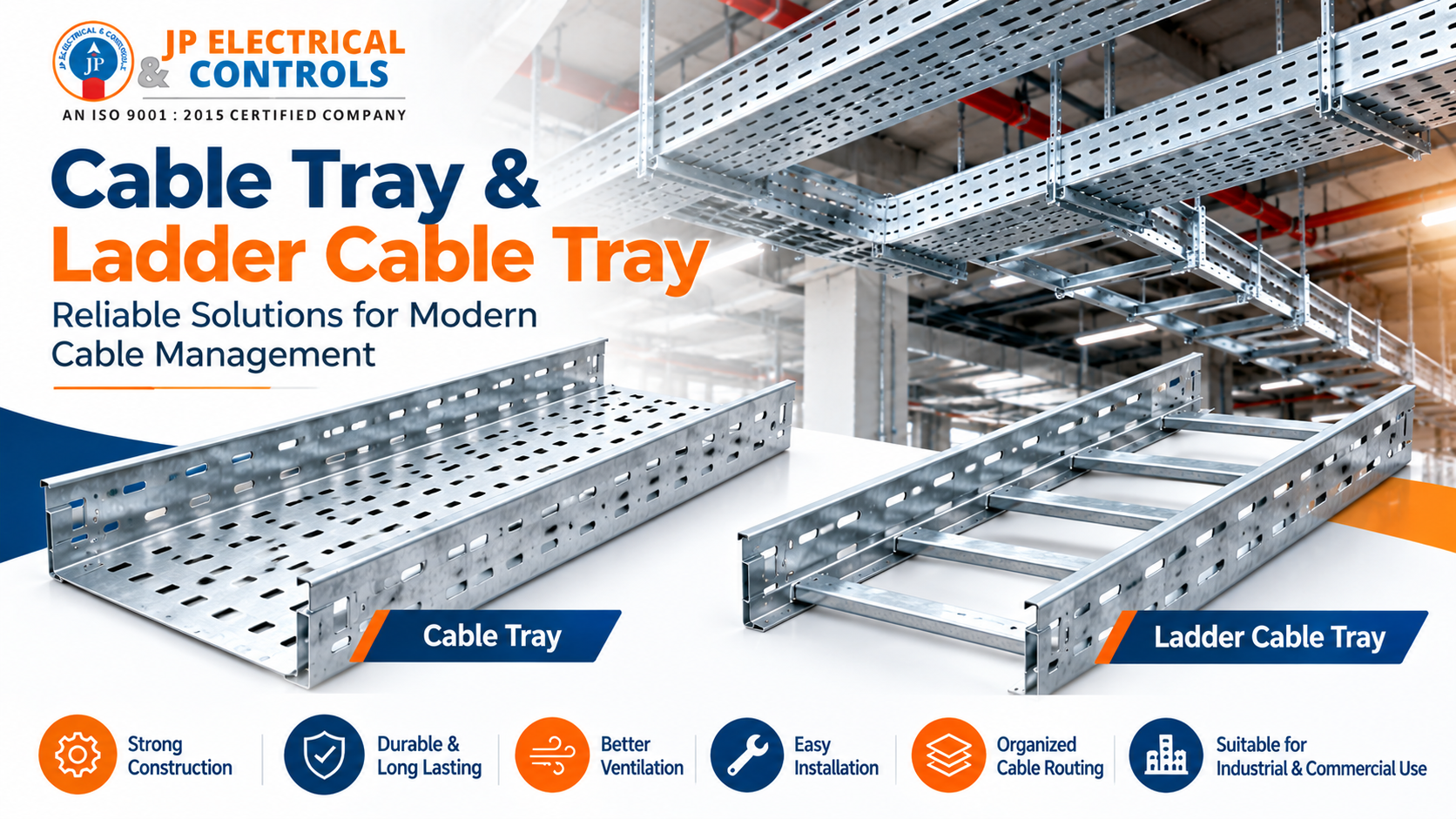
Managing electrical cables properly is important for safety, organization, maintenance, and the long-term performance of an electrical installation. Cable Tray systems provide a practical way to support and route electrical cables in industrial plants, commercial buildings, power projects, data centers, solar installations, and infrastructure projects.
JP Electrical & Controls provides cable management solutions designed to help businesses maintain neat, accessible, and organized cable installations. Among the commonly used options, Cable Tray and Ladder Cable Tray are suitable for different cable routing requirements.
What Is a Cable Tray?
A Cable Tray is a support system used to carry and organize electrical and communication cables. Instead of allowing cables to remain loosely arranged or supported individually, cable trays provide a structured pathway.
Cable trays can be manufactured in different designs and materials depending on the application. Perforated trays, ladder trays, GI trays, hot-dip galvanized trays, and powder-coated trays are commonly selected according to project requirements.
A properly designed cable tray system can make cable installation more organized while also making inspection, maintenance, and future cable additions easier.
What Is a Ladder Cable Tray?
A Ladder Cable Tray has two longitudinal side rails connected by regularly spaced cross members or rungs. This ladder-style construction provides strong cable support while allowing good air circulation around the cables.
Ladder cable trays are particularly useful when projects involve large quantities of power cables or longer cable runs. Their open structure also allows technicians to access cables more easily during installation and maintenance.
Cable Tray vs Ladder Cable Tray
Although both systems are used for cable management, their design and typical applications can differ.
| Feature | Cable Tray | Ladder Cable Tray |
| Design | Solid or perforated support structure | Side rails with cross rungs |
| Cable Support | Suitable for various cable types | Excellent for larger cable runs |
| Ventilation | Depends on tray design | Very good airflow |
| Maintenance | Easy cable access | Easy cable access |
| Application | Commercial and industrial projects | Power and industrial installations |
| Installation | Flexible | Suitable for longer cable routes |
The right choice depends on cable type, load, installation environment, available space, and project requirements.
Benefits of Cable Tray Systems
Using a Cable Tray can provide several practical advantages:
1. Organized Cable Routing
Cable trays provide a defined route for electrical cables, helping keep installations neat and structured.
2. Easy Maintenance
Because cables remain accessible, technicians can inspect, repair, replace, or add cables more conveniently.
3. Better Cable Management
A properly planned tray system helps separate and arrange different cable runs, reducing unnecessary cable clutter.
4. Flexible Installation
Cable trays can be installed in different layouts depending on the building structure and routing requirements.
5. Long-Term Practicality
A suitable cable tray material and finish can provide dependable performance for different indoor and outdoor applications.
Benefits of Ladder Cable Tray
A Ladder Cable Tray offers additional advantages for installations involving heavier or larger cable loads.
- Excellent ventilation around cables
- Strong and stable cable support
- Convenient cable installation
- Easy access for maintenance
- Suitable for long cable runs
- Helps organize multiple power cables
- Practical for industrial and power applications
Its open design makes it particularly useful where heat dissipation and accessibility are important considerations.
Where Are Cable Trays Used?
Cable Tray systems are widely used in many types of projects, including:
- Industrial manufacturing plants
- Commercial buildings
- Power generation facilities
- Solar power projects
- Data centers
- Warehouses
- Infrastructure projects
- Airports and transportation facilities
- Electrical substations
- Large commercial complexes
The specific tray design should be selected according to the cable load, environment, installation method, and project specifications.
Why Choose JP Electrical & Controls?
JP Electrical & Controls focuses on practical cable management solutions for industrial and commercial requirements. The company offers different cable tray options to support organized electrical installations.
When selecting a cable tray system, factors such as material, dimensions, cable load, finish, installation environment, and support spacing should be considered. Choosing the appropriate system helps ensure reliable cable routing and easier future maintenance.
How to Select the Right Cable Tray?
Before purchasing a Cable Tray or Ladder Cable Tray, consider:
- Cable quantity: Determine how many cables will be installed.
- Cable weight: Select a tray with appropriate load capacity.
- Installation environment: Consider indoor, outdoor, humid, or corrosive conditions.
- Tray dimensions: Choose suitable width, height, and length.
- Material and finish: Select the appropriate protection based on the environment.
- Future expansion: Allow sufficient space for additional cables.
- Support system: Ensure the tray has suitable supports and installation accessories.
Conclusion
Both Cable Tray and Ladder Cable Tray provide practical solutions for organizing and supporting electrical cables. Cable trays offer flexibility for different cable management requirements, while ladder cable trays are particularly useful for larger cable runs and applications requiring excellent ventilation and accessibility.
With the right design, material, and installation approach, a cable tray system can make electrical installations safer, more organized, and easier to maintain. JP Electrical & Controls offers cable management solutions for a variety of industrial, commercial, power, solar, and infrastructure applications.
Frequently Asked Questions
1. What is a Cable Tray?
A Cable Tray is a support system used to organize, route, and support electrical cables in buildings and industrial installations.
2. What is a Ladder Cable Tray?
A Ladder Cable Tray consists of two side rails connected by cross rungs. It is commonly used for supporting larger cable runs and power cables.
3. What is the difference between Cable Tray and Ladder Cable Tray?
A conventional cable tray may have a solid or perforated base, while a ladder cable tray has an open ladder-like structure with cross rungs.
4. Where are Ladder Cable Trays commonly used?
Ladder Cable Trays are commonly used in industrial plants, power projects, commercial buildings, infrastructure projects, and installations with multiple or heavy cables.
5. How do I choose the right Cable Tray?
Consider the number and weight of cables, installation environment, tray dimensions, material, support requirements, and future expansion needs.
6. Are Cable Trays suitable for industrial projects?
Yes. Cable trays are widely used in industrial environments for organized electrical cable routing and maintenance access.
7. Can Cable Trays be used for outdoor installations?
Yes, depending on the material and protective finish selected for the environmental conditions.
8. Who manufactures Cable Tray solutions?
JP Electrical & Controls provides cable management products and solutions for various industrial and commercial applications.