
Scalp microbiome research, personalized diagnostics, regulatory change, and digital-first retail are reshaping hair care innovation.
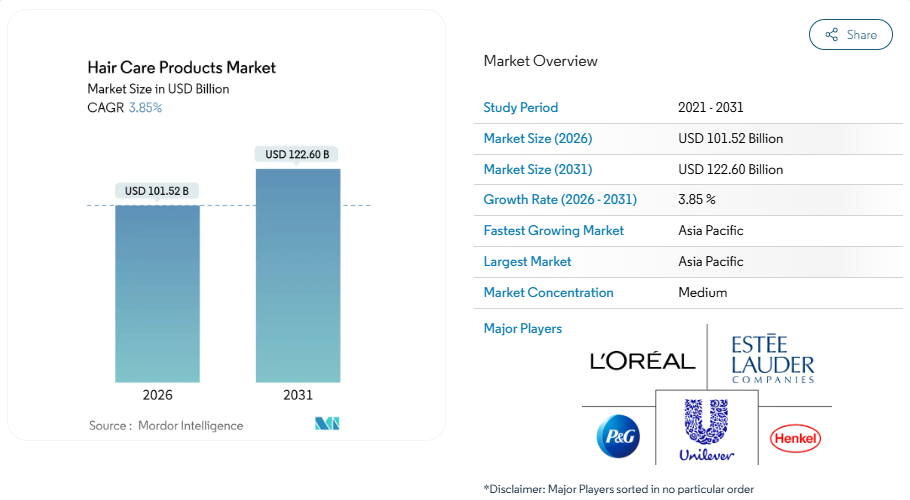
According to a research report by Mordor Intelligence, the hair care market is valued at USD 101.52 billion in 2026 and is projected to reach USD 122.60 billion by 2031, advancing at a CAGR of 3.85%. Growth is being shaped by demand for scientifically validated formulations, rapid regulatory change, digital-first retail, and rising consumer interest in personalized and sustainable hair care solutions.
Scalp Science Is Influencing Product Development
Scientific research into the relationship between the scalp microbiome and follicle vitality is creating new directions for hair care research and development. Manufacturers are increasingly exploring formulations that address scalp health alongside traditional hair-cleaning and conditioning functions.
Probiotic actives are emerging as an area of interest as brands seek to incorporate microbiome-focused positioning into product development. Bond-repair chemistries are also gaining attention as consumers increasingly seek solutions designed around hair strength and repair.
These developments are shifting product innovation toward more science-led formulations. For ingredient suppliers, the trend creates opportunities to develop specialized actives and technologies that can support differentiated product claims.
Personalization Is Creating New Competitive Opportunities
The hair care market remains fragmented, creating space for niche companies to compete with established brands through specialized consumer experiences.
Personalized diagnostics are becoming an important differentiation strategy. Digital tools can help consumers identify individual hair or scalp concerns and connect those needs with targeted product recommendations.
This model changes the traditional product-discovery process by moving toward more individualized purchasing journeys. Smaller brands can use these capabilities to compete through specialization rather than relying solely on scale, broad distribution, or large advertising budgets.
Refillable packaging is another area where niche disruptors can differentiate themselves while responding to growing consumer interest in sustainability.
Digital Retail Is Compressing the Discovery-to-Purchase Journey
E-commerce is changing how consumers discover and purchase hair care products. Digital-first retail models allow brands to communicate product benefits directly to consumers while providing increasingly interactive shopping experiences.
Virtual try-on tools are helping compress the discovery-to-purchase cycle by allowing consumers to evaluate potential products or looks digitally before making purchasing decisions.
The growing role of digital tools is also influencing competitive dynamics. Brands can use online channels to test products, engage niche audiences, and collect consumer feedback without relying exclusively on traditional retail networks.
For established manufacturers, this creates pressure to integrate digital capabilities with existing brand and distribution infrastructure.
Asia-Pacific Strengthens Its Market Position
Asia-Pacific is maintaining a leading position in the hair care market, supported by regulatory harmonization and a rapidly expanding middle class.
Regulatory alignment can help companies operate more efficiently across markets by reducing complexity in product development and compliance processes. At the same time, rising incomes are supporting greater spending on both mass and premium hair care products.
The combination of expanding consumer purchasing power and premiumization is creating opportunities across multiple product categories. Brands are increasingly able to target consumers at different price points while introducing higher-value products with specialized formulations.
Regulation Is Becoming a Strategic Consideration
Rapid regulatory change is adding another layer of complexity to product development. Hair care manufacturers must increasingly account for evolving requirements when selecting ingredients, developing formulations, making product claims, and preparing products for different markets.
Companies with established regulatory capabilities can potentially manage these changes more efficiently, particularly when operating across multiple geographic markets.
Regulatory readiness is therefore becoming part of the broader competitive infrastructure of hair care companies alongside formulation research, manufacturing, distribution, and digital commerce.
Check out more details and stay updated with the latest industry trends, including the Japanese version for localized insights: https://www.mordorintelligence.com/ja/industry-reports/hair-care-products-market?utm_source=gracebook
Market Segmentation
The hair care products market is segmented by:
By Product Type
- Shampoo
- Conditioners
- More Product Types
By Category
- Mass
- Premium
By Ingredient Type
- Natural/Organic
- Conventional/Synthetic
By Distribution Channel
- Supermarkets/Hypermarkets
- Specialty Stores
- More Distribution Channels
By Geography
- North America
- Europe
- Asia-Pacific
- South America
- Middle East and Africa
Market forecasts are provided in terms of value (USD).
Competitive Landscape
The hair care market includes major global beauty and consumer goods companies alongside specialized brands and emerging niche disruptors.
The leading companies identified in the market include:
- Unilever PLC
- L'Oréal S.A.
- Estée Lauder Companies
- Henkel AG and Co. KGaA
- Procter and Gamble Company
Competitive dynamics are increasingly influenced by scientific formulation capabilities, personalization, digital retail, regulatory infrastructure, and sustainability initiatives.
While established companies benefit from scale and broad distribution, niche brands are using personalized diagnostics, specialized formulations, and refillable packaging to capture targeted consumer segments.
Outlook Through 2031
The hair care market is valued at USD 101.52 billion in 2026 and is projected to reach USD 122.60 billion by 2031 at a CAGR of 3.85%.
The industry's evolution will increasingly connect scientific research with consumer-facing digital experiences. Scalp microbiome research, probiotic actives, and bond-repair technologies are influencing formulation development, while personalized diagnostics and virtual try-ons are changing product discovery.
Asia-Pacific's expanding middle class and regulatory harmonization are supporting both volume growth and premiumization. Meanwhile, niche brands are creating competitive pressure through personalization and refillable packaging.
As consumers increasingly demand evidence-based products and more individualized experiences, companies capable of combining scientific innovation, regulatory readiness, digital commerce, and sustainable practices can strengthen their position through 2031.
About Mordor Intelligence
Mordor Intelligence is a global market intelligence firm, founded in 2014, helping businesses make informed decisions through data-driven insights, industry expertise, and advanced analytics. With 550+ domain experts and on-ground specialists across 150+ countries, the company delivers comprehensive intelligence across aerospace & defense, agriculture, automation, automotive, chemicals & materials, consumer goods & services, electronics, energy & power, financial services, food & beverages, healthcare, hospitality & tourism, information & communications technology, and logistics.
Its offerings include syndicated industry reports, custom research and advisory, and subscription platforms such as Data Center Intelligence. Mordor Intelligence is ISO 9001:2015 and ISO/IEC 27001:2022 certified, a member of ESOMAR and the Market Research Society of India, and a four-time Great Place to Work® honoree. Learn more at mordorintelligence.com.