
Social media engagement, fragrance innovation, wellness positioning, and Asia-Pacific demand are reshaping the global home care industry.
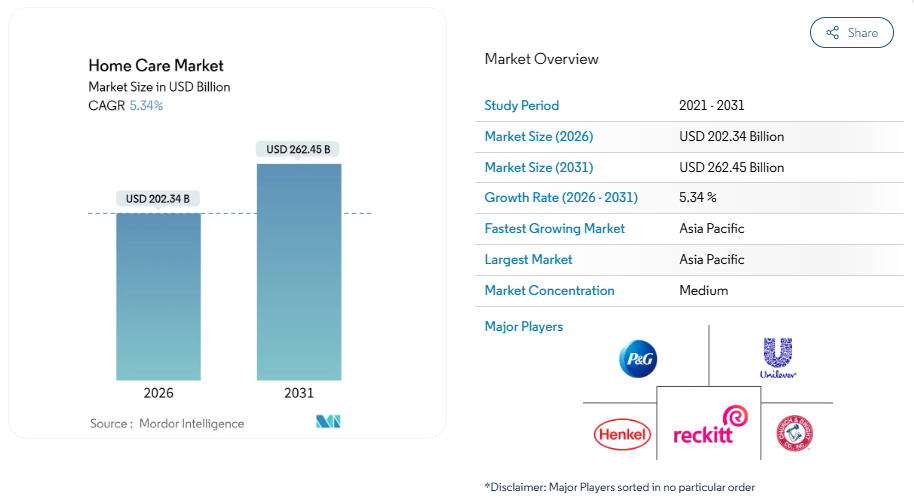
According to a research report by Mordor Intelligence, the home care market size is valued at $202.34 billion in 2026 and is expected to reach $262.45 billion by 2031, registering a CAGR of 5.34% during 2026–2031. Growth reflects a shift from volume-led commodity sales toward premium products shaped by wellness positioning, fragrance innovation, and digitally amplified brand narratives. Social media marketing and rising demand across Asia-Pacific are also influencing how household care brands compete and expand.
Social Media Is Turning Cleaning Products Into Consumer Lifestyle Brands
Household cleaning products have traditionally competed on price, cleaning efficacy, and availability. Social media is adding another dimension by turning cleaning routines into highly shareable consumer content.
The #CleanTok hashtag generated 79 billion views by mid-2025, illustrating the scale of interest in cleaning-related content. This visibility creates opportunities for brands to connect product demonstrations, cleaning tips, and household routines with purchasing decisions.
Commercial examples highlight the potential impact. Unilever reported a 38% sales increase for Cif following a partnership with micro-influencers, while Vileda's collaboration with cleaning content creators drove a 306% spike in mop sales. These reported outcomes demonstrate how targeted creator campaigns can help translate online engagement into product demand.
For home care companies, influencer marketing is increasingly part of brand strategy rather than simply an awareness-building activity. Product performance remains important, but cultural relevance and relatable demonstrations can influence consumer discovery and purchase intent.
Premiumization Is Reshaping Product Positioning
The home care market is moving beyond purely functional cleaning claims toward products positioned around wellness, sensory experience, and lifestyle preferences.
Fragrance innovation is one area supporting this transition. Scent can influence how consumers perceive cleaning products and the overall household environment, giving manufacturers opportunities to differentiate products beyond basic cleaning performance.
Premium positioning also allows companies to build more distinctive brand narratives around product experience, convenience, and formulation choices. Digital channels can reinforce these attributes through demonstrations, creator recommendations, and consumer-generated content.
For manufacturers, the challenge is to ensure that premium messaging remains supported by product efficacy and consistent quality. Brands must balance formulation performance with the experience and identity consumers increasingly associate with household care products.
Asia-Pacific Provides a Major Growth Opportunity
Asia-Pacific is leading absolute growth in the home care market, supported by urbanization, expanding middle-class households, and increasing opportunities for branded products.
China's urbanization rate exceeded 67% in 2025, while India's middle class is adding substantial numbers of households annually, according to the supplied market context. These changes expand the potential consumer base for household cleaners and other home care products.
Urban households can present different purchasing needs from those in less densely populated areas, including preferences around convenience, packaging, product performance, and fragrance. Rising purchasing power can also support the adoption of premium products alongside established mass-market offerings.
For global brands, the region offers opportunities to expand distribution while adapting product positioning to local consumer preferences and purchasing behavior.
Digital Brand Narratives Are Changing Competition
The growing influence of social media is changing how home care brands compete for attention. Short-form video, micro-influencer partnerships, and creator-led product demonstrations provide alternative ways to communicate product benefits.
These approaches can make product attributes easier to understand by showing cleaning performance in familiar household settings. They also create opportunities for brands to engage niche audiences and test messages across different consumer groups.
The shift raises the importance of coordination between marketing, product development, and sales. Campaigns may generate attention, but long-term performance still depends on product availability, reliable quality, and the ability to convert trial into repeat purchasing.
Check out more details and stay updated with the latest industry trends, including the Japanese version for localized insights: https://www.mordorintelligence.com/ja/industry-reports/home-care-market?utm_source=gracebook
Home Care Market Segmentation
The home care market is segmented by:
By Product Type
- Air Care
- Dishwashing
- Bleach
- Insect Repellent
- More Product Types
By Packaging Format
- Bottles
- Aerosol Cans
- More Packaging Formats
By Formulation
- Synthetic
- Natural and Organic
By Distribution Channel
- Supermarkets/Hypermarkets
- Convenience Stores
- More Distribution Channels
By Geography
- North America
- Europe
- Asia-Pacific
- More Regions
Market forecasts are provided in terms of value (USD).
Competitive Landscape
The home care industry includes multinational consumer goods companies with established brands, extensive distribution networks, and broad product portfolios.
The leading companies identified in the market include:
- Henkel AG & Co. KGaA
- Unilever PLC
- Procter & Gamble Company
- Reckitt Benckiser Group PLC
- Church & Dwight Co., Inc.
Competition is increasingly shaped by the combination of formulation efficacy, fragrance differentiation, premium positioning, and digital engagement. Established companies are using creator partnerships and social media campaigns to strengthen consumer connections, while the broader market continues to serve consumers with varying price and performance expectations.
Outlook Through 2031
The home care market is projected to grow at a CAGR of 5.34% during 2026–2031 and reach USD 262.45 billion by the end of the forecast period.
Premiumization, fragrance innovation, and social media engagement are changing how brands communicate value. At the same time, Asia-Pacific's expanding urban and middle-class consumer base is creating additional opportunities for branded household care products.
As social platforms increasingly connect product demonstrations with purchasing behavior, companies that combine reliable formulation performance with relevant digital storytelling and regionally adapted strategies can strengthen their competitive position.
About Mordor Intelligence
Mordor Intelligence is a global market intelligence firm, founded in 2014, helping businesses make informed decisions through data-driven insights, industry expertise, and advanced analytics. With 550+ domain experts and on-ground specialists across 150+ countries, the company delivers comprehensive intelligence across aerospace & defense, agriculture, automation, automotive, chemicals & materials, consumer goods & services, electronics, energy & power, financial services, food & beverages, healthcare, hospitality & tourism, information & communications technology, and logistics.
Its offerings include syndicated industry reports, custom research and advisory, and subscription platforms such as Synapse. Mordor Intelligence is ISO 9001:2015 and ISO/IEC 27001:2022 certified, a member of ESOMAR and the Market Research Society of India, and a four-time Great Place to Work® honoree. Learn more at mordorintelligence.com.