
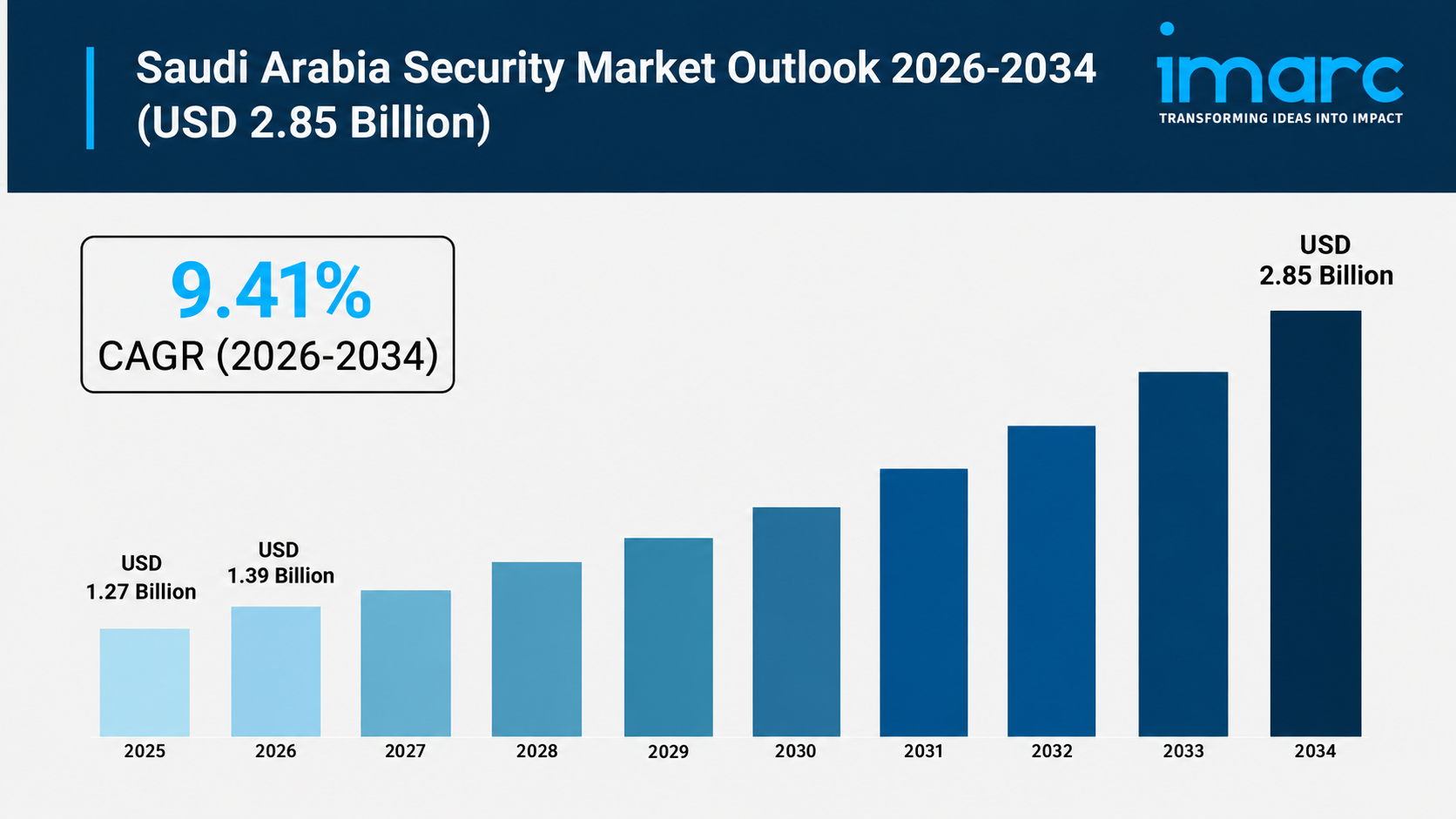
IMARC Group, a leading global market research and management consulting firm, has published its latest market intelligence report on the Saudi Arabia security market. The Saudi Arabia security market size was valued at USD 1.27 Billion in 2025 and is projected to reach USD 2.85 Billion by 2034, growing at a compound annual growth rate of 9.41% from 2026-2034. driven by accelerating urbanization, Vision 2030 megaproject buildouts, and the Kingdom’s strategic emphasis on safeguarding critical assets across public and private sectors.
The Saudi security landscape is fundamentally shaped by Vision 2030 modernization objectives and accelerating investment in smart city infrastructure. Riyadh’s transformation into a global business hub, alongside the development of entertainment destinations and tourism facilities, has created unprecedented demand for integrated security ecosystems capable of managing complex threat environments. The convergence of physical and cybersecurity requirements, particularly evident in megaprojects like NEOM and the Red Sea Project, is pushing the market toward comprehensive risk management frameworks rather than standalone hardware deployments. The Kingdom’s hosting of major international events and religious pilgrimages, including the annual Hajj that welcomes millions of visitors, underscores the importance of scalable security infrastructure capable of managing massive population flows while maintaining safety standards.
Saudi Arabia Security Market at a Glance:
- Market Size (2025): USD 1.27 Billion
- Market Size (2026): USD 1.39 Billion
- Forecast Market Size (2034): USD 2.85 Billion
- Growth Rate 2026-2034: CAGR off 9.41%
- Leading Component: System, with a 66% share
- Leading End User: Commercial, with a 25% share
- Dominant Region: Northern and Central Region, with a 40% share
How AI is Reshaping the Future of the Saudi Arabia Security Market
- Predictive Threat Detection Through Behavioral Analytics: Intelligent surveillance platforms incorporating machine learning and behavioral analytics are transforming traditional monitoring into predictive threat detection, enabling automated anomaly recognition and crowd management optimization across distributed security networks.
- Sovereign AI for Government Audit and Oversight: The Saudi Authority of Internal Auditors introduced its AI tool “Sara” at the Annual Internal Audit Conference, a platform fully hosted within the Kingdom that combines analytical capability with stringent cybersecurity protocols to support decision making across government audit operations.
- Cloud Native AI Infrastructure Reaching the Kingdom: Databricks launched its platform on Google Cloud for clients in Saudi Arabia, giving organizations a nearby, compliant environment to build and scale AI applications on corporate security and operational data with improved speed and oversight.
Grab a sample PDF of this report: https://www.imarcgroup.com/saudi-arabia-security-market/requestsample
Saudi Arabia Security Market Trends and Drivers:
Vision 2030 infrastructure development is the single largest demand driver for the market. NEOM’s futuristic city concept, Red Sea tourism developments, and Qiddiya’s entertainment complexes require integration of cutting edge security technologies including perimeter monitoring, intelligent surveillance networks, and sophisticated access management from the design stage itself, protecting infrastructure investments valued in the hundreds of billions of dollars. Riyadh’s own expansion initiative, targeting roughly CAD 1.04 trillion in investment over the next decade to establish the capital as a global economic, social, and cultural center, is generating parallel demand for city scale security infrastructure spanning transport, public parks, and cultural amenities.
Critical infrastructure protection is a second structural pillar. The Kingdom’s position as a global energy leader creates a continuous imperative to protect oil production facilities, refineries, pipeline networks, and export terminals, while transportation infrastructure including airports, seaports, and metro systems requires multilayered security architectures combining passenger screening, cargo inspection, and emergency response coordination. Saudi Arabia’s participation in international defense exhibitions, including its pavilion at the Eurosatory defense and security exhibition in Paris, reflects the growing sophistication of the Kingdom’s domestic security and defense industrial base.
Regulatory tightening is accelerating adoption across every facility category. Building codes increasingly embed security specifications alongside structural and fire safety requirements, while the Security Surveillance Cameras Law introduced meaningful financial penalties for tampering and unauthorized footage release, formalizing compliance obligations for commercial buildings, healthcare institutions, and educational campuses across the Kingdom.
Regulatory and Compliance Landscape Shaping Demand:
- National Cybersecurity Authority Essential Cybersecurity Controls: The NCA’s ECC 2:2024 framework replaced the original 2018 version, refining its structure to four domains, roughly 28 subdomains, and about 110 controls, with the NCA now conducting unannounced regulatory inspections and requiring Class A organizations to undergo regular independent security audits.
- Mandatory Reach Extended to the Private Sector: The NCNICC-1:2025 standard, which came into effect in January, extended binding cybersecurity obligations beyond government entities and Critical National Infrastructure operators to non-CNI private sector companies for the first time, materially widening the Kingdom’s compliant customer base.
- Security Surveillance Cameras Law Enforcement: The Ministry of Interior enforces fines of up to SAR 10,000 for system tampering and SAR 20,000 for unauthorized footage release, establishing enforceable compliance requirements across commercial, healthcare, educational, and industrial facilities.
- Global Cybersecurity Leadership Ranking: Saudi Arabia maintained its Tier 1 “Role modelling” classification in the Global Cybersecurity Index published by the International Telecommunication Union, alongside a first place ranking in the IMD World Competitiveness Yearbook’s cybersecurity index, reinforcing the Kingdom’s positioning as a regional security technology hub.
Key Vision 2030 Programs Supporting the Industry:
- NEOM Giga Project Security Integration: NEOM represents more than USD 500 Billion in planned investment, with advanced surveillance and communication systems being integrated from the planning stage across The Line and its associated business city developments, creating sustained demand for perimeter monitoring and intelligent command center technology.
- Red Sea Global and Qiddiya Security Infrastructure: Red Sea Global, a Public Investment Fund backed developer, and Qiddiya, another PIF backed giga project, both embed security directly into infrastructure and operations planning rather than treating it as a retrofit, spanning tourism, hospitality, and entertainment assets.
- New Murabba and Riyadh Smart City Expansion: New Murabba, a 19 square kilometer mixed use development in Riyadh, is projected to add SAR 180 Billion to non-oil GDP and create more than 330,000 jobs, with advanced security systems integrated throughout the district alongside a broader SAR 500 Billion municipal smart city investment spanning Riyadh, Madinah, Makkah, Jeddah, and Al Khobar.
- Ministry of Investment Cybersecurity Funding: Saudi Arabia’s Ministry of Investment announced more than SR 500 Million in new cybersecurity funding, strengthening the Kingdom’s startup development and digital investment environment as strategic sponsor of the Black Hat Middle East and Africa cybersecurity event.
- Tourism and Hajj Security Mandates: With Vision 2030 targeting 150 Million annual visitors and a 10% contribution to GDP from tourism by the end of the decade, authorities have heightened enforcement of Hajj permit rules and stationed security personnel at all major entry points to Makkah to manage population flows during the pilgrimage season.
Saudi Arabia Security Industry Segmentation:
The report has segmented the market into the following categories:
Breakup By Component:
- System (Access Control Systems, Alarms and Notification Systems, Intrusion Detection Systems, Video Surveillance Systems, Barrier Systems, Others)
- Service (System Integration and Consulting, Risk Assessment and Analysis, Managed Services, Maintenance and Support)
System based security solutions command a 66% share, anchored by video surveillance networks featuring high resolution imaging and wide area coverage, alongside access control platforms incorporating card readers and biometric scanners that support granular permission management. Intrusion detection technologies, ranging from perimeter sensors to motion activated alerts, provide the early warning capabilities that underpin the segment’s leadership.
Breakup By End User:
- Government
- Military and Defense
- Transportation
- Commercial
- Industrial
- Others
Commercial leads end user demand with a 25% share, driven by expanding retail infrastructure, hospitality developments, and corporate establishments requiring comprehensive protection for assets, personnel, and visitor environments. Financial institutions, healthcare facilities, and educational establishments within the commercial category add specialized requirements such as vault protection and campus safety systems.
Breakup By Region:
- Northern and Central Region
- Western Region
- Eastern Region
- Southern Region
The Northern and Central Region holds a commanding 40% share, reflecting Riyadh’s concentration of government institutions, diplomatic facilities, and financial centers. The region’s metro systems, airport expansions, and integrated transport networks require sophisticated surveillance and access control installations managing millions of passenger movements while maintaining continuous security vigilance.
Competitive Landscape:
The report provides a comprehensive analysis of the competitive landscape in the Saudi Arabia security market with detailed profiles of key companies, including:
- ABTSS Co.
- NASTECH Group
- National Security Services Company
- Nesma Security Company Services
- SAT Microsystems
- Security Matterz
The market demonstrates a moderately consolidated structure, with established international technology providers competing alongside regional specialists that differentiate through localized service delivery and intimate understanding of Saudi regulatory requirements. Strategic partnerships between global manufacturers and local implementation specialists, such as the tie up between IDEMIA Public Security and SAMI Advanced Electronics, illustrate how market access increasingly combines global innovation with regional execution capability.
Market Concentration Analysis:
- Moderately Consolidated, Locally Anchored: International technology providers capture premium segments through global research and development capability, while regional integrators such as ABTSS Co. and NASTECH Group compete on localized service delivery and regulatory familiarity.
- Recurring Revenue Reshaping Vendor Strategy: Market players increasingly bundle hardware provision, software platforms, installation services, and long term maintenance contracts, creating recurring revenue streams that strengthen customer relationships and raise switching costs for competitors.
- Partnership Driven Market Entry: Global biometric and defense electronics specialists are entering the Kingdom through joint ventures with domestic players rather than standalone entry, a pattern reinforced by localization requirements tied to Vision 2030.
What Does The Full Report Cover?
- Comprehensive quantitative analysis of component, end user, and regional market segments
- Latest market drivers, restraints, and challenges shaping the Saudi Arabia security industry
- Detailed regional mapping highlighting the Northern and Central Region’s leadership position
- Competitive landscape and profiling of leading domestic and international security providers
- Analysis of AI, cloud, and biometric technology adoption trends across the Kingdom
- Impact assessment of Vision 2030 megaprojects on security infrastructure demand
- Regulatory and compliance landscape covering NCA frameworks and surveillance legislation
Note: If you require specific details, data, or insights that are not currently included in the scope of this report, we are happy to accommodate your request. As part of our customization service, we will gather and provide the additional information you need, tailored to your specific requirements. Please let us know your exact needs, and we will ensure the report is updated accordingly to meet your expectations.
Recent News and Developments in Saudi Arabia Security Market
- October 2025: IDEMIA Public Security entered a strategic partnership with SAMI Advanced Electronics, a principal player in Saudi Arabia’s electronics sector, to advance biometric and smart mobility solutions across travel and transportation infrastructure in the Kingdom.
- December 2025: Saudi Arabia’s Ministry of Investment announced more than SR 500 Million ($133 Million) in new cybersecurity funding, revealed as strategic sponsor of the fourth edition of Black Hat Middle East and Africa at the Riyadh Exhibition and Convention Center.
- January 2026: The NCNICC-1:2025 standard came into effect, extending mandatory NCA cybersecurity compliance obligations to non-CNI private sector companies operating in the Kingdom for the first time.
- May 2026: The National Cybersecurity Authority confirmed Saudi Arabia’s Tier 1 “Role modelling” classification in the ITU’s Global Cybersecurity Index, alongside a first place global ranking in the IMD World Competitiveness Yearbook’s cybersecurity index.
- July 2026: Shalfa Facilities Management Company, in partnership with Shalfa Global Security, signed a SAR 36 Million contract with Saudi Arabia’s Zakat, Tax and Customs Authority to provide security guard services across the authority’s headquarters and branches nationwide.
Key Questions This Report Answers
- What is the current size and growth outlook of the Saudi Arabia security market?
- Which component and end user category commands the largest market share?
- Which region leads the Saudi Arabia security market and why?
- What are the key drivers, restraints, and emerging opportunities shaping industry growth?
- How is AI adoption changing surveillance and access control technology choices?
- Which companies lead the competitive landscape and how consolidated is the market?
- What Vision 2030 programs and regulatory frameworks are shaping demand?
About Us
IMARC Group is a global management consulting firm that helps the world’s most ambitious changemakers to create a lasting impact. The company provides a comprehensive suite of market entry and expansion services. IMARC offerings include thorough market assessment, feasibility studies, company incorporation assistance, factory setup support, regulatory approvals and licensing navigation, branding, marketing and sales strategies, competitive landscape and benchmarking analyses, pricing and cost research, and procurement research.
Media and Sales Contact
IMARC Group
Email: sales@imarcgroup.com
United States: +1-201-971-6302
India: +91-120-433-0800
United Kingdom: +44-753-714-6104