
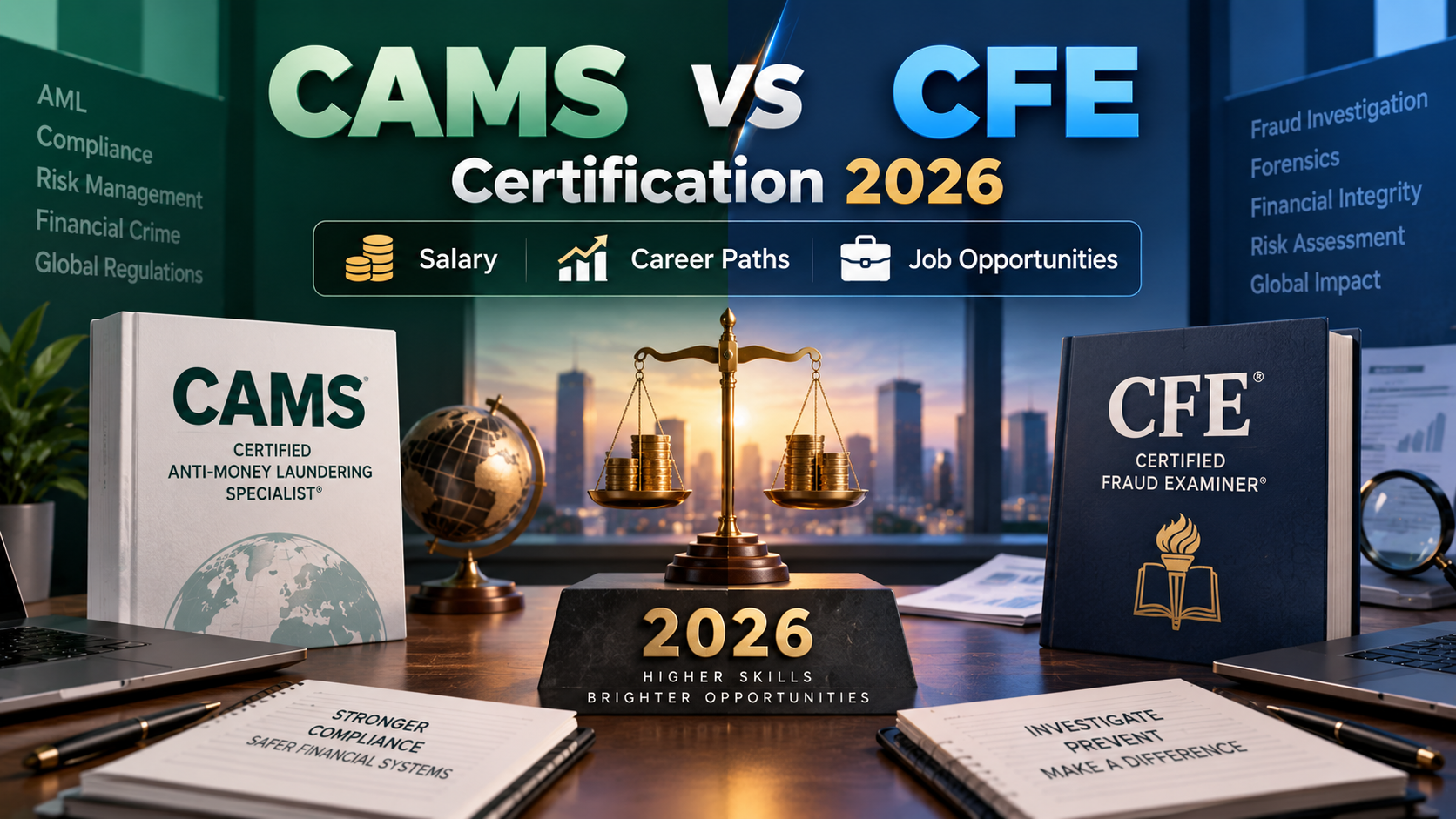
Financial crime, fraud, money laundering, and regulatory compliance continue to create specialized career opportunities across banks, fintech companies, insurance organizations, consulting firms, government agencies, and large corporations. For professionals entering these fields, two credentials frequently considered are CAMS (Certified Anti-Money Laundering Specialist) and CFE (Certified Fraud Examiner).
Although both certifications relate to financial crime, they prepare professionals for different types of work. CAMS concentrates heavily on anti-money laundering (AML), financial crime compliance, transaction monitoring, KYC, risk management, and regulatory frameworks. CFE has a broader fraud-focused scope covering fraud prevention, investigation, financial transactions, and legal considerations.
Understanding their salary potential, career paths, and employment opportunities can help professionals decide which credential better aligns with their goals in 2026.
This concept is explained in greater depth in a YouTube video shared by Cert Mage.
What Is CAMS Certification?
CAMS stands for Certified Anti-Money Laundering Specialist and is offered by ACAMS. It is a specialist-level credential designed for professionals working in anti-money laundering and broader anti-financial-crime environments.
ACAMS identifies roles such as Compliance Officer, MLRO/BSA Officer, Risk Manager, Internal Auditor, Head of Compliance, Head of KYC, and Head of Transaction Monitoring among the positions relevant to CAMS.
The certification covers areas such as:
- Financial crime risks and methods
- AML and counter-financing-of-terrorism concepts
- Global anti-financial-crime frameworks
- Governance and regulations
- Building effective compliance programs
- Financial crime technology and tools
- Risk identification and mitigation
The current CAMS examination consists of 120 multiple-choice questions and provides 3.5 hours for completion. Candidates must also satisfy ACAMS eligibility requirements.
What Is CFE Certification?
CFE stands for Certified Fraud Examiner and is offered by the Association of Certified Fraud Examiners (ACFE).
Where CAMS specializes primarily in AML and financial crime compliance, CFE concentrates on identifying, preventing, detecting, and investigating fraud. This makes it relevant to professionals in corporate investigations, forensic accounting, internal audit, compliance, risk, and anti-fraud functions.
A CFE professional may work with suspicious accounting activity, employee fraud, asset misappropriation, financial statement fraud, corruption, internal controls, and investigative processes.
For accountants, for example, ACFE explains that CFE knowledge can help professionals evaluate accounting systems for weaknesses, interpret financial information for unusual patterns, assess fraud risk, and investigate fraud indicators.
CAMS vs CFE: Main Differences
| Feature | CAMS | CFE |
| Full Name | Certified Anti-Money Laundering Specialist | Certified Fraud Examiner |
| Primary Focus | AML and financial crime compliance | Fraud prevention and investigation |
| Issuing Organization | ACAMS | ACFE |
| Common Industry | Banking and financial services | Corporate, accounting, audit and investigations |
| Strong Career Area | AML/KYC/financial crime compliance | Fraud examination and investigation |
| Typical Roles | AML Analyst, KYC Analyst, Compliance Officer | Fraud Investigator, Fraud Analyst, Forensic Accountant |
| Senior Path | AML/Compliance leadership | Fraud/Investigation leadership |
The certifications overlap in financial crime and compliance, but their specialization is noticeably different.
CAMS Salary Potential in 2026
There is no single salary attached to CAMS because compensation depends heavily on location, industry, experience, employer, and level of responsibility.
A CAMS-focused career can begin with positions such as AML Analyst, KYC Analyst, transaction-monitoring specialist, or financial crime investigator. With experience, professionals may progress toward Compliance Officer, BSA/AML Officer, AML Manager, MLRO, Head of Financial Crime, or senior compliance leadership.
ACAMS describes AML analyst, AML specialist, and AML investigator positions as common starting points, with potential progression into roles including Chief Compliance Officer, FIU Director, and Money Laundering Reporting Officer.
As responsibility increases, salary potential normally increases as well. Therefore, CAMS should be viewed as a credential supporting a broader AML career path rather than as a guarantee of a particular salary.
CFE Salary Potential in 2026
CFE also offers significant earning potential, particularly for professionals combining fraud expertise with accounting, auditing, investigations, compliance, or management experience.
ACFE's 2024 Compensation Guide reports that CFEs earned a 32% compensation premium compared with non-certified peers among the surveyed anti-fraud professionals. The same research reported median annual compensation of approximately $101,000 for CFEs with a four-year degree and $112,000 for CFEs with a graduate degree.
These figures should not be interpreted as guaranteed CFE salaries. They reflect ACFE survey respondents and compensation can differ substantially according to geography, experience, employer, seniority, and job function.
Career Opportunities After CAMS
CAMS is particularly relevant when you want to build your career around AML and regulated financial services.
Potential positions include:
AML Analyst: Reviews transactions and customer activity to identify unusual behavior and possible money-laundering risks.
KYC Analyst: Conducts customer due diligence, verifies customer information, evaluates risk, and supports regulatory compliance.
AML Investigator: Investigates alerts, transactions, accounts, and customer activity requiring deeper financial-crime analysis.
Compliance Officer: Helps an organization maintain processes and controls consistent with applicable regulations.
BSA/AML Officer: Oversees AML compliance responsibilities, particularly within financial institutions operating under relevant U.S. requirements.
Financial Crime Manager: Leads teams responsible for AML, transaction monitoring, investigations, and related controls.
CAMS can therefore fit particularly well within banks, fintech organizations, payment companies, investment firms, cryptocurrency businesses, consulting organizations, and other regulated financial institutions.
Career Opportunities After CFE
CFE provides a different career direction. Instead of concentrating primarily on money laundering, professionals can pursue broader fraud-related responsibilities.
Common opportunities include:
Fraud Investigator: Investigates suspected internal or external fraudulent activity.
Fraud Analyst: Reviews data, transactions, behavioral patterns, and alerts to identify possible fraud.
Forensic Accountant: Uses accounting and investigative skills to examine financial records and suspicious transactions.
Internal Auditor: Evaluates controls, operational processes, risk, and potential fraud exposure.
Corporate Investigator: Handles allegations involving employee misconduct, corruption, theft, conflicts of interest, or other corporate wrongdoing.
Anti-Fraud Manager: Develops fraud-prevention programs and manages investigative teams.
CFE can also complement accounting and compliance careers. ACFE specifically notes its applicability to compliance professionals responsible for policies, procedures, laws, regulations, and fraud-related controls.
CAMS vs CFE for Banking Careers
For someone targeting AML, KYC, transaction monitoring, sanctions-related compliance, or financial crime compliance within banking, CAMS offers specialized knowledge closely aligned with those functions.
For professionals interested in fraud investigations, internal fraud, forensic accounting, corporate misconduct, or broader anti-fraud work, CFE provides a more investigation-centered path.
There can also be considerable overlap. Financial institutions may operate integrated financial crime departments where AML analysts, fraud investigators, compliance professionals, and risk specialists collaborate.
Can You Earn Both CAMS and CFE?
Yes. The certifications can complement each other because they address different aspects of financial crime.
For example, someone may begin in AML operations and earn CAMS to strengthen knowledge of money laundering, financial crime risks, compliance frameworks, and controls. Later, CFE could broaden that professional's knowledge of fraud investigation and prevention.
Holding both may be especially relevant for professionals seeking broader financial crime, investigations, compliance, risk, or leadership responsibilities. However, obtaining both is not necessary for every career.
Preparing for CAMS and CFE in 2026
Preparation should begin by understanding the official objectives and requirements of the certification you plan to pursue. Build a study schedule that separates major topics into manageable weekly targets.
Rather than relying only on memorization, candidates should practice applying concepts to realistic scenarios. Financial crime examinations frequently require understanding how rules, investigative concepts, risks, and controls work in practical situations.
Practice questions can also help identify weaker areas before examination day. Cert Mage provides additional preparation information for professionals comparing the two credentials through its CAMS vs CFE certification guide. Candidates can use such preparation resources alongside official certification materials to organize their study process and understand important differences between the two paths.
CAMS vs CFE: Choosing Based on Career Goals
The most useful distinction is the type of work you want to perform.
Consider CAMS when your target career revolves around AML compliance, KYC, transaction monitoring, financial crime controls, banking compliance, or AML leadership.
Consider CFE when your professional direction involves fraud examination, fraud investigations, forensic accounting, corporate investigations, internal audit, or fraud risk management.
Professionals interested in the broader financial crime ecosystem may eventually find value in knowledge from both disciplines.
Final Thoughts
CAMS and CFE are established professional certifications, but they serve different career objectives. CAMS has a specialized focus on anti-money laundering and anti-financial-crime compliance, making it closely connected with banking, fintech, KYC, transaction monitoring, and compliance careers. ACAMS itself positions CAMS as a global benchmark for AML competency.
CFE takes a broader anti-fraud approach and can support careers in investigations, forensic accounting, auditing, corporate fraud prevention, and compliance.
Salary should therefore not be the only consideration. Experience, industry, geographic location, education, technical skills, and management responsibility can have major effects on compensation. Choosing a certification that matches the work you want to perform is a more practical foundation for long-term career development.
FAQs
Is CAMS better than CFE for AML careers?
CAMS is specifically designed around anti-money laundering and anti-financial-crime work, so its subject matter aligns directly with AML, KYC, transaction monitoring, compliance, and related banking roles.
Is CFE useful for banking professionals?
Yes. Banks employ fraud analysts, investigators, auditors, compliance specialists, and risk professionals. CFE can be particularly relevant when a banking position focuses on fraud detection, prevention, or investigation.
Which certification has better salary potential?
There is no universal salary comparison because compensation depends on job title, experience, location, employer, and seniority. ACFE's 2024 survey found a 32% compensation premium for surveyed CFEs compared with non-certified peers.
Can CAMS help me become an AML analyst?
Yes. AML analyst and related financial crime positions are closely aligned with CAMS subject matter. ACAMS identifies AML and financial crime professionals as a core audience for its programs.
Can I obtain both CAMS and CFE?
Yes. CAMS can develop AML and compliance knowledge while CFE adds broader fraud examination and investigation knowledge. The combination can be relevant to professionals working across multiple financial crime functions.
Is CAMS useful outside traditional banks?
Yes. AML and financial crime controls are relevant across fintech, payment services, investment businesses, consulting, legal and accounting firms, regulatory bodies, and other regulated sectors.
Which certification is more suitable for forensic accounting?
CFE's curriculum and career orientation are more directly connected with fraud examination and forensic accounting. CAMS is more specialized toward AML and financial crime compliance.
What jobs can I pursue with CAMS?
Potential paths include AML analyst, KYC analyst, AML investigator, compliance officer, risk manager, BSA/AML officer, MLRO, financial crime manager, and senior compliance positions.
Read More: Are Oracle Certifications Worth It in 2026? Benefits, Costs, and Career Paths