
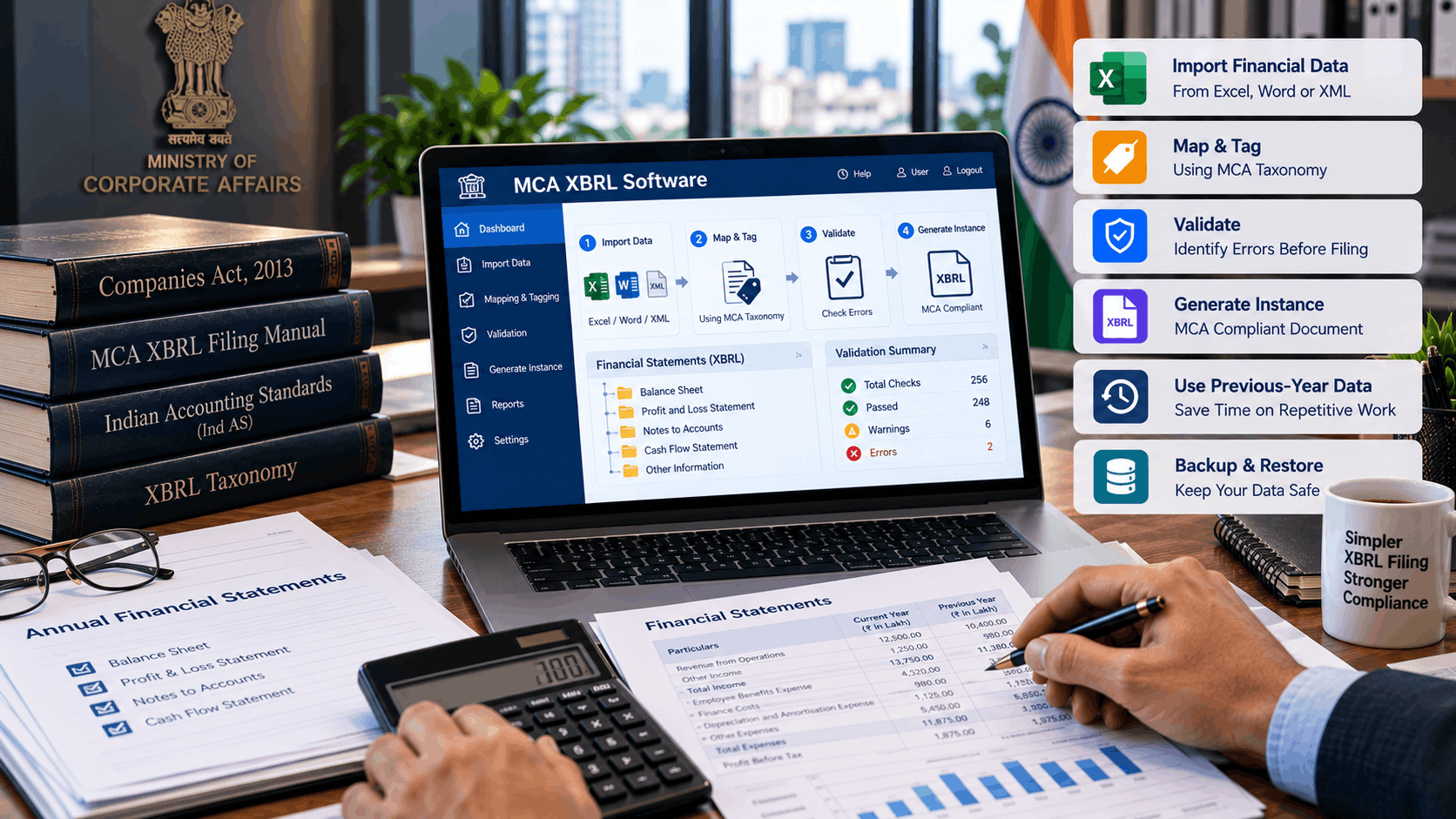
Preparing annual financial statements is only one part of the reporting process for companies covered by XBRL requirements. The information also needs to be converted into a structured format, mapped against the relevant taxonomy and checked for errors before it can move through the prescribed filing process.
The right MCA XBRL Software can bring these activities into a single workflow. Instead of preparing tags, checking data and creating the instance document through disconnected processes, users can work with tools designed specifically for structured financial reporting.
The Ministry of Corporate Affairs' XBRL filing guidance describes the process of creating an XBRL instance document, mapping financial statement elements to taxonomy elements, validating the document and completing the required filing steps. The software therefore works as a preparation and checking layer around the regulatory filing process rather than replacing the filing requirements themselves.
What Does MCA XBRL Software Actually Do?
XBRL software converts financial reporting information into a structured format by associating reported facts with appropriate taxonomy elements. The work can cover balance sheets, profit and loss statements, notes, schedules, auditor information and other financial or non-financial data that needs to be reported.
Webtel's XBRL solution describes an instance-document generation facility based on MCA taxonomy, along with XML import and export, previous-year data loading, mapping and tagging utilities, error-location features and validation checks. These functions are intended to organize the preparation process before the resulting document is submitted through the applicable filing workflow.
One important point is that software does not make the underlying information accurate by itself. The source financial statements still need to be correct, and the person preparing the report needs to review whether the selected tags properly represent the reported information. Automated checks can identify many issues, but professional review remains part of the process.
Key Capabilities to Look For
Different XBRL applications can offer very different workflows. A useful comparison should therefore focus on the tasks performed during actual preparation rather than simply counting features. Data import, taxonomy mapping, tagging, error identification and validation are among the areas worth examining before selecting a solution.
| Capability | Purpose During XBRL Preparation |
|---|---|
| Data Import | Brings existing financial information into the preparation workflow |
| Mapping & Tagging | Associates reported facts with relevant taxonomy elements |
| Instance Generation | Creates the structured XBRL document |
| Error Locator | Helps identify potential issues requiring correction |
| Validation | Checks the prepared instance before filing |
| Previous-Year Data | Can reduce repetitive preparation work |
| Backup & Restoration | Helps protect working data and completed preparation |
Webtel states that its software supports importing and exporting data from Excel, Word and XML files and loading previous-year data. It also describes alert messages for certain balance-related issues, an error locator and in-built validation checks. These functions can be useful where large financial statements contain many individual facts that require review.
The most useful feature is ultimately the one that fits the company's existing workflow. A system may have numerous functions but still create unnecessary work if users cannot easily import their source information or review the mapping. Testing the preparation process with representative data can provide a clearer picture than relying only on a feature list.
Why Validation Should Not Be Left Until the End
Validation is an important part of XBRL preparation because an instance document can contain problems that are not obvious when reading the original financial statements. Incorrect mappings, missing information, inconsistent values and other technical issues may need to be resolved before the filing can proceed.
MCA's XBRL filing manual describes loading the instance document into the MCA validation tool, validating it, carrying out pre-scrutiny and performing final verification before submission. This makes validation part of the overall filing workflow rather than an optional final check.
A software solution that provides validation within the preparation process can help users identify problems earlier. Webtel describes an advanced validator that uses MCA validation checks from within its software. However, validation should still be followed by a review against the approved financial statements to confirm that the structured data accurately reflects the source information.
Financial XBRL and Cost-XBRL Have Different Uses
The term XBRL software can refer to different reporting workflows. Financial-statement XBRL focuses on structured reporting of applicable financial statements and related information. Cost-XBRL, on the other hand, is associated with cost audit and compliance reporting and has its own preparation requirements.
For companies that also need to prepare cost-related XBRL reports, Cost-XBRL software can address a different workflow. Webtel's Cost-XBRL solution is described as supporting the conversion of cost audit and compliance reports into XBRL mode, including data import, text-block tagging and instance-document preparation.
MCA's instructions for the cost audit XBRL form also specify that the attached XBRL document must be successfully validated using the applicable MCA XBRL validation tool and that the instance document must correspond to the relevant cost audit report. This is why companies should identify the exact reporting requirement before selecting an XBRL application.
How Companies Can Prepare More Efficiently
A structured workflow usually begins with confirming the applicable reporting requirement and taxonomy. Once the financial statements are ready, relevant information can be imported or entered into the software. Mapping and tagging can then be completed while the source documents remain available for comparison.
The next stage should focus on reviewing the tagged information and resolving errors. Previous-year information can provide a useful starting point where the software supports it, but reused data should always be checked against the current reporting period. Changes in accounts, disclosures or company information should not be carried forward without verification.
The final stage is validation and submission preparation. MCA has also introduced updates to its XBRL validation environment, including V5.1 versions for C&I, IND-AS and Costing taxonomies in 2025. This makes it important for preparers to pay attention to current MCA instructions and validation-tool requirements rather than relying indefinitely on an older filing setup.
Frequently Asked Questions
What is MCA XBRL Software?
MCA XBRL Software is software used to prepare financial information in XBRL format for applicable MCA filings. It can assist with taxonomy mapping, tagging, instance-document generation and validation.
Does XBRL software automatically complete an MCA filing?
Not necessarily. Software can support preparation and validation, but the applicable filing process still has to be followed. Users remain responsible for reviewing the information and completing the required submission steps.
Why is taxonomy mapping important in XBRL?
Mapping connects individual financial or non-financial facts with the appropriate taxonomy elements. Incorrect mapping can cause the structured report to represent information inaccurately or produce validation issues.
Can the same software be used for financial XBRL and Cost-XBRL?
The requirements can differ. Financial statements and cost audit reports can involve different taxonomies and preparation workflows, so users should confirm that the software supports the specific type of report they need to file.
Is validation mandatory before XBRL filing?
The applicable filing process can require validation of the XBRL instance through the MCA validation tool. MCA's filing documentation describes validation and pre-scrutiny as steps in the XBRL filing workflow.