
Urbanization, functional nutrition, e-commerce, and sustainable packaging are reshaping packaged food demand worldwide.
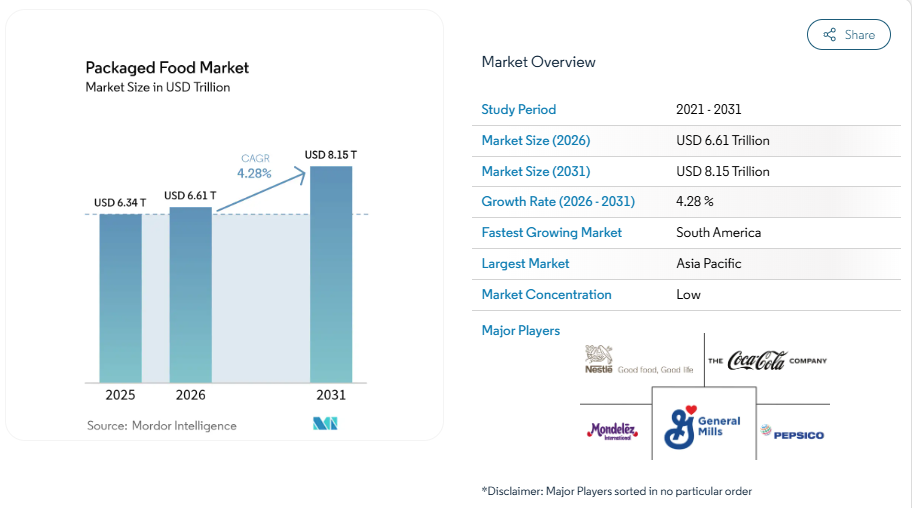
According to a research report by Mordor Intelligence, the packaged food market is estimated to grow from USD 6.61 trillion in 2026 to USD 8.15 trillion by 2031, registering a CAGR of 4.28% during 2026–2031. Rapid urbanization, rising disposable incomes in emerging economies, and demand for convenient yet nutrient-dense products are reshaping category dynamics, while organic, free-from, and functional offerings are moving further into mainstream retail.
Convenience and Nutrition Are Converging
Urban lifestyles are changing how consumers evaluate packaged food products. Convenience remains an important purchase consideration, but consumers increasingly expect convenience to be combined with nutritional value.
This is creating opportunities for products positioned around protein, probiotics, fortification, and other functional benefits. Categories that were previously concentrated in specialist or premium channels are increasingly moving toward mainstream shelves as manufacturers adapt formulations and product portfolios to broader consumer demand.
The trend is particularly relevant in emerging economies, where rising disposable incomes are expanding purchasing power while urbanization increases demand for products that fit faster-paced lifestyles.
For manufacturers, this creates a need to balance convenience, nutritional positioning, taste, affordability, and shelf stability within increasingly competitive categories.
Organic and Free-From Products Move Toward the Mainstream
Consumer demand is also shifting toward natural, organic, and free-from products. These attributes are becoming increasingly relevant across packaged food categories as consumers pay closer attention to ingredients and product claims.
The expansion of these offerings is influencing both product development and portfolio strategy. Established food companies are increasingly required to evaluate whether their existing products remain relevant to younger and more health-conscious consumers.
The shift also creates opportunities for ingredient suppliers capable of supporting clean-label formulations and functional claims while maintaining product performance and cost competitiveness.
E-Commerce Is Reshaping Packaged Food Distribution
Digital retail is changing expectations around how quickly packaged food can reach consumers. In dense urban markets, e-commerce platforms are compressing delivery windows to less than fifteen minutes, increasing pressure on retailers to rethink inventory placement and fulfillment.
Supermarkets are responding by incorporating micro-fulfillment zones into existing retail infrastructure. These facilities can bring inventory closer to consumers while improving the ability to support rapid online orders.
This development is changing the relationship between physical stores and digital commerce. Retail locations are increasingly serving not only as shopping destinations but also as fulfillment points within digitally connected food distribution networks.
For packaged food manufacturers, this makes distribution efficiency and digital-channel availability increasingly important considerations alongside traditional retail shelf placement.
Sustainable Packaging Is Driving Material Innovation
Packaging sustainability is becoming a significant area of investment across the packaged food value chain. Sustainability mandates and changing consumer expectations are encouraging companies to reduce dependence on conventional single-use plastics.
Fiber-based and enzymatically recyclable substrates are emerging as alternatives, although these materials can carry a cost premium of approximately 15–25%. This creates a commercial challenge for manufacturers and packaging suppliers seeking to balance environmental objectives with margin requirements.
The transition also extends beyond material selection. Companies must consider packaging performance, product protection, shelf life, recyclability, manufacturing compatibility, and end-of-life management.
As sustainability requirements become more prominent, packaging innovation is increasingly becoming a competitive consideration rather than simply a compliance issue.
Competitive Strategies Are Shifting
Competitive intensity is increasing as established packaged food companies reassess their portfolios. Incumbents are pruning underperforming SKUs while pursuing acquisitions of plant-based specialists to strengthen their relevance among younger consumer groups.
This portfolio restructuring reflects the changing balance between established categories and emerging demand. Companies need to maintain scale in high-performing conventional categories while developing positions in areas associated with health, sustainability, plant-based consumption, and functional nutrition.
Acquisition strategies can provide established companies with faster access to specialized products, technologies, and consumer segments than organic portfolio development alone.
Check out more details and stay updated with the latest industry trends, including the Japanese version for localized insights: https://www.mordorintelligence.com/ja/industry-reports/packaged-food-market?utm_source=gracebook
Market Segmentation
The packaged food market is segmented by:
By Product Type
- Dairy
- Confectionery
- Bakery
- Snacks
- Meat
- Breakfast Cereals
- Baby Food
- More Product Types
By Category
- Conventional
- Organic
By Distribution Channel
- Supermarkets/Hypermarkets
- Convenience Stores
- Online Retail Stores
- More Distribution Channels
By Geography
- North America
- Europe
- More Regions
Market forecasts are provided in terms of value (USD) and volume (tons).
Competitive Landscape
The packaged food market includes major global companies with extensive product portfolios, manufacturing networks, distribution capabilities, and established consumer brands.
The industry leaders identified in the market include:
- PepsiCo, Inc.
- The Coca-Cola Company
- General Mills Inc.
- Mondelez International
- Nestlé SA
Competition is increasingly influenced by companies' ability to respond to changing consumer preferences while maintaining operational scale. Functional products, plant-based offerings, sustainable packaging, and digital distribution are becoming important areas for portfolio development and differentiation.
Outlook Through 2031
The packaged food market is estimated to increase from USD 6.61 trillion in 2026 to USD 8.15 trillion by 2031. Growth will be shaped by the intersection of convenience, nutrition, digital distribution, and sustainability.
Urbanization and rising incomes are expanding demand for convenient products, while functional, organic, and free-from attributes are moving toward mainstream consumption. At the distribution level, rapid e-commerce fulfillment is encouraging retailers to integrate micro-fulfillment capabilities into their networks.
Meanwhile, sustainability requirements are accelerating packaging innovation despite higher costs associated with some alternative materials. Together with portfolio rationalization and acquisitions in emerging categories, these developments are creating a more competitive and rapidly evolving packaged food industry.
About Mordor Intelligence
Mordor Intelligence is a global market intelligence firm, founded in 2014, helping businesses make informed decisions through data-driven insights, industry expertise, and advanced analytics. With 550+ domain experts and on-ground specialists across 150+ countries, the company delivers comprehensive intelligence across aerospace & defense, agriculture, automation, automotive, chemicals & materials, consumer goods & services, electronics, energy & power, financial services, food & beverages, healthcare, hospitality & tourism, information & communications technology, and logistics.
Its offerings include syndicated industry reports, custom research and advisory, and subscription platforms such as Synapse. Mordor Intelligence is ISO 9001:2015 and ISO/IEC 27001:2022 certified, a member of ESOMAR and the Market Research Society of India, and a four-time Great Place to Work® honoree. Learn more at mordorintelligence.com.