
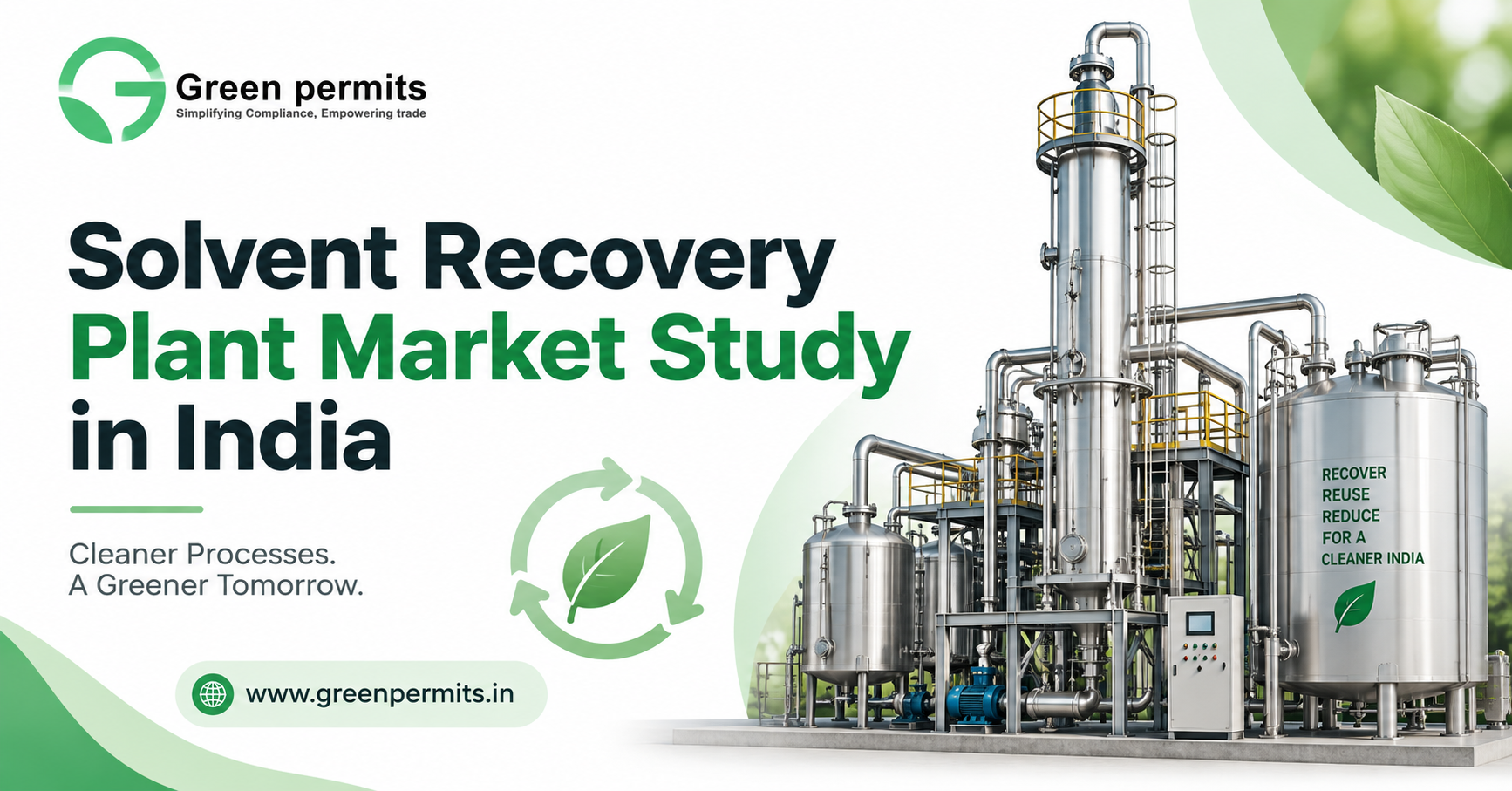
A Solvent Recovery Plant Market Study in India helps investors understand whether sufficient spent solvent is available, which industries can supply it, what recovered solvents can be sold, who the potential buyers are, and whether the proposed plant can operate profitably before major investment is made.
Solvent recovery is particularly relevant for pharmaceutical, chemical, paint, coating, printing, electronics, agrochemical and other manufacturing industries that use solvents such as acetone, methanol, IPA, toluene, ethyl acetate, DMF and similar materials.
Industry research published in 2026 estimated India's solvent recovery and recycling market at about USD 88.3 million in 2026, with the market projected to reach around USD 99.6 million by 2028. Pharmaceuticals, chemicals, paints and coatings are among the major end-use segments.
Green Permits Consulting supports investors with solvent recovery market studies, feedstock assessment, buyer research, feasibility studies, DPR preparation, plant-capacity planning and environmental approval strategy.
What is a Solvent Recovery Plant?
A solvent recovery plant processes spent or contaminated solvents so that usable solvent can be separated from impurities and recovered for reuse or sale, subject to quality and regulatory requirements.
The most common recovery route is based on distillation. CPCB guidance for spent-solvent utilisation describes fractional distillation followed by suitable condensation as a recovery process for various industrial solvents.
A simplified process is:
Spent Solvent → Pre-Treatment → Distillation → Condensation → Purification → Recovered Solvent → Residue Management
The actual process depends on the solvent mixture, boiling points, contamination level and required recovered-product purity.
Why the Solvent Recovery Market is Growing
Indian industries use large quantities of solvents for extraction, reaction, cleaning, coating, formulation and other manufacturing processes.
At the same time, disposing of spent solvent can create both regulatory and financial costs.
Recovery gives industries an opportunity to reduce virgin solvent purchases, recover value from waste streams and improve resource efficiency.
The wider Indian solvent market itself is large. One 2026 industry estimate placed the Indian solvent market at approximately USD 4.6 billion in 2025, with pharmaceuticals, agrochemicals and paints and coatings among the important demand drivers.
For a recovery project, however, the key opportunity is not the size of the virgin solvent market. The real question is how much recoverable spent solvent can actually be secured.
Which Industries Generate Solvent Waste?
Pharmaceutical and API manufacturing is one of the most important sectors for solvent recovery because solvents are extensively used during reactions, purification and extraction.
Chemical manufacturers, paint and coating companies, printing businesses and other industrial users can also generate recoverable solvent streams.
CPCB's spent-solvent guidance specifically covers solvents associated with pharmaceutical and industrial operations, including materials such as methanol, IPA, ethyl acetate, acetone, toluene, DMF, xylene and several other solvents.
A market study should therefore identify actual industrial clusters rather than simply estimating demand at national level.
Feedstock Availability Comes First
For a solvent recovery plant, spent solvent is the feedstock.
Before deciding plant capacity, the investor should determine how many tonnes or kilolitres can realistically be sourced every month.
For example, a 20 KLD plant may look attractive on paper, but if only 8 to 10 KLD of consistent feedstock can be secured, plant utilisation and profitability may remain weak.
The correct planning sequence is:
Industrial Generator → Solvent Type → Available Quantity → Purchase / Handling Cost → Recovery Yield → Recovered Product → Buyer
This gives a much more realistic view of the business.
Solvent Type Changes the Economics
Not all spent solvent has the same commercial value.
A relatively clean single-solvent stream can be easier and cheaper to recover than a mixed stream containing water, solids and multiple solvents.
The recovery economics depend on factors such as boiling point, contamination, moisture, purity requirement, energy consumption and residue generation.
A market study should therefore not evaluate only total waste volume.
It should separate the available feedstock by solvent type and quality.
Recovered Solvent Buyers
The recovered product may be used by chemical manufacturers, pharmaceutical companies, paint and coating manufacturers, printing businesses or other industrial users depending on purity and specification.
Some industries may reuse recovered solvent internally, while independent recovery plants may sell to third-party buyers.
The important commercial question is:
Recovered Solvent Specification → Suitable Buyer → Selling Price
A plant capable of recovering solvent technically may still struggle commercially if buyers require higher purity than the plant can consistently achieve.
Buyer discussions should therefore happen before machinery is finalised.
Captive Recovery vs Independent Recovery Plant
There are two common business models.
A manufacturing company may install a captive recovery plant to recover its own spent solvent and reuse it internally.
Alternatively, an independent recycler may collect spent solvent from multiple industries, recover it and sell the recovered product.
Captive recovery can provide better control over feedstock quality because the solvent source is known.
Independent recovery may provide a larger market opportunity but requires a stronger collection network, logistics system, testing capability and regulatory compliance framework.
The market study should determine which model is more suitable for the investor.
Location of the Solvent Recovery Plant
Location can strongly affect profitability.
A plant located near pharmaceutical, chemical or paint manufacturing clusters can reduce transportation cost and improve access to regular feedstock.
States with strong pharmaceutical and chemical manufacturing activity may therefore offer better sourcing opportunities, but site selection should still consider the exact industrial cluster.
Transporting low-value or highly contaminated spent solvent over long distances can reduce margins.
The best location is normally one where both feedstock generators and recovered-solvent buyers are reasonably accessible.
Solvent Recovery Technology
Distillation is widely used for solvent recovery because different components can be separated based on their boiling characteristics.
Depending on the feedstock, the plant may use atmospheric distillation, vacuum distillation, fractional distillation or multiple-stage systems.
Condensation and cooling arrangements also depend on solvent properties. CPCB guidance notes different cooling arrangements for higher- and lower-boiling solvents.
The technology should therefore be selected after laboratory analysis of actual feedstock rather than only from a machinery supplier's standard proposal.
Recovery Yield and Product Quality
Recovery yield directly affects project revenue.
Suppose one tonne of spent solvent enters the plant. Not all of it will necessarily become saleable recovered solvent.
Part may consist of water, non-volatile contamination, residue or other impurities.
The market study and DPR should therefore calculate:
Feedstock Input → Recoverable Solvent → Saleable Quality → Residue
Using an unrealistic recovery percentage can make the financial model appear much more profitable than actual operations.
Pilot testing or representative feedstock analysis can improve project assumptions.
Solvent Recovery Plant Setup Cost
There is no fixed cost for every solvent recovery facility.
Investment depends on plant capacity, solvent types, distillation system, condensers, storage tanks, utilities, fire-safety systems, pollution controls, laboratory equipment and automation.
The total investment should consider:
Land + Building + Distillation System + Storage + Utilities + Safety Systems + Pollution Controls + Laboratory + Working Capital
Working capital is particularly important for independent recovery plants because spent solvent may need to be purchased before recovered solvent is sold.
Environmental Approvals and Hazardous Waste Compliance
Spent solvent recovery in India is closely connected with hazardous-waste regulation.
CPCB has directed that solvent recovery units should operate with the applicable authorisation and follow prescribed procedures for safe handling, processing, storage and hazardous-waste movement.
Depending on the project, the plant may need to assess Consent to Establish, Consent to Operate and Hazardous Waste Authorisation from the applicable State Pollution Control Board or Pollution Control Committee.
Manifest, transportation and residue-management requirements may also apply.
These approvals should be considered while preparing the feasibility study rather than after the plant has been installed.
What Should a Solvent Recovery Market Study Cover?
A strong market study should determine whether enough feedstock and buyer demand exist to support the proposed plant.
It should evaluate major solvent-generating industries, solvent types, available quantities, existing recovery competition, procurement prices, logistics, expected recovery yield, recovered-product specifications and buyer prices.
The study should then recommend a realistic plant capacity.
For investors, the correct sequence is:
Feedstock Market → Solvent Mix → Buyer Market → Technology → Capacity → Site → DPR → Plant Setup
This is much safer than selecting machinery first.
DPR and Financial Feasibility
After the market study, a Detailed Project Report - DPR can convert the opportunity into a complete investment plan.
The DPR can assess plant capacity, process technology, machinery, material balance, land, utilities, manpower, project cost and environmental approvals.
The financial model should evaluate feedstock cost, recovery yield, selling price, operating cost, working capital, profitability and cash flow.
Sensitivity analysis is particularly important because the project should understand what happens if spent-solvent prices rise or recovered-solvent selling prices fall.
Common Mistakes in Solvent Recovery Projects
One common mistake is calculating the market only from India's total solvent consumption instead of identifying actual recoverable waste streams.
Another is assuming that every litre of spent solvent can be converted into saleable recovered product.
Investors can also underestimate energy cost, transportation, hazardous residue disposal and working capital.
The project should therefore be based on actual feedstock samples, supplier discussions and buyer specifications rather than general market assumptions.
How Green Permits Helps with Solvent Recovery Plant Market Studies
Green Permits Consulting supports entrepreneurs, recyclers and industrial companies with solvent recovery market studies, spent-solvent sourcing analysis, buyer assessment, feasibility studies, technology evaluation, DPR preparation, CAPEX and OPEX modelling and environmental approval planning.
The objective is to determine whether sufficient feedstock, recovery value and buyer demand exist before major capital is committed.
Learn More About Solvent Recovery Plant Market Study
If you are planning a solvent recovery facility in India, the project should first be evaluated for spent-solvent availability, solvent composition, recovery yield, buyer demand, technology, plant capacity and regulatory requirements.
Read more about plant feasibility and DPR consulting services here:
👉 https://www.greenpermits.in/09/solvent-recovery-plant-market-in-india-buyers-demand/
📞 Get Expert Assistance for Solvent Recovery Plant Market Study
If you need help with a Solvent Recovery Plant Market Study, feasibility report, feedstock assessment, buyer research, DPR preparation or plant setup, Green Permits Consulting can assist you.
🌐 Website: www.greenpermits.in
📞 Phone: +91 78350 06182
📧 Email: wecare@greenpermits.in